
Life-Style
A blessed centenarian
Mithoo Coorlawala recalls her egalitarian upbringing and charmed life
"We sisters did a lot of things that others could not,” recalled centenarian Mithoo Coorlawala about her upbringing. "On a particularly nice day, Father (Nadirshah Chenoy) would say, ‘don’t go to school today’” and she and her two siblings would spend the day picnicking on their vast estate. "There would be servants carrying carpets for us to lie on and material to build tents from,” she reminisced. With siblings Freny and Firoze, Mithoo had a charmed life, she admits. "There would be an ayah following us even when we went for a walk on the grounds of our home.”
When Parsiana met her at her elegant apartment in Bombay’s Malabar Hill, Coorlawala was at the door to greet the representative, before settling down for a chat in her greenery filled balcony. Having gently chided the representative for a "bad” picture of hers published in the issue she was reading (see "Earliest subscriber?” Readers’ Forum, Parsiana, April 21, 2018), the elegantly turned out Coorlawala (double string of pearls, diamonds sparkling on her fingers, stockings and peep-toe shoes) took us for a walk through her life and times. The tete-a-tete spread out over two meetings.
Her 100th birthday celebration on September 24, 2017, hosted by her close family members at the Falaknuma Palace in Hyderabad where "30 of them, including people from New York, Boston and Madras, came to greet me,” was a walk down a very long memory lane for her. A photograph of the event felicitating "Begum” Coorlawala is among her prized possessions. "It was nice seeing the Palace (now a Taj property). In my younger days my father would see the Nizam or important noblemen very often at some palace or the other,” says Coorlawala.
When Parsiana met her at her elegant apartment in Bombay’s Malabar Hill, Coorlawala was at the door to greet the representative, before settling down for a chat in her greenery filled balcony. Having gently chided the representative for a "bad” picture of hers published in the issue she was reading (see "Earliest subscriber?” Readers’ Forum, Parsiana, April 21, 2018), the elegantly turned out Coorlawala (double string of pearls, diamonds sparkling on her fingers, stockings and peep-toe shoes) took us for a walk through her life and times. The tete-a-tete spread out over two meetings.
Her 100th birthday celebration on September 24, 2017, hosted by her close family members at the Falaknuma Palace in Hyderabad where "30 of them, including people from New York, Boston and Madras, came to greet me,” was a walk down a very long memory lane for her. A photograph of the event felicitating "Begum” Coorlawala is among her prized possessions. "It was nice seeing the Palace (now a Taj property). In my younger days my father would see the Nizam or important noblemen very often at some palace or the other,” says Coorlawala.
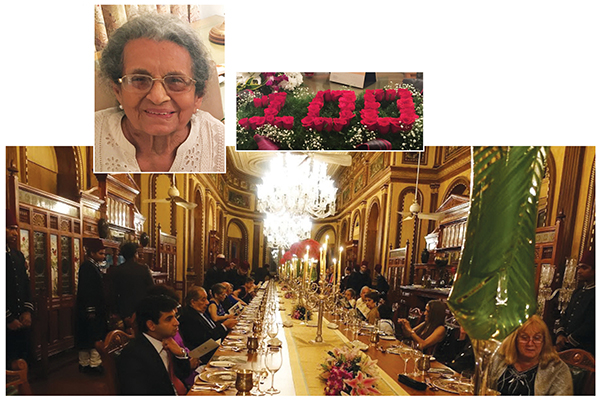
(Clockwise from top left) Mithoo Coorlawala, celebrating her 100th;
floral decorations at her party; birthday banquet with extended family members
It was a tradition that all children of the extended Chenoy family would study at the family endowed Bai Ratanbai J. Chenoy School for at least two years. Coorlawala too followed suit. "At assembly, the Parsi students had to recite the daily prayers, including the Havan gah, Atash Niyaesh and Dua Tandarosti,” she notes. She completed her schooling at St Ann’s School. "We were a prayerful family,” she recollects. "I used to feel upset, till about 20 years ago, if I had not done my prayers before going to bed. Now it does not matter…Religion is important, prayers are not.”
Graduation from St Xavier’s College Bombay followed, after which the young Coorlawala was sent off to Newnham College, Cambridge to study for her tripos (the final honors examination for a BA degree). "Those were the best years of my life,” avers Coorlawala. "It was a great place to make friends…The faculty was not overwhelming… You felt yourself growing… There was a total sense of freedom…no servants, no ayahs.” Nadirshah insisted that the young Coorlawala keep in touch with news from her home city while she was there. "‘Miss, miss, your native newspaper (Rehbar-e-Dakkhan) is here,’ the hall porter would tell me,” whenever she received the Hyderabad newspaper, she reminisces. "I sometimes used the newspaper to start the fire in the fireplace in my rooms,” she says, a mischievous smile playing on her lips.
Over coffee and canapés, Coorlawala recollects that in her youth, there were no mixed gatherings of men and women in the Nizam’s capital. "We would set off to the house of some nobleman or the other, and the women would get dropped off at the ‘women’s area’ to mingle with the female family members of the host while the men congregated separately.
"I am used to a very egalitarian society,” she states. With forefathers in the China trade, she says her family has been in Hyderabad for about 250 years. In 2004, she was a key organizer of a 100-member reunion to celebrate their family’s association with the twin cities of Secunderabad and Hyderabad (see "Cheers for the Chenoys,” Parsiana, April 2004). "Our estate is now the Aga Khani Colony,” she claims, not with remorse, or misty eyed, but matter-of-fact. "My life has not changed much… but I do have a nostalgia for the old culture… Manners used to be the big thing back then… Maybe people are more practical now.”
Of her 74-year marriage to the late Lt Col Khushroo Coorlawala, Mithoo says, "We had a very special life together… We gave each other a lot of space.” A few weeks after their 1942 marriage, Khushroo was shipped off to the front in Burma. "We never saw each other for the rest of the war, except when he was on a two-month recuperation stint in Shillong… Letters took two months to reach Hyderabad from the war zone… Whenever I received a letter, I did not know if he was alive or dead,” Mithoo reminisces. Part of the Women’s Voluntary Service during the second World War, in Hyderabad she looked after an "information room” where "we had to update maps with the position of various battalions on the Burma front (where Khushroo was stationed).
"I respect so much his decision for leaving the Army in 1951,” she says, narrating details of Khushroo’s stint in Kashmir during the 1948 invasion by Pakistan. "He was there to fight a civil war…He was now fighting against his colleagues and friends who were part of the undivided Army… He was determined to opt out… When people asked him what he would do outside the Army, he would say, ‘I’ll do better than what I am doing now,’” she points out. "They tried to ‘bribe’ Khushroo with offers of military attaché positions at Indian missions in Paris and Washington DC,” but the soldier was determined he had had enough. Daughter Prof Uttara Asha Coorlawala Lalvani who teaches dance at Barnard College, USA and who was visiting Bombay when Parsiana spoke to her mother, adds that her father’s resignation was finally accepted, but pension was not allowed. "We have never figured out why,” she tapers off.
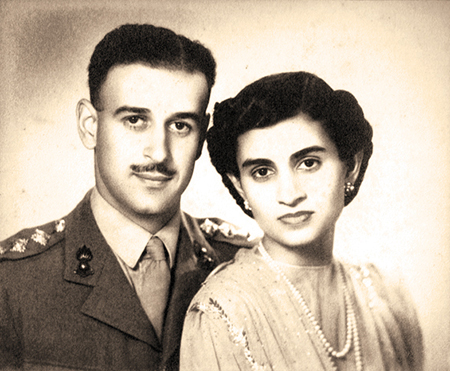
Khushroo and Mithoo on their engagement
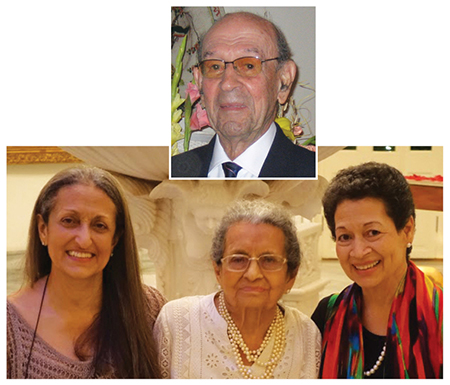
Inset: Khushroo; alongside (from l): Uttara Asha Coorlawala Lalvani, Mithoo, Sherena Khan
The early 1950s saw Mithoo and Khushroo step into the world of commerce in Bombay, where he served in the pharmaceutical company Johnson and Johnson, and subsequently the Associated Cement Companies. "We didn’t think we would like it here (Bombay), but we did,” Mithoo declares. Initially, she missed the courtly manners of the people of her home city. Some Parsis were very dismissive of other communities, she lets us know, but adds charmingly that we should not mention this, for fear of offending anyone! "Our parents had many friends in Bombay, who helped us settle down,” she says, particularly mentioning Lady Jenna Duggan, Lady Jeroo Mody and Lady Freny Bomanjee.
In Bombay Mithoo involved herself in fund raising activities for the Time and Talents Club and the Cancer Society. "I used to do clerical work at the blood bank at St Georges Hospital and assist with running programs at the Leslie Sawhney Foundation,” she states. Daughter Sherena Khan adds, "She was the most active of all her friends, even now, the most active lady I know… We (she and sister Uttara Asha) had an unfettered upbringing… could do what we liked,” she states. Uttara Asha appreciates, "Our upbringing was as liberal as hers (Mithoo’s) was.”
Mithoo reminisces about her attempts to learn golf to be able to play with Khushroo. "I took lessons while he was away in Europe once, to surprise him, but it didn’t work at all… He did not come for my Cambridge Society meetings,” she says. "I would tell Sir Cowasji Jehangir that he was at the atash behram, when he would ask why Khushroo did not attend, which he (Jehangir) thought was a very silly joke!” In reality the golf captain of the Willingdon Sports Club and president of the Bombay Presidency Golf Club would be out putting on the green!
"I never think ‘oh I could have done this or I could have done that,’” states Mithoo. "As we have talked these few hours, I realize how blessed I am,” she ends.
◆ ◆ ◆
From the archive