
Zoroastrians Abroad
Centenary celebration
"Mummy’s languages in order of her proficiency at them were English, Gujarati, Bengali and Hindi, all of which she can still speak, read and write. Although it must be confessed that her handwriting always was undeniably the worst in the world. It was fun to try and decipher what she had written. Macular degeneration has now rendered her unable to see words,” writes Zal Kutar, sharing a biographical account of his mother Jer on the occasion of her 100th birthday.
The centenary "celebration with her children, grandchildren and great-grandchildren as well as other family and friends took place at the hall of the Ontario Zoroastrian Community Foundation in Mississauga, Canada…on December 23, 2009,” mentions her younger son Hormazdyar. A Canadian citizen since 2005, she had migrated to Toronto in April 2000.
Prior to that her life had been spent at different times in Navsari, Bombay, Jamshedpur, Calcutta, Bareilly, Germany where she had picked up a little German, and Iran. Born to Sohrab Dastur and Jaijee Bajan, Jer spent the first three-four years of her life with her mother in Navsari where a neighbor taught the little girl the rudiments of Gujarati. Her father being an accountant with S. B. Billimoria and Company, he was working in Bombay where his wife and daughter joined him after some years. There Jer was sent to an English medium school.
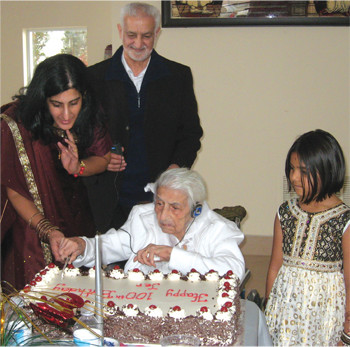
Jer Kutar cuts a cake on her 100th birthday at the Ontario Zoroastrian Community Foundation Hall
At the age of 12 the family migrated to Jamshedpur when S. B. Billimoria recommended Sohrab to the then chairman of Tata Steel, R. D. Tata who was in need of an internal auditor. There being no English language schools in Jamshedpur for young Jer she was sent off to Calcutta to the Gokhale Memorial School for Girls. She enjoyed school, more so because when she went home for holidays her mother would insist on domesticating her.
As writes Zal in the 16-page booklet A Family History: The Life and Times of Jer Kutar, during vacations "her mother would promptly send the cook off on his holiday and leave young Jer to cook for the family, the excuse being that it was the only way to teach her cooking…The great advantage of her forced internment to the kitchen during her holidays was that she learned not to do this kind of thing to her children. We were treated like royalty. Holidays were for picnics…
"She was also taught to knit and do embroidery, tatting, sewing and all manner of other hand work. These she enjoyed and kept up all her life. I can remember Mummy taking her knitting along when she went to watch the cricket matches at the Keenan Stadium with the Bihar team playing the West Indies, and other test teams. And God bless her I still have more of her sweaters than I shall ever need.”
At the age of 23 Jer married Kaikhushru (Keki) Kutar in Navsari and the following year the couple sailed to Germany where Keki was to study steel making and gain experience to help improve his career prospects. Just when she was about to deliver her first born, a friend of hers took her to a Catholic hospital. Intimidated by the nuns in their black habits and fearing it could be an inauspicious omen, Jer opted instead to deliver the baby at the Protestant hospital which looked more cheerful. Four months later they returned to India. Their second son was born in Jamshedpur.
While Keki rose up the ladder of promotions until he was appointed general manager of TISCO and director of some of its subsidiaries, Jer started knitting for the troops during World War II and even later for the Indian army, ultimately knitting a sweater even for Field Marshal Sam Manekshaw. Active with several women’s groups like the Council of Women, the Parsee Stree Mandal, the All India Women’s Conference, she was also associated with the Bal Vihar, a home for street children and Sishu Niketan for the children of lepers. She even worked with the Sisters of Mercy who ran a hospital and Mother Theresa’s Missionaries of Charity.
"All of these had some illustrious leading lady of the company as its titular president and some hardworking lady as secretary but the one factor they had in common was Mummy in the role of treasurer.” She had inherited her father’s skill with accounts as also his strict honesty. "The only complaint against her accounting came from the accountant at the Central Bank of India. The manager of the Bank called her in to his office one morning and sat her down with his accountant to reorganize all her various signatures. She was made to regularize all her signatures and use only one form for the future. Henceforth she signed all her accounts as Jer Kutar…”
When Keki was appointed as steel advisor to the government by the Shah of Iran for two years, Jer socialized with the wives of the ambassadors to the court, playing bridge with them, eating delicacies at their table served on impeccable linen. As Zal observed, it was "quite a change from being the substitute holiday cook for her mother.” They were even able to afford two holidays — to the Far East and to Europe.
While in Tehran in 1971, Keki died of a sudden massive heart attack, leaving her heartbroken. The following year her father passed away. Her mother had died the year they shifted to Iran.
In the last three decades she divided her time between her two sons and other relatives, choosing ultimately to make her home in Toronto.
◆ ◆ ◆
From the archive