
Books
Sensitive short stories
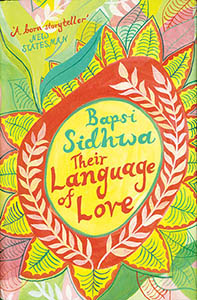
Their Language of Love by Bapsi Sidhwa. Published in 2013 by Penguin Books India Private Limited, 11 Community Centre, Panchsheel Park, New Delhi 110017, India. Pp: 253. Price: Rs 499.
After several years — An American Brat (1993) and Water (2006) — Bapsi Sidhwa has returned to fiction with her latest collection of short stories, Their Language of Love. Sidhwa confesses in the Author’s Note that she is a novelist by inclination and not a short story writer; and this is true as many of the stories seem to occupy the nebulous state between the short story and the novella. However, whether short or long, they are extremely readable and sensitively written, though, I feel, that nothing can match her Ice Candy Man (memorably filmed as Earth by Deepa Mehta), a poignant tale of a young girl growing up in Pakistan at the time of the Partition, a novel in which the personal and the political are brilliantly juxtaposed and balanced.
In the title story, Roshni, who has recently had an arranged marriage, has to come to terms not only with the USA, a new country, but also with Nav, her new husband, whom she hardly knows. Sidhwa captures Nav’s slightly patronizing attitude to his wife with gentle humor. "The bossy aspect of Nav’s personality… kept rearing its aggravating head like a leery squirrel.” In "Breaking It Up,” a short story on which An American Brat is based, Zareen travels to USA to abort a marriage between her daughter, Feroza, and an American Jew, David. The means she adopts to achieve her goal are quite unusual — she petrifies David by enthusiastically describing Parsi wedding customs; though she is sure that her daughter will recover from a broken heart, Zareen wonders if, by succumbing to the pressures of society, she had "done the right thing.”
In the title story, Roshni, who has recently had an arranged marriage, has to come to terms not only with the USA, a new country, but also with Nav, her new husband, whom she hardly knows. Sidhwa captures Nav’s slightly patronizing attitude to his wife with gentle humor. "The bossy aspect of Nav’s personality… kept rearing its aggravating head like a leery squirrel.” In "Breaking It Up,” a short story on which An American Brat is based, Zareen travels to USA to abort a marriage between her daughter, Feroza, and an American Jew, David. The means she adopts to achieve her goal are quite unusual — she petrifies David by enthusiastically describing Parsi wedding customs; though she is sure that her daughter will recover from a broken heart, Zareen wonders if, by succumbing to the pressures of society, she had "done the right thing.”

Bapsi Sidhwa: impacting readers
Sidhwa mentions in her Author’s Note that her friendship with different American women who lived in Lahore from the ’50s to the ’90s is the inspiration of two stories based on Ruth, a young and pretty New England Protestant, who moves to Lahore with her husband. What captures the reader’s attention is not the main protagonists but the minor characters like Billo, Ruth’s maid, who sets the dog on beggars, snake charmers and hawkers trespassing her property and the silent watchman, Jungi Khan, who protects Ruth’s virtue.
 Sehrabai, the protagonist in the story which has the same title, is a 72-year-old who refuses to be cowed down in spite of being confined to her bed by paralysis; she recalls "the sunlit moments that peaked amidst the darkened hollows of her life like snow capped mountains.” In her prime, she was an extremely attractive woman with most of Lahore’s male population at her feet. But she neglects her daughter, Ruby, who is angular and isolated and resents her mother’s charm and allure. Too late does Ruby learn to "decode the preoccupation that appeared to turn her mother cold and remote and absent from her.”
Many of the stories seem to germinate from personal experiences. Sidhwa comes from a Parsi family that owned the Murree Brewery. The brewery’s Lodge in Rawalpindi was requisitioned by General Ayub Khan when he moved from Karachi to Islamabad. It is here that a fictional meeting with Zulfikar Ali Bhutto in "A Gentlemanly War” takes place. "Defend Yourself Against Me” takes place in Houston where Sidhwa spends much of her time and, like her, the narrator is a professor of English at the University of Texas. Though the narrator is an Anglican Protestant, she is also from Lahore where Sidhwa grew up.
In some of the stories, Sidhwa touches upon valid and interesting truths and it is these which form the backbone of the collection: "When one lives cheek by jowl with people of other faiths — saints jump boundaries and the barriers of animosity fall.” Hence, it is no surprise that in "The Trouble-Easers,” a Muslim woodcutter’s fortunes change after he meets two Zoroastrian angels. This is noteworthy, keeping in mind the fact that the Muslims were supposed to have driven the Zoroastrians out of Persia over 1,000 years before. Once again in "A Gentlemanly War” which is set against the background of the Indo-Pak War of 1965, the Indian army is just 16 miles from Lahore. "It is rumored that the Indian Generals have vowed to toast each other with their finest Scotch at their old pre-Partition haunt, the Gymkhana Club in Lahore.” It was a gentlemanly war because there were no civilian casualties. Also, it was unlikely that the Indian intelligence was unaware that Lahore was left defenceless still they did not attack. What others referred to as a "strange miscalculation,” Sidhwa believed was an "unacknowledged compassion,” which resulted from the bonds between the two countries — "the two halves of the divided Punjab — of friendship, shared languages, neighborhoods and customs.”
At a party in Houston, in "Defend Yourself Against Me,” the narrator recognizes Khan who was her neighbor in Karachi. His village in India was attacked by Sikhs during the 1947 riots. Khan’s immediate family was killed, his mother probably beaten and raped and he was left for dead: his body was covered with scars and he had a wound at the back of his head which is "a raw and flaming scar, as if bone and flesh had been callously gouged out.” Two young Sikhs, Khushwant and Pratab are also guests and Joanna, the host’s wife, suggests that a romantic relationship between Khan’s sisters-in-law and the Sikhs be encouraged. This seems to be a ridiculous idea to the narrator considering the suffering the family had undergone at Sikh hands. When Khan’s mother arrives, there is a rather melodramatic scene where Khushwant and Pratab, turbanless with their hair and beards loose and wild, prostrate themselves before her and beg her forgiveness for what their forefathers had done to her. The lady is nonplussed and when she recovers she sadly admits that she had forgiven their fathers a long time ago. "How else could I have lived?”
It is stories like these which leave an impact on the reader and the characters live on in our imagination long after we have closed the book.
◆ ◆ ◆
From the archive