
A jurist’s jottings
Memorable incidents pertaining to law, politics and public life are recounted
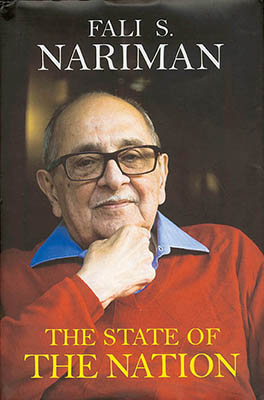
Extracts from jurist Fali Nariman’s book The State of the Nation.
Elections now do not mean the spending of crores, but of multiples of crores.
When I read those figures, I was reminded of an election episode in Uttar Pradesh (UP) of 75 years ago. It has been recounted by Lal Bahadur Shastri in a 1959 tribute to Jawaharlal Nehru:
"The general elections under the new Government of India Act took place in 1937; they were of great significance. In these elections Nehru played a very important role. I remember his visit to the district of Allahabad. It was about 8.30 p.m. when he finished his speech... Nehru had taken no tea in the afternoon and... he was feeling very hungry. He asked me whether there was any restaurant in the city... I remembered the railway station where some tea could be got. He said: ‘Let
us go there.’
"We motored to the railway station and went to the railway restaurant… After having... the tea we were asked to pay the bill. Every one of us searched his (or her) pockets and found that none of us carried sufficient money. Between us we could collect about Rs 2.50. Nehru had about Rs 1.25. Purnima Banerjee (a dedicated freedom fighter, who later became a member of the Constituent Assembly) another rupee and I gave the few annas to complete the full amount
required. How awkward would it have been if we had failed to make up the amount among ourselves!’’
Let me remind you of a story related by Roger Chongwe (a brave lawyer from Zambia) at the Madrid Congress of the International Commission of Jurists in the 1980s. Under the penal code in Zambia, it was an offence to express opinions defamatory of the country’s president. In the 1970s, three candidates stood for the office of president of Zambia. Sometime later, one of the unsuccessful ones became bankrupt. When the official receiver of the bankrupt individual came to seize his assets, he wrote on the court summons:
"Kenneth Kaunda (the president) is a bastard and a son of a b****. He should be told that the government of this country does not belong to him alone.’’
He was prosecuted and tried for defaming the head of state. In the course of the trial, the official receiver was questioned by the prosecutor and asked if he held the president in high esteem after he read the scribble on the summons. The prosecutor expected the government official to answer: ‘Not after I read the writing on the summons.’ But the official receiver instead truthfully said: "I never at any time held the president in high esteem.” The case for the prosecution collapsed! So much for ‘reputation’ of the high and mighty!
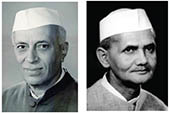
Jawaharlal Nehru (left) and Lal Bahadur Shastri: budgetry deficit?
"A bribe from the sellers?”
The Nehru era had produced great bureaucrats, who believed in, and practised, honor, integrity and self-denial. Dharma Vira was one of them — his life spanned almost a century. He rose from a humble recruit to the highest rank, that of cabinet secretary of the Government of India. After retirement, he wrote Memoirs of a Civil Servant (Vikas, New Delhi, 1975), in which he spoke of Percy Marsh, district magistrate of Aligarh (now in UP), who had taken a keen interest in Dharma Vira then as a young service officer. One day Marsh told Dharma Vira:
"Now listen carefully. Two things you must always do. One is to take a decision and take it quickly, right or wrong. Most often you are likely to be right in your decision. But even if you are wrong, less damage will be done than by not taking a decision. And the second thing is that you are an executive officer. You should keep your mouth shut as far as possible. The less you speak the less trouble you will get into... Talking is the task of politicians. You will be judged by your actions and not by your talks. So you better speak less and act more.”
Dharma Vira greatly valued this advice. He once told me a fascinating story: As cabinet secretary, he had headed a government delegation that went abroad to purchase some aircraft. After the agreement was signed, the sellers’ representative asked Dharma Vira as to in whose name should the amount of the customary discount be credited. Dharma Vira’s reply was: "Excellency, make out the cheque in the name of the Government of India.” When he came back to India and handed over the cheque to his prime minister, Jawaharlal Nehru roared at him: "What have you done?” he asked. "You have accepted a bribe from the sellers? The reduction in price was a bribe for you to clinch the deal.” "Yes, Sir,” responded Dharma Vira, "but would you have preferred it if I asked the sellers to open an account in my name in Switzerland and deposited the money there?” Nehru, still smoldering with rage, did not reply. The moralist in Nehru was quietened by the realist in Dharma Vira. In his lifetime Dharma Vira was typical of many generations of noble, upright public servants. After his passing (and of the likes of him) there has been a steep decline of standards in public life.
And not in India alone. A Harvard professor, Lawrence Lessig, recounts the story of Senator John Stennis, from Mississippi. Like Dharma Vira, the senator was of the old school. When Stennis retired in 1989, after 41 years, he was the most senior member in the Senate’s history. He thought and acted differently from other senators. Asked by a colleague to hold a fund-raiser with defence contractors, Stennis recoiled and remarked: "Would that be proper? I hold life and death over those companies. I don’t think it would be proper for me to take money from them.” It is a story (Lessig writes) about a change of norms. Stennis wasn’t concerned that holding a fund-raiser with defence contractors would break the law. Probably it would not. He was worried that it "wasn’t proper!” He was worried about breaking prevailing norms on Capitol Hill. Lessig says that it is this that has changed over the years.
The wall of separation
When I was in college (in British India) way back in the 1940s, it used to be jokingly suggested that the fall of the British Empire began with the building of country clubs, because once you build a country club what is the point of it unless you keep somebody out? And when the locals — or the ‘natives’ — are the ‘somebody’ there is justifiable resentment! The great divide — the wall of separation — started with the British country club! The British could afford to operate behind a wall of separation because they ruled (and made no pretence about it). They ruled, they did not govern; hence they faced few problems when it came to governance. But the rulers had one great quality — they instilled in their officials a high sense of idealism in government service. This went a long way. It was important that an official in government remained (first and last) a public servant in the service of the people. When the British left, we discarded the idealism, which had inspired generations of public officials in British India.
We too started, as a nation, by making promises but did not keep them. The Government of India promised to grant the rulers of the Princely States privileges and privy purses if they joined the Indian Union. They joined but the promise was not kept. As everyone now knows, the real reason for the government of the day reneging on its promise was because a few of the erstwhile rajas and maharajas had ‘conspired’ to form, in the late 1950s, a new political party — the Swatantra Party — in opposition to the ruling Congress! These rajas and maharajas had to be taught a lesson — so off with their privileges and privy purses: lock, stock and barrel! Not only those of the maharajas of the larger Princely States but even those of the rulers and thakurs (lords or chieftains) of the much smaller states, many of whom were entirely dependent for their livelihood on their privy purses.
Certain privileges as well as privy purses were guaranteed not only by solemn covenants of government but also by express constitutional provisions deliberately enacted to assure the erstwhile rulers of the government’s pledge (Articles 291 and 362). These articles were simply deleted by the Constitution 26th Amendment Act 1971. When the constitutional validity of the 26th Amendment was challenged, a bench of five judges of the Supreme Court solemnly held that whilst the courts were not powerless to correct the government, which had reneged on its solemn pledge and guarantees, the 26th Amendment, by deleting Articles 291 and 362, did not alter "the basic structure of the Constitution.” This was the verdict despite a binding prior decision of a bench of 11 judges in Madhavrao Scindia vs Union of India (AIR 1971, SC 530), in which 10 of them had clearly stated as a matter of constitutional law that "the privileges of rulers and the institution of rulership had been made an integral part of the constitutional scheme.!”
Good instincts
An aside about V. N. Khare would not be out of place here. ‘Wise’ is the encomium I give to him since he was the judge who, as chief justice, came to the aid of upholding the supreme dignity of the apex court. Sometime in February 2004, I was sitting in Court Room No. 2 on a Miscellaneous Day (i.e., when matters other than final hearings are taken up for disposal). A party in person was arguing his own case and raised his voice a bit, in order to emphasize the point that he was making. Unfortunately for him, the judges asked him not to raise his voice, but he wouldn’t listen, and kept on arguing in a loud tone, which prompted the judges to send for the court martial to physically remove him. This was too much for me. I got up from my seat in the second or third row and shouted to the court martial not to touch him since I felt that no litigant could be removed physically from court premises for arguing his case — howsoever unreasonably. But the marshal did as the judges in court had directed and removed the party in person under duress and the case was dismissed.
I was so enraged that I stomped out of the room and finding that the chief justice of India had risen for the day, I phoned his secretary and asked him whether I could see Chief Justice Khare at his residence. On receiving a favorable reply, I then went directly to the residence of the chief justice and told him about the incident and said that in my (then) over 50 years at the bar I had never witnessed a litigant being thrown out of the court whilst arguing his own case. And the fact that this was done in the Supreme Court had set a most unhealthy precedent. Chief Justice Khare was visibly disturbed and thanked me for bringing this to his notice. He then sent for the litigant in person, personally apologized to him on behalf of the court and ordered that his dismissed case be restored and heard once again by the same bench! Here was a ‘Daniel-come-to-judgment,’ I said to myself! When Chief Justice Khare retired at age 65 on May 2, 2004, we honored him with a farewell dinner at the Hotel Imperial in New Delhi. Apart from Chief Justice M. N. Venkatachaliah, no other retired chief justice of India has been so honored by the Bar Association of India. I believe that a judge must have good instincts and good responses — qualities that I greatly admire more than the writing of good judgments!