
Books
Of family, factory and friends
 Business with a difference: Bicycles, Boilers, Beliefs by Darius Forbes. Published by Farhad and Naushad Forbes and printed at Pragati Printers Private Limited, December 2011. Pp 235
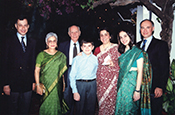
Darius Forbes, patriarch of the Forbes Marshall Group, is now 86. He retired a long time ago, handing the company over to his sons Farhad and Naushad and his daughter-in-law Rati. "Our father is a businessman, and a very successful one at that. Business, to him, must be successful; and successful not at some indeterminate date in the future, but here and now. He has never chased turnover, or market share… business to him has never been the end in itself. Instead, business exists for customers, for people and for society,” write Farhad and Naushad in their Foreword. "But to truly understand the history of Forbes Marshall, one needs to understand our father. He was either the origin of, or present at the origin of, all our values, most of our policies and much of our business. That led us to push our father to write his memoirs. And when our argument in favor of this book did not seem to be carrying the day, we passed things over to our mother. End of story!”
 And the beginning of the book with the unusual title! "Bicycles reflect an important element at different points in our father’s life. At the start of his career, he made five calls (customer visits) a day in Ahmedabad using a bicycle, because that was all he could afford…Boilers are at the heart of any steam system, something that is in our father’s blood… (His) ability to hang on to an idea, an approach, a business in spite of opposition comes again from his deep belief in what is right,” explain the sons.
 The book is indeed a family saga, narrating through word and picture the story of four generations of the Forbes and Marshall families (who are related to each other), with the young fifth generation waiting in the wings to make their mark as their ancestors had. It traces the blossoming of a small trading business into a multi-division, ISO 9001 certified manufacturing concern with internationally renowned partners like Spirax Sarco, UK, Krohne Messtechnik and Arca Regler, Germany, Shinkawa Electric Company, Japan, Codel, UK, Vyncke, Belgium, etc. Forbes Marshall makes advanced products in the fields of steam engineering and control instrumentation, for diverse sectors like textiles, food processing, paper, power, chemicals, etc, and has almost 40 offices in India and abroad.
And the beginning of the book with the unusual title! "Bicycles reflect an important element at different points in our father’s life. At the start of his career, he made five calls (customer visits) a day in Ahmedabad using a bicycle, because that was all he could afford…Boilers are at the heart of any steam system, something that is in our father’s blood… (His) ability to hang on to an idea, an approach, a business in spite of opposition comes again from his deep belief in what is right,” explain the sons. The book is indeed a family saga, narrating through word and picture the story of four generations of the Forbes and Marshall families (who are related to each other), with the young fifth generation waiting in the wings to make their mark as their ancestors had. It traces the blossoming of a small trading business into a multi-division, ISO 9001 certified manufacturing concern with internationally renowned partners like Spirax Sarco, UK, Krohne Messtechnik and Arca Regler, Germany, Shinkawa Electric Company, Japan, Codel, UK, Vyncke, Belgium, etc. Forbes Marshall makes advanced products in the fields of steam engineering and control instrumentation, for diverse sectors like textiles, food processing, paper, power, chemicals, etc, and has almost 40 offices in India and abroad. The book begins with a narration of Darius’ early years. He was born 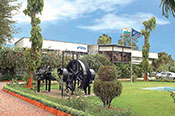 on October 2, 1926 in Bombay, at Marshall Lodge which was his mother Dolat Marshall’s family home. His father Minocher was a lawyer and worked as interpreter at the Madras High Court, on a modest salary. "Before he moved to Madras, my father had practiced at the Bombay High Court. There the authorities discovered his extraordinary flair for languages: he could read, write and converse in Marathi, Hindi, Gujarati and Marwari. He was also known for his expertise in Sanskrit. He was often called upon to provide official translations… He set up a home for us in Royapuram (in Madras), not far from our Parsi agiary and dharamshala. We had many Parsi neighbors,” Darius relates in the memoir. The family’s first car was a second-hand Standard which arrived around 1940 "but my father would use it only if it was raining. Otherwise he took the tram to the High Court. We had enough to be happy and comfortable, but avoided waste. I learnt as a child to use resources carefully — a habit that has endured.”
 His schooling was at the Madras Christian College High School. "I must admit that I was only an average student… If I ever won a prize of any kind, it was probably for elocution or something like that.” Many a happy holiday was spent with grandparents in Bombay, despite a 26-hour each way journey on the Bombay Express! "In those days our family could only afford to travel inter class. It was better than third class, but not as posh as second class. First class, of course, was used only by Europeans and Maharajas.” While Darius and his older sisters Thritty and Seheroo along with their mother would stay with maternal grandparents Nanabhoy and Bhikaiji Marshall at Marshall Lodge at Cumballa Hill, Minocher would be with his parents Khan Bahadur Cursedji and Shirinbai Forbes at Gowalia Tank nearby.
What might have been carefree college days were punctuated in 1942 when the freedom movement gained momentum with Gandhiji’s call to the British to quit India. "My parents were aware of my nationalist inclinations and it worried them immensely… On the day of the big protest, thousands of us students from all the colleges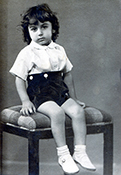 gathered near Presidency College, across the road from Marina Beach, to show our solidarity … bursting with the feeling that this was our country and we were going to take it back.” Confident that the police would not shoot, the demonstrators continued with their fiery speeches. Warnings to disperse went unheeded and so the firing began. "We ran and I jumped over the parapet wall towards the sea. I had just cleared it when my friend fell. With a shock I realized that he had been shot. Later, when things subsided and we carried away the body, I realized that this event was to have a long-lasting effect on my life. My parents were horrified that I had been involved in the demonstration and come so close to being shot myself. They decided that I had become far too involved in the dangerous trends around me and must be sent away for my own safety.”
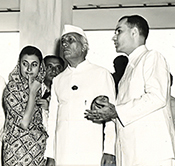
Then came the question of choosing a career. With several lawyers in the family, law was an option. "But then I learned that before you received your license to practice law, you had to swear allegiance to the King of England. The thought was repulsive to me. Yes, I did want to be a lawyer — but to swear allegiance to the King of England? Never.” For the ICS (then the Imperial Civil Service) too, the oath was a prerequisite. "It was then that I thought I might as well take up engineering.” Choosing to do mining and metallurgy at the prestigious Banaras Hindu University (BHU), Darius and his father went one afternoon to visit Dr Sarvepalli Radhakrishnan, who was then BHU vice chancellor. "Dr Radhakrishnan was an alumnus of Madras Christian College and his family home was not far from where we lived in Madras… As we left, he said to me: ‘Tell your parents not to worry about you going so far away. I will be there to take care of you.’”
Within three months of joining BHU, however, the budding engineer fell ill with jaundice. "I have no memory of the five days I lay unconscious in hospital… Apparently no one had expected me to live… Dr Radhakrishnan himself had sat up with me on two nights, pressing my forehead with a cold compress to bring the fever down.” Despite his eagerness to complete his education in Banaras, his mother adamantly refused to let him do so. Nor did she agree to let him go to the Massachusetts Institute of Technology! In 1945, as the Second World War was ending, he set sail for Karachi, where his sister Thritty lived after marriage, to attend the Nadirshah Eduljee Dinshaw Engineering College, a Parsi institution affiliated to Bombay University. "I’m afraid I took my studies rather casually… so at the end of the year my parents felt that I might as well go back home to Madras. Partition of India was in the air (but) it was beyond our imagination that anything could prevent us from travelling freely between Karachi and Bombay as we had always done. I have no words for the sorrow and despair I feel when I think of the events that followed.”
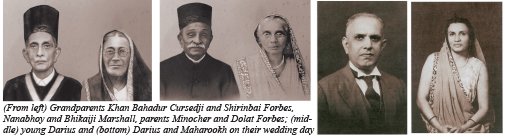 In the chapter titled "Nanabhoy’s boys,” Darius traces the genesis of the family’s business enterprise. Decades earlier, grandfather Nanabhoy Marshall had moved from Bharuch to Bombay by bullock cart, covering the distance in three months with wife and children in tow! (Nanabhoy and Bhikhaiji had 10 children.) Trading in grain, Nanabhoy soon secured a contract to supply hay to the municipal tramway company in Bombay. He was also one of the distributors for coal imported from Britain, selling it to the textile mills flourishing by then in Bombay. He sourced and organized the labor for the construction of Sewri Bridge connecting the island of Bombay to the mainland. "He also had a 25 percent share in the construction of the Royal Opera House… and as a child I often heard stories of the exquisite Italian marble it had been built with and of the regular plays, performances and grand social events by the British that my family members had attended there.” As Nanabhoy’s business bloomed, so did the grounds of Marshall Lodge, providing the large family with mangoes, papayas, fresh almonds, grapefruit, vegetables and fragrant roses!
Around the end of the First World War, Nanabhoy gifted Rs 10,000 each to two of his sons — Maneckji and Jeejeebhoy — to invest as they wished and they launched M.N. Marshall and Company and J.N. Marshall and Company respectively. Working between Bombay and Ahmedabad, the two built their business supplying coal and lubricating oil to the flourishing cotton mills. Darius joined his uncle’s J. N. Marshall and Company in 1946, when he was just 20 years old. The firm was at that time a small outfit located at Savoy Chambers behind Excelsior cinema, operating out of premises rented from the Tatas.
"Jeejeebhoy (J. N. Marshall) was handsome, debonair and an extrovert,” writes his daughter Maharookh, Darius’ cousin whom he later married. "My father had the best grounding in sales. One who has sold successfully in Ahmedabad could do so anywhere in the world. He became a top notch salesman, and would have been able to sell a refrigerator to an Eskimo.” JN acquired different agencies — from companies like the German AEG, distributing steam turbines, electric motors, fans, switches, etc for industrial use, Skoda, a Czech company, whose product range included diesel engines, stone crushers, water tube boilers, etc. When Spirax Sarco products found their way to India, it was decided that Darius would be sent for training to the Spirax headquarters in Cheltenham, UK to master the tools of the trade and return to take charge of the Spirax business of J. N. Marshall. "With all the new collaborations we had established during my visit to the UK, our business was poised to become quite complex, and grow in a number of different directions,” Darius notes. He was back in Bombay by 1951.
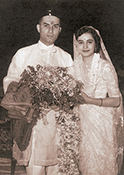
By 1952, Darius and Maharookh felt the time had come for them to marry. "Being first cousins, we knew each other well and our families were delighted with the match,” Darius states. "They knew we loved each other,” says Maharookh. "But my mother warned me: ‘Remember, Maharookh, they do not have much money…’ ‘I don’t expect to have much. If I marry him I will be content with whatever we have,’” Maharookh writes. They were married in 1954 at the Colaba agiary. Farhad was born on December 8, 1955 and by 1957 Maharookh went to work at J. N. Marshall’s engineering department in Bombay. "However it was only after I started working with Darius at Mehta Chambers at Opera House in 1964, then continued to do so when we moved to Poona in 1967, and he treated me as an independent working individual with capabilities, that I became really involved with the business and started enjoying what I did,” writes Maharookh.
Darius made further visits to England, and business partners became close friends. Soon, "as steam engineers we added our first control instruments to the business, setting us on the path that eventually made us experts in instrumentation and control of process efficiency.” With the Indian government imposing restrictions and making imports more and more difficult, the time had come to build a factory and move into manufacture. But land in Bombay was too expensive. "I knew Poona to be a lovely place, much cleaner than Bombay and more open and healthy. Establishing ourselves in Poona would also give us space in which we could expand endlessly if we wanted to.” A 10-acre plot was purchased on the main Bombay Poona highway at Pimpri (Kasarwadi) and the first bay of the factory was inaugurated on June 29, 1959. Naushad was born the following year in Bombay. By mid 1967, the family decided to go and live in Poona in a beautiful bungalow at Koregaon Park.
In a decision unusual for a businessman or politician in India, Darius chose to retire on his 58th birthday in October 1984 (58 being the official age of retirement in the country), though he continued to maintain his association with the organization as a father figure. "The growth I have seen in the company since I retired has exceeded my highest expectations … I would give every credit to Farhad, Naushad and Rati and the team they have developed… I am particularly proud that they have retained the values and driving philosophies inculcated in our organization over the years.”
After J. N. Marshall’s death in 1990, a family settlement was worked out, "which we did to the satisfaction of all concerned, with Simmonds Marshall going to Shiamak (Maharookh’s brother) and his family and Spirax Marshall to ours. In 1994, our company was renamed Forbes Marshall.”
Corporate Social Responsibility has long been a priority — the Shehernaz Medicare Centre, a 30-bed hospital in the campus, provides free treatment not just for the people at Forbes Marshall but for the needy in neighboring areas. Welfare programs encourage women from weaker sections become self-supporting through sewing, craft or making things they can sell; health and education for the local community is carried forward on a continuing basis.
"After I retired, I could spend more time on activities that I enjoyed but had not much time for before,” writes Darius. Knowledgeable, caring and a connoisseur of Western music, the industrialist has had a long and fruitful association in an honorary capacity with several institutions -- Poona’s well-known Dastur Group of Schools, KEM Hospital, Poona Music Society, Bombay’s Centre for the Advancement of Philanthropy, Panchgani’s Moral Rearmament, Ahmedabad’s Indian Institute of Management, Lions Club, Rotary, etc.
What makes the book readable is the family feeling, which is its warp and weft. There seems no desire to glamorize or dramatize achievements or events. Though very much a first person narrative (with compilation and writing by Saaz Aggarwal who turned interviews into prose), what enhances it are the interspersed anecdotes, observations and remarks not just by wife, sons, daughter-in-law and grandchildren, but by business associates and friends as well, who provide their perspective of the man and his work.
"Our father’s Memoirs are actually one of two books,” state Farhad and Naushad, with a corporate history of Forbes Marshall being planned. A new Forbes Marshall factory is also coming up at Chakan outside Poona on a 50-acre site to manufacture state of the art products for pollution monitoring and clean energy technology.
on October 2, 1926 in Bombay, at Marshall Lodge which was his mother Dolat Marshall’s family home. His father Minocher was a lawyer and worked as interpreter at the Madras High Court, on a modest salary. "Before he moved to Madras, my father had practiced at the Bombay High Court. There the authorities discovered his extraordinary flair for languages: he could read, write and converse in Marathi, Hindi, Gujarati and Marwari. He was also known for his expertise in Sanskrit. He was often called upon to provide official translations… He set up a home for us in Royapuram (in Madras), not far from our Parsi agiary and dharamshala. We had many Parsi neighbors,” Darius relates in the memoir. The family’s first car was a second-hand Standard which arrived around 1940 "but my father would use it only if it was raining. Otherwise he took the tram to the High Court. We had enough to be happy and comfortable, but avoided waste. I learnt as a child to use resources carefully — a habit that has endured.”His schooling was at the Madras Christian College High School. "I must admit that I was only an average student… If I ever won a prize of any kind, it was probably for elocution or something like that.” Many a happy holiday was spent with grandparents in Bombay, despite a 26-hour each way journey on the Bombay Express! "In those days our family could only afford to travel inter class. It was better than third class, but not as posh as second class. First class, of course, was used only by Europeans and Maharajas.” While Darius and his older sisters Thritty and Seheroo along with their mother would stay with maternal grandparents Nanabhoy and Bhikaiji Marshall at Marshall Lodge at Cumballa Hill, Minocher would be with his parents Khan Bahadur Cursedji and Shirinbai Forbes at Gowalia Tank nearby.What might have been carefree college days were punctuated in 1942 when the freedom movement gained momentum with Gandhiji’s call to the British to quit India. "My parents were aware of my nationalist inclinations and it worried them immensely… On the day of the big protest, thousands of us students from all the colleges
gathered near Presidency College, across the road from Marina Beach, to show our solidarity … bursting with the feeling that this was our country and we were going to take it back.” Confident that the police would not shoot, the demonstrators continued with their fiery speeches. Warnings to disperse went unheeded and so the firing began. "We ran and I jumped over the parapet wall towards the sea. I had just cleared it when my friend fell. With a shock I realized that he had been shot. Later, when things subsided and we carried away the body, I realized that this event was to have a long-lasting effect on my life. My parents were horrified that I had been involved in the demonstration and come so close to being shot myself. They decided that I had become far too involved in the dangerous trends around me and must be sent away for my own safety.”Then came the question of choosing a career. With several lawyers in the family, law was an option. "But then I learned that before you received your license to practice law, you had to swear allegiance to the King of England. The thought was repulsive to me. Yes, I did want to be a lawyer — but to swear allegiance to the King of England? Never.” For the ICS (then the Imperial Civil Service) too, the oath was a prerequisite. "It was then that I thought I might as well take up engineering.” Choosing to do mining and metallurgy at the prestigious Banaras Hindu University (BHU), Darius and his father went one afternoon to visit Dr Sarvepalli Radhakrishnan, who was then BHU vice chancellor. "Dr Radhakrishnan was an alumnus of Madras Christian College and his family home was not far from where we lived in Madras… As we left, he said to me: ‘Tell your parents not to worry about you going so far away. I will be there to take care of you.’”
Within three months of joining BHU, however, the budding engineer fell ill with jaundice. "I have no memory of the five days I lay unconscious in hospital… Apparently no one had expected me to live… Dr Radhakrishnan himself had sat up with me on two nights, pressing my forehead with a cold compress to bring the fever down.” Despite his eagerness to complete his education in Banaras, his mother adamantly refused to let him do so. Nor did she agree to let him go to the Massachusetts Institute of Technology! In 1945, as the Second World War was ending, he set sail for Karachi, where his sister Thritty lived after marriage, to attend the Nadirshah Eduljee Dinshaw Engineering College, a Parsi institution affiliated to Bombay University. "I’m afraid I took my studies rather casually… so at the end of the year my parents felt that I might as well go back home to Madras. Partition of India was in the air (but) it was beyond our imagination that anything could prevent us from travelling freely between Karachi and Bombay as we had always done. I have no words for the sorrow and despair I feel when I think of the events that followed.”
In the chapter titled "Nanabhoy’s boys,” Darius traces the genesis of the family’s business enterprise. Decades earlier, grandfather Nanabhoy Marshall had moved from Bharuch to Bombay by bullock cart, covering the distance in three months with wife and children in tow! (Nanabhoy and Bhikhaiji had 10 children.) Trading in grain, Nanabhoy soon secured a contract to supply hay to the municipal tramway company in Bombay. He was also one of the distributors for coal imported from Britain, selling it to the textile mills flourishing by then in Bombay. He sourced and organized the labor for the construction of Sewri Bridge connecting the island of Bombay to the mainland. "He also had a 25 percent share in the construction of the Royal Opera House… and as a child I often heard stories of the exquisite Italian marble it had been built with and of the regular plays, performances and grand social events by the British that my family members had attended there.” As Nanabhoy’s business bloomed, so did the grounds of Marshall Lodge, providing the large family with mangoes, papayas, fresh almonds, grapefruit, vegetables and fragrant roses!Around the end of the First World War, Nanabhoy gifted Rs 10,000 each to two of his sons — Maneckji and Jeejeebhoy — to invest as they wished and they launched M.N. Marshall and Company and J.N. Marshall and Company respectively. Working between Bombay and Ahmedabad, the two built their business supplying coal and lubricating oil to the flourishing cotton mills. Darius joined his uncle’s J. N. Marshall and Company in 1946, when he was just 20 years old. The firm was at that time a small outfit located at Savoy Chambers behind Excelsior cinema, operating out of premises rented from the Tatas.
"Jeejeebhoy (J. N. Marshall) was handsome, debonair and an extrovert,” writes his daughter Maharookh, Darius’ cousin whom he later married. "My father had the best grounding in sales. One who has sold successfully in Ahmedabad could do so anywhere in the world. He became a top notch salesman, and would have been able to sell a refrigerator to an Eskimo.” JN acquired different agencies — from companies like the German AEG, distributing steam turbines, electric motors, fans, switches, etc for industrial use, Skoda, a Czech company, whose product range included diesel engines, stone crushers, water tube boilers, etc. When Spirax Sarco products found their way to India, it was decided that Darius would be sent for training to the Spirax headquarters in Cheltenham, UK to master the tools of the trade and return to take charge of the Spirax business of J. N. Marshall. "With all the new collaborations we had established during my visit to the UK, our business was poised to become quite complex, and grow in a number of different directions,” Darius notes. He was back in Bombay by 1951.
By 1952, Darius and Maharookh felt the time had come for them to marry. "Being first cousins, we knew each other well and our families were delighted with the match,” Darius states. "They knew we loved each other,” says Maharookh. "But my mother warned me: ‘Remember, Maharookh, they do not have much money…’ ‘I don’t expect to have much. If I marry him I will be content with whatever we have,’” Maharookh writes. They were married in 1954 at the Colaba agiary. Farhad was born on December 8, 1955 and by 1957 Maharookh went to work at J. N. Marshall’s engineering department in Bombay. "However it was only after I started working with Darius at Mehta Chambers at Opera House in 1964, then continued to do so when we moved to Poona in 1967, and he treated me as an independent working individual with capabilities, that I became really involved with the business and started enjoying what I did,” writes Maharookh.
Darius made further visits to England, and business partners became close friends. Soon, "as steam engineers we added our first control instruments to the business, setting us on the path that eventually made us experts in instrumentation and control of process efficiency.” With the Indian government imposing restrictions and making imports more and more difficult, the time had come to build a factory and move into manufacture. But land in Bombay was too expensive. "I knew Poona to be a lovely place, much cleaner than Bombay and more open and healthy. Establishing ourselves in Poona would also give us space in which we could expand endlessly if we wanted to.” A 10-acre plot was purchased on the main Bombay Poona highway at Pimpri (Kasarwadi) and the first bay of the factory was inaugurated on June 29, 1959. Naushad was born the following year in Bombay. By mid 1967, the family decided to go and live in Poona in a beautiful bungalow at Koregaon Park.
In a decision unusual for a businessman or politician in India, Darius chose to retire on his 58th birthday in October 1984 (58 being the official age of retirement in the country), though he continued to maintain his association with the organization as a father figure. "The growth I have seen in the company since I retired has exceeded my highest expectations … I would give every credit to Farhad, Naushad and Rati and the team they have developed… I am particularly proud that they have retained the values and driving philosophies inculcated in our organization over the years.”
After J. N. Marshall’s death in 1990, a family settlement was worked out, "which we did to the satisfaction of all concerned, with Simmonds Marshall going to Shiamak (Maharookh’s brother) and his family and Spirax Marshall to ours. In 1994, our company was renamed Forbes Marshall.”
Corporate Social Responsibility has long been a priority — the Shehernaz Medicare Centre, a 30-bed hospital in the campus, provides free treatment not just for the people at Forbes Marshall but for the needy in neighboring areas. Welfare programs encourage women from weaker sections become self-supporting through sewing, craft or making things they can sell; health and education for the local community is carried forward on a continuing basis.
"After I retired, I could spend more time on activities that I enjoyed but had not much time for before,” writes Darius. Knowledgeable, caring and a connoisseur of Western music, the industrialist has had a long and fruitful association in an honorary capacity with several institutions -- Poona’s well-known Dastur Group of Schools, KEM Hospital, Poona Music Society, Bombay’s Centre for the Advancement of Philanthropy, Panchgani’s Moral Rearmament, Ahmedabad’s Indian Institute of Management, Lions Club, Rotary, etc.
What makes the book readable is the family feeling, which is its warp and weft. There seems no desire to glamorize or dramatize achievements or events. Though very much a first person narrative (with compilation and writing by Saaz Aggarwal who turned interviews into prose), what enhances it are the interspersed anecdotes, observations and remarks not just by wife, sons, daughter-in-law and grandchildren, but by business associates and friends as well, who provide their perspective of the man and his work.
"Our father’s Memoirs are actually one of two books,” state Farhad and Naushad, with a corporate history of Forbes Marshall being planned. A new Forbes Marshall factory is also coming up at Chakan outside Poona on a 50-acre site to manufacture state of the art products for pollution monitoring and clean energy technology.
◆ ◆ ◆
From the archive