
Books
“Fire in your belly”
"They could easily be called the ‘Three Mad Indian Musketeers’…but the calling was so strong that these three young men took the risk of bicycling 44,000 miles facing all kinds of difficulties, hostilities and dangers to their lives…They were the first trio to cross some of the most difficult terrains on cycle…The three hot-blooded youth had only…one mission…to make the rest of the world aware of their own motherland… But to know more you have to read the book,” noted a message by Ranjitsinh Gaekwad, former maharaja of Baroda, read at the launch of With Cyclists Around the World.
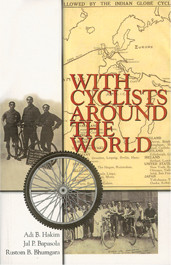
This reprint published by Roli Books is the new avatar of With cyclists round the World, being the memoirs of the late cyclists Jal Bapasola, Rustom Bhumgara and Adi Hakim, first published in 1929/30. Since the original book was not available and not even in the possession of some family members of the cyclists, Adi’s daughter-in-law Roda took it upon herself to get the book reprinted once she had convinced her husband Darayous and earned the support of author and art critic Esther David. She persisted despite rejections from several publishers.
"After four and a half years of ‘will they, won’t they’ coincidentally the book was in our hands on March 17, the same date on which the travelers returned to Mother India,” announced Darayous Hakim at the launch on the evening of April 19, 2008 at the Parsi Dharamsala’s Godrej Hall in Baroda. The function being co-sponsored by Shree Parsi Panchayat Vadodara, president Jal Patel who released the book referred to all the travails the cyclists "had to endure, even a stint in jail… they worked to earn money for the trip to move forward. I recommend this book to you, specially the youth, as you must have fire in your belly like these three men.”
All the copies sent by Roli Books were sold out in half-an-hour’s time and people were asking for more, reported Roda Hakim in her write-up on the event. She was, grateful to the publishers for taking "an old story and reproducing it in a way that made it so relevant to suit present times.” As acknowledged Jal Bapasola’s son Sorab in his written missive, "We were happy to see that the first edition was published by Adi Hakim, Shera House, Parsi Colony, Dadar, Bombay… First the father, and now the son.”
After nearly 80 years this tribute to the epic-makers turned out to be a celebration, marked with a jashan and finally khaanee-peenee (feasting) that goes with every Parsi function.
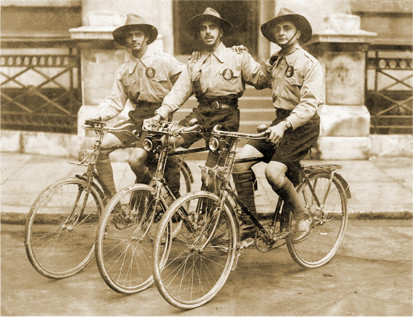
Intrepid cyclists: Adi Hakim, Jal Bapasola and Rustom Bhumgara
Girdling the globe
With Cyclists Around the World by Adi B. Hakim, Jal P. Bapasola and Rustom B. Bhumgara. Published in 2008 by Roli Books Private Limited, M-75, G. K. Market, New Delhi 110048. Pp: x + 363. Price: Rs 350.
"Such deeds of heroism and adventure deserve all praise and encouragement.” This comment by Benito Mussolini, Prime Minister of Italy, is quoted on the rear cover of With Cyclists Around the World, a record maintained by Adi Hakim, Jal Bapasola and Rustom Bhumgara, three young men from the Bombay Weightlifting Club who set off on a round-the-world trip on their bicycles. The trip started in Bombay on October 15, 1923 and the intrepid young men travelled 44,000 miles in temperatures as high as 140°F and also well below freezing point. They weathered storms and rode through every conceivable terrain: deserts, jungles, swamps, mountains often spending days without water and food. At times they suffered from fever, food poisoning and malaria and their bicycles underwent multiple punctures, burst tyres, snapped forks and broken pedal axles; but their journey was a tribute to their indomitable spirit as they overcame every imaginable obstacle and soldiered on, never giving up hope. Their journey lasted for close to four years and they returned to their starting point in triumph on March 18, 1928.
No one can argue that this is a painstaking record of a great expedition and a gigantic test of endurance. After reading the blurbs, one approaches it with a feeling of great adventure and expectation. However, very often our hopes are thwarted and we are left with a feeling of frustration and disappointment. The narrative is often a series of journeys described in great detail which end in uninteresting and nondescript places. The record is peppered with statements like: "We covered 60 miles and arrived at Abadeh… The governor much appreciated our effort and accompanied us on horseback for 19 miles till we reached Sturgestan… Villages after villages were left behind when by midday we arrived at Yezdkhest… After a journey of 80 miles from sunrise to sunset we reached Koomisah repairing punctures on the way… Ispahan is 53 miles from here.” And these are the contents of merely one paragraph of 20 lines. The scenery described is very predictable, sand in deserts, snow on mountains, rocky terrains. There is most often nothing startling which takes you by surprise and renders you speechless.
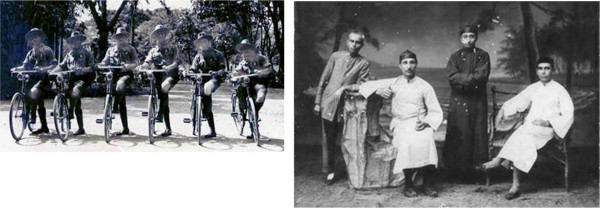
Six cyclists set out on their journey (above); four wearing Chinese garb in Canton
After journeys which suffer from a sense of oneness and have a sense of déjà vu, they reach destinations whose descriptions could have been culled from a tourist brochure and are merely factual and monotonous. The length, breadth, height of monuments are mentioned in laborious detail. After providing us with the dimensions of the Taj Mahal in Agra we are told that the architecture is "exquisite” and the style "flawless;” but no effort is made to substantiate this statement and the reader fails to experience the beauty or the splendor of these monuments which is something eagerly looked forward to in a travelog.
In the course of their journeys they cross several deserts in India, Syria and Persia. However, the experiences they describe suffer from a lack of variety. Hence, one is not surprised by descriptions of great and unbearable heat during the day and bitter cold during the night, lack of food and water, frequent sandstorms, bad roads or non-existent tracks.
Another factor which is made much about is the lack of money and the continuous need to increase their resources. This is constantly referred to and prices of meals, lodgings and more particularly tolls for their cycles are mentioned which interrupts the flow of the narrative and is not a factor which is of great interest to the reader.
The journey starts off with six young men who undertake to circumnavigate the globe. One of them decides to return home after reaching Persia for "personal reasons.” Two more of the group leave on account of "differences of opinion.” No reasons or explanations are offered nor is there a description of the interaction between the three young men who spend almost four years together. Surely there must have been many a pleasant conversation on the trip, some arguments, moments of tension, different points of view — we are not privy to any of these. We do not even know if the record we are reading is the work of a single man, a collective effort of all three of them or whether the information was provided to a third person who compiled the manuscript.
The account also suffers from a very dated style and manner of writing. The prose is full of unfortunate clichés: Purses are always "slender” and often the dawn tends to "peep.” The book often reads like the labored essay of a high school student who has selected the choicest metaphors as well as adjectives and has tried very hard to impress his teacher. "The golden glow of the sunset often illuminated the entire landscape with a dim glimmer that made us pause in our journey and watch meditatively dame nature in all her sublime glory.” The account also suffers from careless editing and slipshod proof-reading. Certain words have been unnecessarily used in the plural form like "equipments” and "environments.” The words on Shakespeare’s tomb which should read as "Curst be he that moves my bones” appears as "Crust be he that of moves my bones.”
The book is most interesting when they describe the customs of the people in the lands they visit; if only they had included more such anecdotes, how interesting the account would have been! There are amusing references to the behavior and customs of the Japanese and the Chinese. The commercial attitude to marriage in Baluchistan is amusingly described. The father of the bride generally receives half of the dowry in advance before the betrothal and even before the groom has had the chance to see the bride. The groom is entitled to enjoy his marital rights after the betrothal and does not have to wait for the marriage when the full bride price is paid. Guests are treated with such veneration and hospitality that certain tribes "permit a grown-up girl of a family to associate with their guests for the satisfaction of his grosser self.” A host would even go to the extent of procuring a girl from his relations or friends by way of a loan for this purpose.
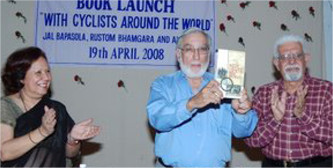
Jal Patel releasing the book as Roda and Darayous Hakim look on
Personal reactions to places they visit often make compelling reading. After the poor roads they cycle through in Asia, they believe that all will be hunky-dory when they reach Europe. However, disappointment looms large when they are faced with the Italian roads which are covered with a fine layer of dust concealing all the potholes and uneven surfaces. Their horror at facing dirt, dust, grime and poverty in Italy is also effectively portrayed. There are similar effective descriptions of bustling market places in Korea with vibrant colors and incessant loud bargaining as well as teeming Chinese streets with shops selling "varnished ducks, dogs with skins flayed, lacquered rats, decayed eggs and decomposing fruit.” The pulsating rhythms of the heaving crowds in New York and the multicultural atmosphere of the metropolis are also successfully captured.
Jawaharlal Nehru, in his foreword to the book envies the young men who "have girdled the globe and tasted adventure to the full.” It is a great sense of disappointment and disillusionment that the authors have not been able to effectively convey this to the reader.
Firdaus GandAvia
"These sweet-natured…”
"It makes absorbing reading and is a reference book which promises to stand the test of time. I congratulate the author on his fine effort,” commended the governor of Andhra Pradesh N. D. Tiwari when releasing Bakhtiar K. Dadabhoy’s Sugar in Milk: Lives of Eminent Parsis at the Banquet Hall of Raj Bhavan, Hyderabad on February 11, 2008. The book launch function which was attended by about 120 guests included numerous Parsis and was well covered by the print and electronic media, as per a report sent by Zenobia Rustomfram. Those present included the former governor of Maharashtra Air Chief Marshal I. H. Latif, numerous senior civil servants (both serving and retired), personalities from the world of art and culture, and Rupa authors based in Hyderabad.
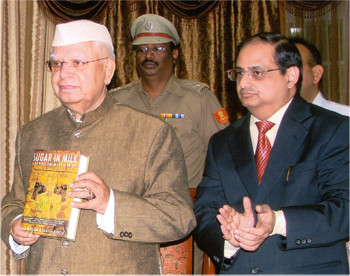
N. D. Tiwari (left) and Bakhtiar Dadabhoy at the book launch
Praising Dadabhoy for his lucid, simple and refined prose, Tiwari commented that the book was very well researched with much thought and effort having gone into writing it. While he had not read the entire book he had glanced through it at some length and found the title of the book appropriately summed up the contribution made by the Parsis to Indian life. "These sweet-natured, peace loving, industrious and adaptive people have integrated themselves into Indian society and also maintained their distinct ethnic identity.” Referring to their outstanding contribution to the moral, social, intellectual, political and commercial life of India, the governor added, "Whether it is in industry, public life, the sciences, the sports arena or the professions, the Parsis had excelled in virtually all spheres. It is most unfortunate that their numbers are dwindling at an alarming rate. I can only exhort the Parsis to take remedial action before it is too late. India can ill-afford to allow this illustrious community to reduce in number.”
The author in his address spoke of what led him to write the book, how long it took him and where he had sourced his material. He said that the book fulfilled a long standing need since there was no one book which carried in-depth profiles of some of India’s greatest Parsis in recent times, a view which luckily for him was shared by his publisher. His interest in biography as a genre and the success of his earlier work Jeh: A Life of JRD Tata, provided all the impetus that was needed.
Dadabhoy also gave those present some insight on how he had selected the personalities profiled in the book. He said that such a selection was likely to please some and displease others, and that since significance is ultimately a matter of personal judgment a writer presented with this kind of brief can only set his teeth and stand by his own instincts. Having said that, he added that given that the book could carry only a limited number of profiles, could one replace Jamsetji Tata or J. R. D. Tata with Ratan Tata? Replying in the negative he said that a similar logic would apply to other personalities as well, and that viewed in this light his choice would become a little more understandable. In conclusion Dadabhoy said that he had written the profiles to read as stories of varying length peppered with anecdotes and sometimes trivia to make them more interesting.
Narendra Luther, a retired chief secretary of Andhra Pradesh, author of numerous books on Hyderabad and a reputed authority on the city who introduced the book, spoke briefly about the personalities profiled in it, supplementing each enumeration with some interesting detail about the personality in question. He also explained the significance of the captivating title "Sugar in Milk” narrating the famous story about how when presented with a bowl full of milk a Parsi priest added some sugar to it suggesting the adaptive and accommodating attitude of the Parsis. In the course of a witty and entertaining speech he said that people buy books to not only read them but also as objects of decoration. Calling Sugar in Milk "a damned good book” he added that since the book had visual appeal as well, it fulfilled both needs. He also congratulated the publisher for a job well done saying that he had read the book from cover to cover, but had not encountered a single typographical or proofing error.
The book was being launched on Basant Panchami, the day the goddess of learning Saraswati is worshipped, coincidentally a most auspicious day for a book launch, pointed out R. K. Mehra, publisher Rupa and Company, the biggest Indian publishing house which was awarded the Best Publisher Award 2007 by the Federation of Indian Publishers. He then spoke on books and publishing in general and Sugar in Milk in particular which he said was the fifth by the author.
The book launch function was compered by Shankar Melkote, a well-known English theater personality, and a TV and a South Indian film star. After the speeches concluded the author signed copies of his book and the guests retired for high tea served in the Durbar Hall of Raj Bhavan.
Luminous lives
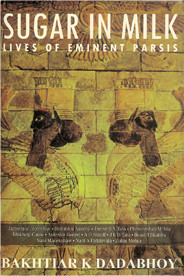
Sugar in Milk: Lives of Eminent Parsis by Bakhtiar K. Dadabhoy. Published in 2008 by Rupa and Company, 7/16, Ansari Road, Daryaganj, New Delhi 110002. Pp: xv + 462. Price: Rs 795.
Being restricted to just a dozen profiles of exceptional Parsis, Bakhtiar Dadabhoy confesses that he found the selection process frustrating. It became more a process of elimination than selection, the problem being not whom to include but whom to keep out! So, presented in chronological order, ranging from the 18th century to contemporary times, we have accounts of the lives of Sir Jamsetjee Jejeebhoy, Dadabhai Naoroji, Jamsetji Nusserwanji Tata, Sir Pherozeshah Mehta, Madame Bhikhaiji Rustom Cama, Ardeshir Godrej, Ardeshir Darabshaw Shroff, Jehangir Ratanji Dadabhoy Tata, Homi Jehangir Bhabha, Field Marshal S. H. F. J. Manekshaw, Nani A. Palkhivala and Zubin Mehta in this handsome hardback volume.
Since biography serves as "a prism through which history is viewed,” the author hopes that the lives of these eminent personages will illustrate the times they lived in. For instance, it is no coincidence that five of these, known for their nationalist sentiments, were contemporaries. The advent of English education in India planted the first germ of nationalist aspiration among Indians. Steeped in the liberal and humanist tradition, these educated Indians were among the first to agitate for political change and swaraj (Dadabhai Naoroji, Sir Pherozeshah Mehta and Madame Cama) or give a fillip to swadeshi through their pioneering schemes (Jamsetji Tata and Ardeshir Godrej).
How does Dadabhoy treat his subjects? His is a popular account, not a scholarly study and showcases the achievements of each personality in a style which though anecdotal is buttressed with well researched facts and figures.
Writing about the munificence of Sir Jamsetjee Jejeebhoy, first baronet, whose life was a classic rags to riches story, the author explains: "By the third decade of the 19th century, merchant charity in India had begun to change from being religious, and restricted to one’s own community or caste, to being more secular. Jejeebhoy was one of the first Parsis to make this transition… As a quote from his biographer Jehangir R. P. Mody illustrates: "Wells, bridges, dharamsalas, panjrapoles (animal shelters), waterworks and schools, sprang up by the open sesame of his princely munificence.”
Dadabhoy reveals that perhaps Jejeebhoy’s most important public activity was his association with, and attempts to rid the Parsi Punchayet (formed in 1673 to perform quasi-judicial functions) of inefficiency and corruption. The Punchayet, managed by leaders known as akabars, dealt mainly with the settlement of family quarrels, marriage and divorce disputes. Jejeebhoy, a trustee for 35 years, introduced voting by secret ballot, a system far ahead of the archaic one prevailing at the time. However, the organization lacked punitive powers. On one occasion the Punchayet sent a request to William Hornby, governor of Bombay, asking for permission to chastise wrongdoers by beating them with shoes! An amused Hornby agreed, but with the proviso that there should be no other corporal punishment.
Much has been recorded regarding the remarkable achievements of Dadabhai Naoroji, the "grand old man of India.” But how many are aware that his mother remained his constant companion, muse, teacher and guardian angel for over half a century? She was a strong woman of remarkable natural intelligence. In contrast, Naoroji’s marriage to Gulbai, when he was 11 and she only seven, was a complete intellectual mismatch, though he proved to be a faithful husband.
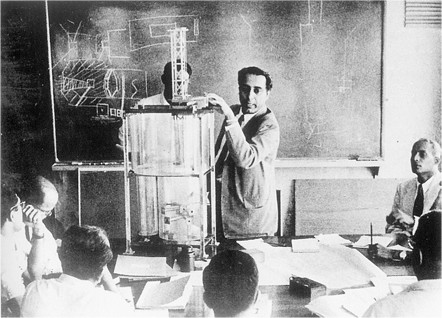
Homi Bhabha with a model of Apsara
Jamsetji Tata’s creative genius really stands out. Breaking new ground at a time when industrial progress in India was more imitative than creative, his was a mind forever in quest of knowledge. This was evident in all his ventures — from producing higher grade cotton yarn to use in his textile mills, pioneering welfare schemes, to setting up India’s first luxury hotel. He has become immortal for envisaging the need for and taking practical steps for providing higher scientific education in India, the generation of hydro-electric power and the manufacture of steel. He introduced a provident fund scheme and a pension fund, the first of its kind in India.
The library in his home was his favorite place and his knowledge "encyclopedic.” The curator of the Calcutta Botanical Museum, an authority on Indian plants, was stunned by Tata’s knowledge of botany. He once confounded an Austrian paper manufacturer who tried to sell him some inferior products by describing the entire process of paper manufacture! It is nuggets like these that greatly enhance the appeal of Dadabhoy’s book.
Dauntless patriot and eminent citizen Sir Pherozeshah Mehta’s best work was done in the Corporation of Bombay and he fully merits having his statue installed outside the municipal headquarters. Once when there was talk of placing a statue of King George V there, Mehta objected on the grounds that the king had done nothing for the city of Bombay to deserve the honor. Someone mockingly remarked that perhaps they should place a statue of Mehta there, to which he responded: "Why not? I have served Bombay for 30 years!”
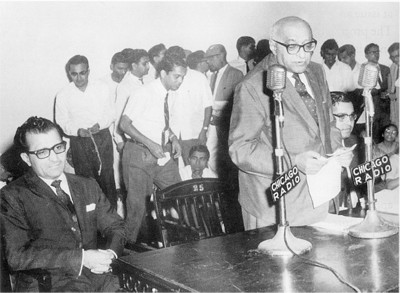
Ardeshir Shroff (at the mike) with Nani Palkhivala (on left)
Mehta never tired of declaring that he was an Indian first and a Parsi afterwards. He was positively hostile to the promotion of communal interests, holding that the fortunes of the Parsis were linked with those of other communities. This did not exactly endear him to his co-religionists and when he stood for election as a trustee of the Bombay Parsi Punchayet he was defeated, though allegedly by unfair means.
Perhaps the first Parsi lady to wear dresses and even play cricket (at the time a strictly male preserve), Madame Bhikhaiji Cama was self-willed, spirited and unconventional. She was the first to ask for complete independence and the first to unfurl an Indian flag at an international forum in India’s independence movement. She had an understanding of internationalism and a deep faith in socialist ideals.
Pioneering industrialist and inventor Ardeshir Godrej started his career as a young lawyer in Zanzibar. But this was short-lived because he was unwilling to twist the truth even when he was about to win an important case. Though he inherited wealth he chose to give it away to his siblings. He could have afforded the best cars, but chose to use public transport, or just walk. He was also a freedom fighter, one of the earliest pioneers who realized that "swadeshi was integral to swaraj.”
Ardeshir Darabshaw Shroff’s forte was the stock market. In his phenomenal memory were stored the names and portfolios of at least 250 clients. Shroff joined Tata Sons as financial adviser in 1940. His vast network of big investors proved to be a boon for the Tatas and stories of him raising funds within a short period of time abound.
Shroff started the Forum of Free Enterprise as a vehicle to counter government propaganda against the private sector. Conscious that the lobbying for free enterprise could be misused by unscrupulous businessmen, he formulated a code of conduct to be followed by all those engaged in free enterprise, ranging from businessmen to doctors, lawyers and journalists.
J. R. D. Tata’s motto was that the best in India must be as good as the best in the world, a dictum which guided him to set up institutions for Tatas in numerous fields ranging from atomic research and social service training to the performing arts. In March 1992 JRD was awarded the Bharat Ratna, India’s highest civilian award. Accepting it with characteristic modesty, he maintained that all he had done was his duty, adding: "Why me? I don’t deserve it. The Bharat Ratna is usually given to people who are dead or it is given to politicians. I am not prepared to oblige the government on the former and I am not the latter.”
Everybody knows that Dr Homi Bhabha was the father of nuclear science in India, but few are aware that he was the first corporate patron of contemporary art as well. He spent his own money to buy paintings of upcoming artists from India and abroad to adorn the walls of his office, the corridors and seminar halls. He even convinced Jawaharlal Nehru to earmark two percent of the total financial outlay for the Tata Institute for Fundamental Research for buying paintings and sculptures.
At 93 Sam H. F. J. Manekshaw is the world’s oldest living Field Marshal. A strict but a very considerate boss, Manekshaw shielded his officers against injustice and urged that rewards be given to them freely. He once asked an officer’s orderly if he knew his name. The orderly replied: "Yes Sir, you are Sam Bahadur,” an appellation which stuck. Manekshaw had great respect for the Gorkhas as fighters and always maintained that "Whoever says that he knows no fear is either lying or a Gorkha.”
After the Bangladesh war, Manekshaw insisted that the Pakistani prisoners of war (POWs) be well looked after. They were allowed to celebrate their festivals, given copies of the Koran, permitted to receive letters and gift parcels. International agencies like the Red Cross were given free access to POW camps. In fact the POWs were housed in barracks while the Indian troops had to make do with tents, which made the cabinet complain to the prime minister that the army chief was treating the Pakistani prisoners like his jamais (sons-in-law).
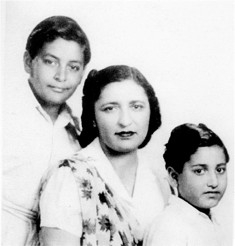
(From left) Zubin Mehta, mother Tehmina and brother Zarin
Indira Gandhi offered Manekshaw the post of High Commissioner to the UK. When he declined, she offered him the post of governor ("Go to Bombay Sam, the Parsis will love you.”) but he refused again, saying that when he became army chief he had taken an oath that he would accept nothing from the government but that he would work without interference.
It is no exaggeration to say that legal luminary Nani Palkhivala’s intervention in the Keshavananda Bharati case of fundamental rights saved democracy in India. His doctrine of the "basic structure” of the Constitution of India is his most enduring contribution to law and ensures that "tyranny and despotism shall not masquerade as constitutionalism.”
In an interesting aside the author notes that the surname came from Palkhivala’s father’s profession — making palkhis (palanquins). His father and uncle had made a palkhi for one Hormusji Sorabjee – former attorney general of India Soli Sorabjee’s grandfather — a fact which neither of them was aware of for a long time.
An orator par excellence and gifted with instant recall, Palkhivala loved using quotations. J. R. D. Tata once commented on his collection and the meticulous way in which the quotations had been filed. JRD’s biographer Russi M. Lala who thought they comprised a few handwritten volumes was stunned to discover that they were all typed out and filled three large cupboards!
While in the USA as India’s ambassador, Palkhivala delivered more than 170 speeches in different states, sometimes making more than three or four speeches in a day at different places.
When he was a young lad Zubin Mehta’s teacher in Vienna informed his father Mehli: "Your son is a born conductor. There is simply not much I can teach him. He knows everything already.” Mehta’s gestures are natural and there is tremendous energy in his conducting, a universally acknowledged fact, despite some carping critics. Mehta’s passion on the podium remains.
Mehta is fiercely Indian, his love for Bombay and his pride in being Indian being well-known. He still holds an Indian passport even though it causes him much harassment when applying for visas to certain countries.
Dadabhoy’s book, liberally illustrated with photographs sourced from various archives and private collections, has few footnotes but an extensive bibliography and index. The type face is clear and large, in short reader friendly. Gracing the front cover is The vision, a painting by Rustum M. K. Daboo, while the back cover displays Meditation, also by the same artist. The author, who is chief commercial manager, South Central Railway based in Secunderabad was educated at the Hindu College, Delhi University and the Delhi School of Economics. This is his fifth literary offering, his earlier works including the bestseller Jeh: A life of JRD Tata and two books on cricket of which he is a great fan despite match-fixing.
Thomas Carlyle wrote: "A well-written life is almost as rare as a well-spent one,” and the author hopes that these 12 lives will be read with both profit and pleasure, a sentiment which the reviewer readily endorses.
SHERENE VAKIL
◆ ◆ ◆
From the archive