
Books
Chronicling a community
Dipanjali Golden Anniversary edited by Novy Kapadia. Published in 2011 by the editor on behalf of the Delhi Parsi Anjuman, Mengusi Parsi Dharamshala, Bahadur Shah Zafar Marg, New Delhi 110002. Pp: xxxii + 266. Price: Not mentioned.
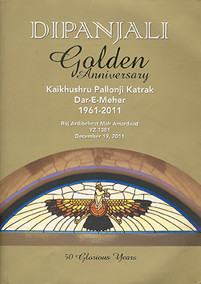
This special edition of a community house journal, meant to be a tribute to the Kaikhushru Pallonji Katrak Dar-E-Meher on its golden jubilee, is itself a monument to what a group of dedicated amateurs can create. Building on an earlier issue published to commemorate the Dar-E-Meher’s 40th anniversary in 2001 it has memorialized the history of a community of outstanding individuals who converged on the nation’s budding capital from the early years of the 20th century, creating institutions, providing service, distilling bonhomie, earning trust. The 266 editorial pages do not include the unnumbered advertising folios bunched together at the end, though the colorful ads must have provided substantial financial support to this coffee table sized art paper edition.
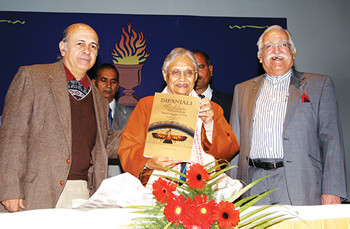
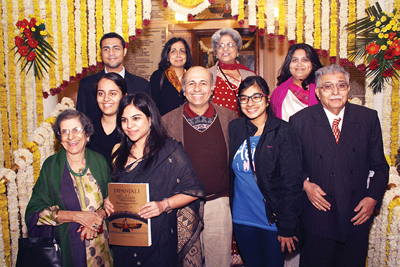
Sheila Dikshit (center) releasing Dipanjali Golden Anniversary flanked by Novy Kapadia (left) and Dadi Mistry; (right) editorial team
A host of congratulatory messages, starting with that of the President of India, the Prime Minister and the president of the All India Congress Committee and other dignitaries of the nation and the community, attest to the standing of the Delhi Parsi Anjuman (DPA) and its president Dadi Mistry. What makes this issue one worth preserving, however, is the recapitulation of events leading to the consecration of the agiary and other institutions in the city by the living who remember how the city and the community evolved; as also the tributes of those who benefited from the leaders’ largeness of heart and spirit.
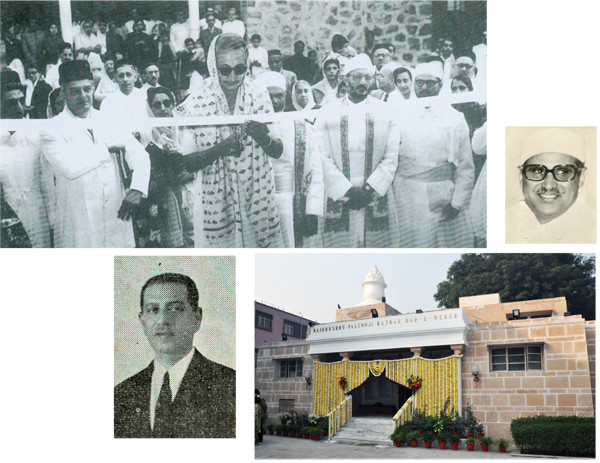
(Above) Shirinbanu Katrak inaugurating the Dar-E-Meher (far right) named after Kaikhushru Katrak (alongside); (above right) Ervad Daraius Bagli
The documentation includes biographical sketches of 17 existing "Pillars of the community” apart from memories and milestones of those who laid the groundwork. But it also includes what young Zoroastrians of Delhi think and do today and anticipate in the morrow. Thus a unique article, "Perspectives on Physics” by Jehangir Cama, a PhD student at the Cavendish Laboratory in Cambridge, UK discusses Relativity, Quantum Mechanics, black holes and work at CERN (European Organization for Nuclear Research) — because he wants us to share his desire to understand the workings of the universe. One very young Farohar (gauging from his photograph), Karl Sidhwa, part of a group of youngsters between the ages of four and 14 studying the Zoroastrian religion at the Mengusi Parsi Dharamshala every alternate Saturday, has this little offering to make: "I run, I stagger, I falter, I fly!/And see the world with a dreamy eye,/My friend, my guide, my faithful faith/ With Ahura Mazda by my side, I shall never be afraid!” The Farohars, now labeled the Young DPA Zoroastrian Club, a creation inspired by Zoroastrian scholar Piloo Jungalwalla, is now in its second generation.
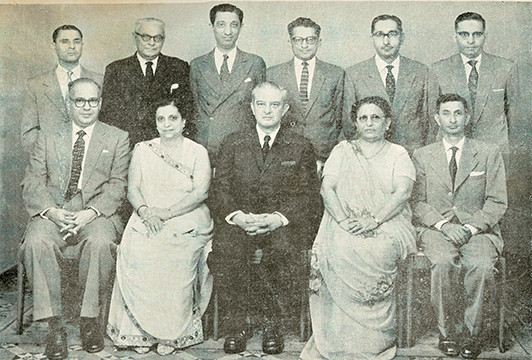
1961-62 Delhi Anjuman trustees (from left, sitting) D. F. Madan, N. N. Marker, S. D. Nargolwala, B. P. Variava, K. R. Bharucha; (standing) S. J. Dinshaw, J. F. Masters, Col N. D. P. Karani, Dr K. R. Hathi, Dr M. S. Shroff and D. F. D. Joshi
"Fifty years is a very long time. Memories tend to fade. With the help of some old records and my own remaining memories of the time, I have written this account of how we built the agiary,” notes Sappy Dinshaw, then joint secretary of the DPA. Thanks to the efforts of Dr Sorabji Shroff and other notables like Sir Maneckji Dadabhoy and Cooverji Bhabha the plot of land it occupies on Bahadur Shah Zafar Marg was provided by the Government of India on perpetual lease in 1949 for four purposes: a dharamshala, a community hall, a fire temple and priest’s quarters. The dharamshala came up in 1951 followed by the community hall in 1954.
However, it was only in 1960 when a new board of trustees headed by Shiavax Nargolwala took office that a determined thrust was undertaken. Shirinbai Katrak offered a trust property and some finance for an agairy to be built in the name of her late husband Kaikhushru Pallonji Katrak. A special general meeting of the anjuman was held in August 1960 and the proposal was formally approved.
An appeal for funds in late 1960 netted a fairly substantial amount by May 1961, notes Dinshaw. The building was designed, the site plan was approved by Dastur (Dr) Hormazdyar Mirza and the foundation stone was laid by Nargolwala on May 5, 1961. In June the Municipal Corporation of Delhi and the Delhi Land and Development Office sanctioned the plan and Sardar Ajit Singh, a well known contractor was entrusted with the construction work. "Delhi had heavy monsoon rains that year and there wasn’t much progress in July and August,” but thereafter the tempo picked up, recalls Dinshaw with Nargolwalla surveying the work every evening or holding a meeting at his residence since the DPA secretary Keki Bharucha, Dinshaw and Singh lived in the vicinity.
"I am not sure whether Ajit Singh made any profit on the contract. Shiavax was continuously prodding him to engage extra labor or work overtime,” notes Dinshaw. "I remember one evening at the site after a bit of a stormy session with Ajit Singh Shiavax cooled down a little and said to him: ‘Ajit, you should consider yourself lucky working with Parsis. You must have been a Parsi in your previous life!’”
Donations in cash and kind were gratefully accepted. The main afargan and utensils, the electrical and sanitary works, the steel doors and window frames, the steel chairs, the carpet, the large framed photograph of Zarathushtra and the well outside were donated, writes Dinshaw.
The foundation stone of the Mengusi Dharamshala had been laid by Shroff on January 29, 1950 and the building inaugurated by him in October 1951. It had 13 rooms besides the dining hall and kitchen and the rate for boarding and lodging was six rupees per day, writes Dinshaw in a parallel article. It now has 44 air-conditioned rooms and the minimum boarding charges for regular rooms are Rs 400 per day.
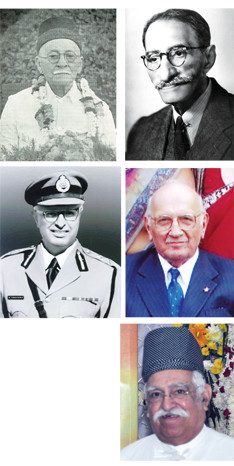
DPA presidents (clockwise from top left): Nowroji Kapadia, Dr Sorabji Shroff, Lt Gen Adi Sethna, Dadi Mistry and Khusro Rustamji
The first of the six stalwarts who preceded Mistry as president of the DPA was founder president Nowroji Kapadia who held the office from 1925 to 1944. Born and bred in Bharuch, Kapadia came on a visit to Delhi in 1880, liked the ancient city and decided to settle here, the first Parsi to do so, acquiring a job as an agent with Ralli Brothers. Becoming successful at work, he moved to a large house at Kashmere Gate, the commercial and social hub of the city in those days, notes his great-grandson Novy. Nowroji was a patriarch with eight of his 10 children surviving. "A favorite pastime was a walk to the Old Delhi Railway Station on the days the Frontier Mail came to Delhi (on its way from Bombay to Peshawar). There he would accost Parsi visitors and take them home for a meal and even to stay overnight or for a few days. He would use this opportunity to enliven them on the advantages of shifting to Delhi.” That there were enough Parsis who began to think like him eventually led to the formation of the DPA.
An associate professor of English at Sri Guru Teg Bahadur Khalsa College, University of Delhi, the last of the Kapadia clan in Delhi is also a sports commentator and journalist who writes, "In a way I feel like Bahadur Shah Zafar, the last of the Mughals. As I am unmarried, there will be nobody to succeed me. So when I die, the approximately 150-year-old tenure of the Kapadia family in Delhi will come to an end.”
Nowroji Kapadia was followed by Shroff who founded the Dr Shroff Charity Eye Hospital now run by his grandsons and great grandsons. Border Security Force founder Khusro Rustamji was president for two years during his posting in the city 1956-58. He was followed by Nariman Shroff, a director of the Indian Railways Board and their chief architect who designed Bombay’s Churchgate Station, for another two years. Nargolwala presided over the DPA for 26 years until his tragic death in a car accident in 1986. Lt Gen Adi Sethna took over the reins in 1987 until his demise in 2006.
Two sections — Memories and Milestones — provide glimpses of life in the early years of Indian independence. Narrated by family members fondly recalling seniors who set the pace of liberal thought and lived the Zoroastrian life as they saw it, the articles are nostalgic of a way of life that is fast fading.
Articles on religious scholarship, the Iranian experience, demography and the fate of the children of intermarried Parsi women find their normal space but in terms of the last it is the experience of the women who have trodden the path like Dr Khursheed Tuli, Ava Khullar, Dinaz Mirchandani and others reflected in their articles that makes for fresh insight. The community is rich in creativity as reflected in the sonnets of Keki Daruwala, the wildlife photography of Cawas Bagli, the enormous impact of PARZOR (since its one-woman foundation by Dr Shernaz Cama) on the documentation and revival of Parsi crafts and community achievements, the puppetry of Dadi Pudumjee, the culinary prowess of Parsi ladies …much of which is reflected in these pages with fresh recipes to boot. When there is so much that is negative on the national and international scene, it feels good to read Dipanjali.
ARNAVAZ S. MAMA
◆ ◆ ◆
From the archive