
Comment
Delhi dharamshalla’s doyenne
For nearly three decades Dhun Bagli has been managing the Delhi Parsi Anjuman’s Parsi Rest House where the rooms are affordable, clean and comfortable
Like a (figurative) crack of the whip, her voice cuts into the quiet of a new day, sending the room-boys, cleaners and cooks scurrying to their jobs. In no time, a pot of mint tea as only the Parsis know how to make, is brought up to the room. Soon thereafter the fragrance of lasan ni akuri and masala na pora come wafting up, stirring the first pangs of hunger. Guests are secure and well looked after in the 36 (12 A/C and 24 non-A/C+1 A/C suite) room Mengusi Parsi Dharamshalla of the Delhi Parsi Anjuman (DPA) run by the indefatigable Dhun Daraius Bagli.
With straight back and steel grey hair, Bagli sits at her desk doing accounts, setting the menu, supervising the staff or styling flowers. Her able adjutant is her daughter-in-law, Binaifer.
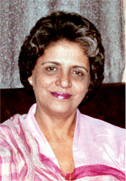
Above: Dhun Bagli
The rooms at the Parsi Rest House on Bahadur Shah Zafar Marg are popular because of their reasonable rates, central location, excellent food and service. Non-Zoroastrians are charged a higher rate, so as to make it affordable for the community. (By about March 2009, six more rooms will be added to the institution.)
Presently while Dhun manages the Dharamshalla, her son Cawas is the priest and pastor of the flock. A recent, serious illness has forced the young priest to take long leave for his treatment and recuperation. Ervad Yezdi Surti is officiating as the priest in the meantime. "The strength and support given to me by my sincere friends has seen me through this ordeal,” says Dhun.
Dhun’s hobby, "Nay, passion,” says she, is flower arranging. She brings form and color alive in her floral arrangements. Be it a wedding or a navjote, a felicitation to a Member of Parliament or a condolence meeting in memory of Lt Gen Adi Sethna or Field Marshal Sam Manekshaw, flowers styled by Dhun add a special touch to the occasion.
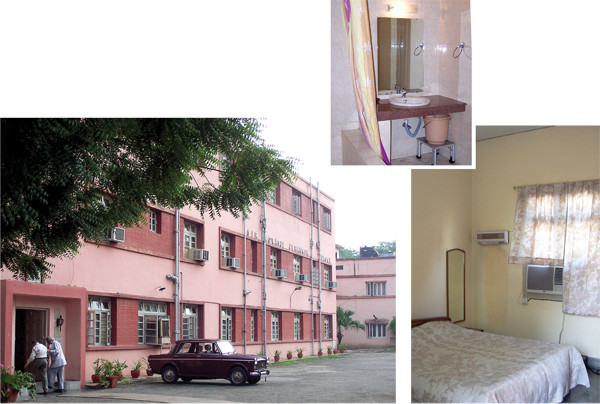
Above: The Dharamshala; air conditioned room and bathroom
"During the muktad, I get up at 3 a.m. to sort and groom the flowers and foliage before arranging them in gleaming silver vases. I like to work with a color-based theme, so it could be the purity of white, the passion of red or the tenderness of pale pink on different days.” By 7 a.m. Dhun is off to the mandi (flower market) to buy the freshest and best flowers for the next day. "It is a labor of love,” she smiles.
Her other favorite pastime was driving. "I love the power of automobiles. There was a time when I took part in car rallies. I can’t do it now and I miss it,” said Dhun, pointing to her painful knees.
"The Delhi Anjuman is seen as liberal,” I observed. "What are your personal views on interfaith marriages and the navjotes of their children? Should we not be moving with the times?”
She does not personally subscribe to the liberal views on religion as does the Delhi Anjuman. "My son Cawas will not perform such ceremonies but we would extend all co-operation.” However, she was very enthusiastic about the opening up of the Dharamshalla to non-Parsis if they were recommended by a member of the DPA. "The idea was initially mooted by the trustees and it is working very well. It brings in substantial income which can be used for the good of the community.”
Zoom back 50 years to Dhun Langrana of Bombay, an outgoing, fun-loving, fond of dancing, career girl in her twenties. She first came to Delhi in 1958 in her capacity as personal secretary to Lady Rama Rao, head of the Family Planning Association of India. They were in New Delhi to attend an International Conference on Planned Parenthood. Dhun and two other Parsi girls (also from Bombay) formed the staff of Lady Rama Rao. Since they had a month long assignment in Delhi, the three young women stayed at the Delhi Dharamshalla. The parents felt safe about their daughters being in Parsi environs.
The dynamic Lady Rama Rao (whose husband Sir Rama Rao was the governor of the Reserve Bank of India) had a hectic schedule of meetings and seminars and kept her staff of three equally busy. "Daraius Bagli, the genial head priest of the Delhi agiary and manager of the Dharamshalla was extremely helpful,” recalled Dhun. "He even brought our lunch to the Vigyan Bhavan every afternoon.” Ervad Bagli’s wife had died not long ago. "He had three lovely children,” said Dhun. "Twin boys, Dinshaw and Dinyar, aged nine years and Bakhtavar (Bakku), a little girl of seven.” The girls from Bombay and the three bereft children, probably looking for a mother figure, got along famously. The evenings were spent in story telling and playing games together. A happy camaraderie built up between the Bagli family and the Bombay girls. "At the end of a month when we were wrapping up the reports of the Conference and preparing to return to Bombay, Daraius proposed to me! I was too surprised to react,” recalls Dhun, "so I told him to come to Bombay and talk with my parents.”
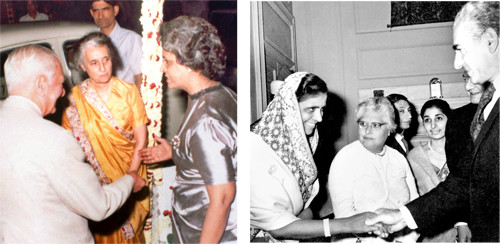
Far left: Former DPA Anjuman president Shiavax Nargolwala and Bagli greeting former prime minister Indira Gandhi Left: Bagli greeting the Shah of Iran. Nerges Nargolwala is standing next to the Shah
When Dhun returned to Bombay and told her mother about the proposal, she dismissed it as one of her daughter’s many pranks and did not give it any serious thought until Daraius came to ask Dhun’s parents for her hand in marriage. In Bollywood parlance it would be called a Kissmat Konnection. "Within one month we got engaged and married and Daraius brought me back to Delhi as his bride,” smiled Dhun.
"Who swept who off their feet?” I asked. "Actually the three children swept me off my feet,” replied Dhun.
The personal secretary of Lady Rama Rao quit her satisfying job and her beloved Bombay and slipped easily into the role of a gorani (wife of a priest) and mother of three children in the capital city of New Delhi.
"At the very outset of our marriage, Daraius and I decided we would not have a child for some time as it would make his three children feel insecure,” she explained. Dhun and Daraius’ only son Cawas was born seven years after they got married. "He was Bakku’s baby from day one,” recalls a nostalgic Dhun, "she would mother him, feed him, play with him and was very proprietary towards him.”
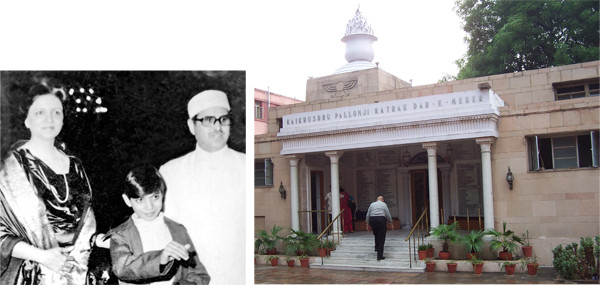
Above: Dhun, Cawas and Ervad Daraius Bagli. Right: Former DPA president Lt Gen Adi Sethna entering the Kaikhushru Pallonji Katrak Dar-E-Meher
"The only thing I found hard to do in the beginning, was bathing the dead bodies,” remembers Dhun. "But Daraius asked me to do it and I continue to do it to this day,” says the 75-year-old manager of the Dharamshalla.
When the older three children were well into adulthood and Cawas was five years old, Dhun yearned to get back to a career outside the home. Her husband acquiesced.
With her personality and credentials Dhun landed a plum job in IBM as secretary to the regional general manager, an Australian gentleman. She worked with the IBM for eight years till their office in India closed.
Thereafter, she was snapped up by the US Embassy. But in less than a year with the Embassy, Dhun’s world fell apart when Daraius suffered a massive heart attack and died the same day. "I was numb with shock and grief,” remembers Dhun. "When little Cawas came home and saw his father, he blurted out between sobs ‘But daddy promised to make me a navar. How could he go away without doing that?’”
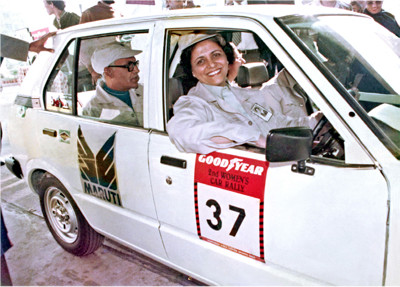
Participating in the ladies car rally to Jaipur
On Daraius’ varsi (first death anniversary) Dhun saw to it that Cawas was ordained a navar.
Made of strong mettle, she picked up the broken threads of her life. When the trustees of the Delhi Anjuman asked her if she would like to take up the responsibility of running the Dharamshalla, Dhun was undecided. "Finally it was my heart that took the decision. I would manage the Dharamshalla in order to perpetuate the legacy and memory of my husband, Daraius… I am happy and at peace with the decision I made.”
The Delhi Dharamshalla or Parsi Rest House as it is now called was built in 1950. By the time Dhun took over its management in 1979, the edifice was beginning to tell its age. "The bathrooms in particular were in a sorry state and needed to be redone. But the trustees were reluctant to make a (financial) commitment.” With the permission of the trustees, Dhun took upon herself the task of raising funds from generous donors and appreciative guests at the Parsi Rest House, to carry out the much needed repairs and renovations. She personally oversaw every step of the work in order to get best results from limited resources. Slowly but surely all the bathrooms were done. Under her sharp supervision the Rest House, garden and agiary took on a life and character of their own, looking brighter and more beautiful. Good food and service encouraged many people to hold social functions in the premises.
Bagli’s motto for Life is printed on the inner flap of her visiting card: "God grant me serenity, to accept the things I cannot change; Courage to change the things I can, And wisdom to know the difference.”
◆ ◆ ◆
From the archive