
Books
Memorial to Mirza
Dasturji Dr. Hormazdyar Dastur Kayoji Mirza Birth Centenary Memorial Volume. Published in 2010 by the Dastur Kayoji Mirza Institute, Udvada, C/o Dastur Dr Peshotan Dastur Hormazdyar Mirza, Ground floor, Nadirshaw Dinshaw Building, 4, Babulnath Road, Bombay 400007. Price: Rs 800.
Few and far between are publications felicitating or commemorating priestly Zoroastrian worthies. The Festschrift under review marks the birth centennial of Dastur Hormazdyar Mirza — 1907-2007. Dasturji himself had passed away in 2004, bequeathing several learned Zoroastrian disciples and inspired devotees worldwide his comprehensive knowledge and liturgical experience.
This handsome volume, edited by Dastur (Dr) Kaikhusroo M. JamaspAsa who also contributes a preface, and Dastur (Dr) Firoze M. Kotwal, with copy editing by Ervad (Dr) Ramiyar P. Karanjia, is dedicated to his blest memory. The Dastur Kayoji Mirza Institute, Udvada, was befittingly responsible for its overall production.

The august Dastur is recalled here in an affectionate memoir by his grand-daughter Aban Mirza who provides useful little insights into that finely disciplined prelate for whom his high-priestly duties and his enduring researches at the K. R. Cama Oriental Institute brought lustre as much to Udvada as to Bombay. The editors, both earlier students of Hormazdyar, are remiss in not including his full bibliography: one most desirable in any commemorative volume of importance.
Contributions from scholars across the globe are printed here, some by his former students and, later, his associates. Happily included is a brief article, hitherto unpublished, "Significance of Zoroastrian Religious Ceremonies” by the late Dastur. It reflects his ritual expertise — he had served Udvada’s Iranshah for six decades — and his formidable scriptural knowledge, a fraction of which is encapsulated in his popularly themed, neatly paraphrased Gatha and Haptanhaiti selections. Seeing the core religion as rigorously monotheistic, he had no time for the dualist heresies or millennial saviors promoted by self-serving demagogs.
JamaspAsa’s lengthily titled "Role of Religion and Spirituality in Promoting Universal Human Values” is disappointingly short: its plea for tolerance is soon moved from Cyrus II to the current "reformist” drive for acceptance and conversion into the faith, expressing that a person is religiously bound to the faith into which he is born.
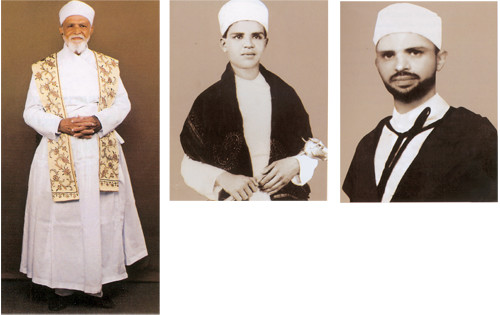
(From left): Dastur (Dr) Hormazdyar Mirza in full regalia; at age 15; and as a graduate
Mobed Mehraban Firouzgary’s contribution significantly concentrates on "Changing Trends” in Iran with its stress on the establishment of school education mainly in Yazd and Kerman. Among these praiseworthy trends, unmentioned here, is the full ordination of women priests — on which Parsiana (May 21, 2011) has given a balanced coverage — among whose mentors was this benevolent Iranian mobed. Would that such benefits accrue in India in its far freer educational atmosphere!
The high-minded Hormazdyar is commemorated at several levels by the various contributors. Thus, the Farrobay Fire that served the priest class — the great one of three most sacred fires in Sasanian times — is seen through its historical perspective from before the 8th till after the 14th centuries in a tightly argued item by the brilliant Japanese Takeshi Aoki. In an age when everything Pahlavi is capable of correction, Aoki has indicated the laxity of manuscript copyists, and come up with some compelling conclusions. When fear is generated by the least twinge to long held totemistic beliefs on fire’s sanctity being disturbed by its shifting, Aoki’s convincing demonstration that the most sacred fires were relocated over the centuries should warn alat- and fire-fetishists that their bluff is being called by history itself. His accompanying photographs show the ruins of Kariyan in eastern Fars, and Karku in central Seistan. The latter fire temple was celebrated in the famous poem composed well after the fall of the Sasanian dynasty.
A different type of fire shift is presented in Michael Stausberg’s piece on the "Experience of Fire among Parsi priests.” It is ultimately unhelpful when it is evident that none of the 47 boiwallas interviewed had thought it fit to consult the Gathic precepts — not even Yasna 43.9 — on which the late honorand, Mirza himself, had grounded his theological beliefs and ritual teachings on this fiery subject. Stausberg’s bland article will hit a raw nerve with convulsions currently dividing the Parsi communities over interdicts and bans centered upon worship in fire temples. Perhaps the Stausberg data base will be augmented through interviews with the laity whose informed notions yield comfortingly different perspectives.
Dying, death and disposal of the dead preoccupies Prof Dorothea Luddeckens’ contribution. It is likewise a tally of interviews, but now with the bereaved in the setting of Bombay’s Doongerwadi. Their recounted attitudes are touchingly naïve and variously expressed, with thoughts predominating on the power and significance of post mortem prayers within a ritualistic framework.
Of absorbing interest to this reviewer is a survey of Japanese scholarship on Ancient Persia, specifically the study of its Zoroastrian religion by Meiken A. Okada. From the Meiji restoration to the present times, this article highlights the painstaking work of researchers little known internationally, but highly respected in their native land. Sufficient detail is given for the Buddhist chief priest Ito Gikyo of the Myoonji Temple and professor at Kyoto University to whet one’s appetite, hopefully to lead onto studies of Japan’s scholarly productions on Zoroastrian literature, religious and secular.
The Okada item is one of three Japanese presentations. As with Aoki firstly, it befell Dr Kanoko Tanaka to provide the last — a strangely compelling "Ode on Prophecy.” Drawn into her parallel world of mystico-fantasy to explain Humata, Hukhta, Hvarshta, the undersigned finds himself enticed, but guardedly. For had not Zarathushtra himself stressed that each one of us would receive his "prophetic” message through our particular thoughts, words and works? It is Tanaka’s dangerously seductive appeal to each student of this volume.
Richly illustrated with a Frontispiece of Hormazdyar in full regalia, and some polychromed earlier Udvada Sanjana branch of high priests, with close-ups of the present joint incumbent Peshotan and the youthful, recently elevated Hormazdyar — all make a splendid start to this compilation.
Photographs are reproduced with a fair measure of clarity. The painstakingly translated Pahlavi and Sanskrit colophons from Codex K5 in Kotwal’s "Chahil Sagan” article are shown in their originals which could have benefited students better had they been given full-page enlargement. (The article itself sheds light on 14th century manuscript traditions, the admixture of Indian and Iranian names, and on Chahil Sagan, patron and philanthropist).
The high standards of transcriptions are not uniformly maintained. As example, the Peer piece on priestly avocations from Pursishn 45 of the Dadestan-i Denig is a case in point. Elsewhere, and far too frequently, several dozens of typographical errors have been ignored, together with inconsistencies of spelling in certain articles. Our plea to the copy editors and all concerned is to rigorously ensure proper proofreading before submitting the collected papers for final printing. For a volume of this quality and importance, these lapses are more than minor irritants. It always has to be remembered that such compilations are treasure houses for students and scholars alike; they are more than prestige productions.
What further irks this reviewer is the absence of translation from the French of Eric Phallipou’s superb research piece on whether Anquetil Duperron’s ethical perceptions came from India and Iran. This item, balanced yet provocative, would have fully deserved an English rendition. Perhaps it will appear thus as Addendum in a future Festschrift with proper acknowledgement to the author and current producers.
Ervad Parvez Bajan’s paper on the daena steers midway between earlier studies and his particular view of post mortem fate. Missing from among his various authorities is the comprehensive monograph by Firouz-Thomas Lankarany which would have added vastly to his current understanding of this crucial term: it transcends mere "religion.” The author’s preference for the eschatological aspect renders Zarathushtra’s clear teachings on the daena and the Chinvat Pul crossing inexactly — they are far more interactive, indeed proactive, in this life than Bajan suggests.
Bygone Parsi greats are given a good airing. John Hinnells goes beyond the Rustam Maneck studies of J. J. Modi and D. L. White. His synoptic chart of the E.I.C., England, and Rustom Maneck, India, is particularly useful. The philanthropist Châhil Sâgan is ably dealt with in Kotwal’s piece. On Nairyosangh Dhaval, we are given an interesting twist by Peshotan Mirza; his dating of this 14th/15th century scholar-priest, however, is untenable. What is further interesting is the association of the nav kutumbis’ (nine families) ancestries with Dhaval — it seems to be an ongoing set piece deriving its thrust from the vague assertions of the Qisse-ye Sanjân which nevertheless omits all mention of the Sanjanas’ founding dynast! Karanjia’s analysis, panth-wise, of the priestly by-names mentions Dhaval as the Sanjanas’ priestly dynast, concentrating rather on the more plausible 12th century Kamdin Zarthost. All in all, an interesting survey that even mentions Vazifdar, better suited as the Arabo-Persian Wazifdar? — but let that pass!
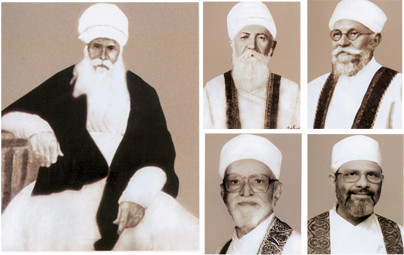
Five generations of Mirza family (clockwise, from top), Dasturs Burjorji, Peshotanji, Kayoji, Peshotan and his father Hormazdyar
Kirdir, the notorious kingmaker, makes his appearance in James Russell’s article on that third century prelate — almost a Pope! — but now through Armenian texts of far later centuries. The gist of his paper focuses, via some hair-raising technical expressions, on the ewen mahr, the mystifying procedure through which Kirdir employed surrogates to visit the celestial regions. Was it, after all, just mirrors? Or was some shamanistic obfuscation added? Kirdir was much the shrewd operator — a real braggadocio! — and his visionary journey into the spirit world was notably at second hand.
It is with Faribourz Nariman’s eulogy of Hormazdyar as honorand that we close this clerical section. For Nariman, it appears necessary to tilt yet again at the windmills of anti-traditionalism and anti-ritualism, skirting around Mirza’s own refreshed thoughts on several liturgical and socioreligious matters upon which this reviewer can personally vouch. This in no way detracts from Hormazdyar’s stature, and it would be no exaggeration to declare that we shall never see his like again.
Fire and water are the liturgical cornerstones of Zoroastrian worship. James Boyd and Ron Williams "Ritual Use of Fire” brings in, amongst others, the fire rituals of East Asia and Shinto in particular where aesthetics and theatricality inform and enhance worship. A Buddhist-Mazdaic syncretism is suggested by Nicholas Sims-Williams in his interpretation of the Kara-Tepe wall-painting where the Buddha figure is limned by two rows of fiery tongues, its later accompanying inscription reading boddo-mozdo. Southern Uzbekistan has yet to yield further religious secrets.
Dr Sindhu Dange’s "The Cult of River Worship” ingeniously parallels Vedic and Avestic river lore. Her view that Aredvi is "holy” is somewhat restrictive, for it has firm connotations of Moist and Flowing (cf. Rasa). Our river deity’s full epithets contain the giveaway Anahita, generally understood to mean "undefiled,” and Dange’s aside on the pious immersion of dar-ni pori does conflict in practice. The Aban Yasht is usefully invoked; the Tir, as in its §§ 4–7, is not, nor are §§ 4–8 and 9–11 of the Fravardin Yasht to substantiate her fine argumentation. We miss the Egyptian connexion with Tir, the asterism whose unfailing regularity of heliacal rising led to the reverence for the river goddess(es), as much in Iran as in Egypt.
The stellar connexion preoccupies Gernot Windfuhr’s bright lit essay on Ashi, the paradigm of reward, and her chariot Auriga, where we do find Tir among the other pertinent Avestic texts. His use of the Yashts is exemplary for the astronomical and celestial association with the worshipful beings from the Zoroastrian pantheon. For those who scan the heavens, they will find in these true enrichment of their prayers. We must leave them to their astrolatry.
Tree and plant motifs figure respectively in Anders Hultgard’s comparative study "The World Tree ....” and in Martin Schwartz’s technically dazzling demonstration of the true identity of the maidenhair fern. The Hultgard item takes us into mythic realms where the Zoroastrian cosmic/world tree with its myriad healing seeds is viewed through the Bundahishn, the Wahman Yasn and the Zadspram anthology. The Scandinavian counterpart, Yggdrasil, "the large awe-inspiring tree,” is studied through the Eddic Grimnismal and the "prophetic” Voluspa. Those captivated by comparative mythology will be greatly rejoiced, for its ramifications spread afar.
M. A. Mehendale’s short piece on the Avestan Upairi Kairya likewise suggests the highly-working activity of the fravashis, those "angelic” protectors of the living. Not discussed is the short, sharp assertion from the Fravardin Yasht that the fravashis of the living are more powerful than those of the departed. We agree Mehendale’s "wandering about” with the Avestan "moving about.” The good Zoroastrian’s activities are indeed intended to be far-ranging.
Richard Frye’s piece puts us right about Cyrus and Cambyses — as Kurosh and Kambujiya – not being particularly Zoroastrian names; their religion too leaves room for doubt. The first true Achemenians, commencing with Darayavaush/Darius, and Khshayarsha/Xerxes were, above all, secular, although laying claim to Mazdayasna, not Zoroaster’s version of it. Were the Achemenians Zoroastrians? The answer has not yet been fixed: it is "in the realm of speculation.” Too right!
Dr T. N. Dharmadhikari has provided an intriguing analysis of the "Vedic Concept of Sraddha (Faith),” utilizing the Chhandogya Upanishad in the main for his argumentation. Parsis, now of long-standing residence in the Indian madarvatan (motherland), will be much exercised in following up their faith against the Hindu background.
In the Qisse-ye Sanjan the author Bahman (Sanjana) blesses the pious memory of his grandfather, a Dastur Hormazdyar too, thus: "May he rest in Paradise!... Because of his knowledge and wisdom in religious matters... he was also called the high priest of the Religion, and he guided everyone on the road to Piety… A hundred thousand blessings upon him!” And so we too close this summary of a lasting monument to the greatest high priest of modern times. May his pious soul be rejoiced!
◆ ◆ ◆
From the archive