
Religion
Golden glow - II
A lively session on rituals marked the afternoon panel discussion to commemorate the 50th anniversary of Delhi’s Kaikhushru Pallonji Katrak Dar-E-Meher
In the afternoon session titled "Zoroastrian rituals and relevance” chairperson Shernaaz Engineer spoke of how the Jam-e-Jamshed Weekly which she edits has a column titled "Tell me why.” The columnists try to explain the religion and its rituals to lay readers, she told the audience gathered on December 18 to commemorate the 50th anniversary of the Kaikhushru Pallonji Katrak Dar-E-Meher. Social forums such as the Delhi meet were crucial for this kind of dissemination of information. At weddings and navjotes the "religious significance is almost entirely lost,” she moaned. The challenge was to enjoy the trimmings while maintaining the essence of the ceremony.
Ervad (Dr) Ramiyar Karanjia, principal of the Dadar Athornan Institute, commented, "We never want to change. We want others to change.” The laity want prayers and ceremonies to be brief. He observed there was a mania to "shorten everything.” In the olden days one cooked on wood, then later gas, pressure cookers and finally microwave ovens. "If something takes two minutes, we are looking for ways to make it in one minute,” he stated.
Ervad (Dr) Ramiyar Karanjia, principal of the Dadar Athornan Institute, commented, "We never want to change. We want others to change.” The laity want prayers and ceremonies to be brief. He observed there was a mania to "shorten everything.” In the olden days one cooked on wood, then later gas, pressure cookers and finally microwave ovens. "If something takes two minutes, we are looking for ways to make it in one minute,” he stated.
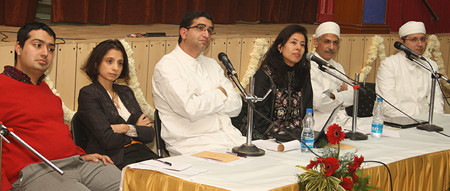
Rituals panelist from left: Dr Zubin Shroff, Freyan Panthaki, Dinyar Patel, Shernaaz Engineer, Ervads (Dr) Ramiyar Karanjia and Rohinton Sidhwa
If priests recommend a ritual, lay people accuse them of trying to extract money by doing so. "Mobeds are trying to fill their stomachs,” they allege. "Even Zoroaster performed rituals” as did his father, Karanjia said quoting texts. Consecration, jashan, navjotes were important rituals. There are different levels of rituals "such as inner and outer.” Certain ceremonies cannot be performed by any mobed. For example, Karanjia said he would not be qualified to perform the boi ceremony at the Iranshah Atash Behram. Only specified and qualified priests can do this. "Certain rituals only a priest can perform. Ladies can perform outer rituals. They can perform them at home.” Even for paramobeds there are rules and regulations.
People ask what is the need to go to an agiary when they can pray at home? Karanjia explained, "We go to the agiary because there is something special there: divine energy or khoré and the presence of divine beings. When a mobed prays an interaction is going on… when he touches the chamach to the sarposh (tray on the afarganyu which holds the atash and ash)…divine energy is transmitted. When two mobeds pray a mechanism is going on to draw that divine energy.” That energy enters the priest’s body and when the hamazori handshake is performed, the energy is exchanged between the priests.
"Rituals play an important role in preserving our scriptures... The mobeds use them to perform rituals… Rituals are the link between the physical and divine world.”
Noting that his knowledge of rituals and ancient languages was limited, Harvard PhD student Dinyar Patel offered instead a "historic understanding” of the roots of what is called the "orthodox divide” that took place around the 1850s. There was the formation of a reformist body which involved the founder of the Indian National Congress party Dr Dadabhai Naoroji. "Dadabhai was very closely involved with Parsi affairs. He was also a priest,” pointed out Patel.
As Naoroji was growing up the calendar controversy "was dying out.” The controversy over which calendar to follow had raged for almost 200 years, said the scholar. The issue had become a tussle between the priests of Iran and India as to who was right. The controversy gained importance because the rituals took place on specified dates and one had to know which calendar to follow. "The issue of reform within the community comes to the fore.”
The Reverend John Wilson had converted two Parsi youth to Christianity in the 1830s. "This sent shock waves through the community,” and the laity and clergy looked for ways to counter this new threat, said Patel. Some of the educated Parsis believed a "reformist element needed to be infused into Zoroastrianism.” At that time literacy among men was limited and almost non-existent among women. Naoroji cited this low literacy as one of the prime reasons for irreligious practices seeping into the religion and rituals.
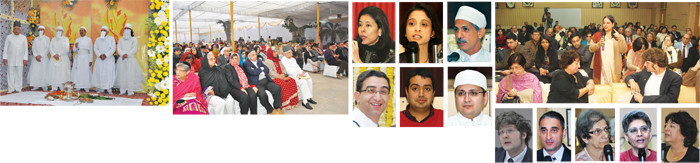
(From left) DPA president Dadi Mistry with priests performing jashan led by Delhi head priest Ervad Cawas Bagli; section of the audience attending the jashan ;Top row: Engineer, Panthaki, Karanjia and Kainaz Shroff (center addressing the audience); second row: Patel, Zubin Shroff, Sidhwa, Anton Zykov, Adil Nargolwala, Dr Ava Khullar, Shernaz Italia and Shahin Bekhradnia
Naoroji attempted to educate the community and slowly turned to the Gathas to explain the principles of the religion. In the 1850s a move to recite prayers in a language that was understood "never caught on,” observed Patel. Thus, despite attempts at reform, the rituals and practices still survived.
The question with reform is "how far do you want to go? Some people reduce the religion to a flame. They say it is not a religion but a philosophy. But Zoroastrianism is a 3,000-year-old religion. You can’t just dismiss this. You need to be knowledgeable” about the change you want to bring about, he said. Parsis consider themselves "a progressive and enlightened community.” Yet in the course of his research he found old documents "rotting away… we need to do a much better job to preserve” our heritage.
Panelist Dr Zubin Shroff, a PhD student at the Harvard School of Public Health asked Karanjia what purpose sitting in an agiary served if one did not understand the prayers or rituals. "There are times when you don’t need to understand things,” replied Karanjia. You just want to sit quietly, calmly. Cosmic forces, divine powers take over. We always want to think, think, think and that is a limitation… It is important to understand the prayers… Our prayers serve two purposes, informative and performance… Our prayers are mantras… some things you understand; some things you experience.”
Delhi Parsi Anjuman (DPA) trustee Ava Khullar referred to Beh-ram Panthaki, the presiding priest for the Washington community who, when performing a ceremony, explains the meaning of the prayers, rituals, etc. She believed an explanation would "not take away from the purity if there are interjections.”
Panthaki’s daughter, Freyan, who was on the panel, said she was "an atheist but I have a huge sense of belonging to the community… If there was any religion which I wanted to be a part of, Zoroastrianism would be it... It has a very simple philosophy that goes a long way… What I like about this religion is that there is no overarching body. The Bombay Parsi Punchayet (BPP), however, tries to be that… The strength of this community is that many of us with differing points of view are permitted to be part of it. Rituals exist but because something exists does not mean it is of value. It’s not a good enough reason for it to continue.”
She referred to the Washington community where discussions take place over which language should be spoken at functions, Persian, Gujarati or English? Finally all three are spoken and the program gets lengthened by three times! The religion itself "is not strong enough to unite the two communities.” She felt to experience divine energy, there was no need to stick to "a particular ritual.” Buddhists have chanting ceremonies, Hindus have their customs, "but I believe you could just as easily sit for half an hour in your living room or bedroom and achieve the same level of divine energy. It’s not the ritual that gets you there.”
Anton Zykov, an attaché at the Russian embassy who has studied Zoroastrianism said it is very hard to know what practices were there over a millennium ago. "The sources are very questionable when we speak of the early history of the Parsis. There are no earlier sources of the Parsi history before the Kisseh-i Sanjan. Contrary to what Dinyar said there have been enormous changes in the rituals.” He referred to the disposal of dead bodies in the Vendidad and the role of pall-bearers. The Rivayets, the written questions and answers exchanged between the priests of Iran and India, noted that the Zoroastrian rituals "have deteriorated in Hindustan.” Wooden biers were used for corpses which was anathema to the Iranian priests. In Iran bodies are being buried in accordance with the requirements laid down in the Avesta, he remarked.
DPA trustee Adil Nargolwala said that sometimes when he goes into the agiary he "feels the hair rise on the nape of my neck… I feel something different, something very nice.”
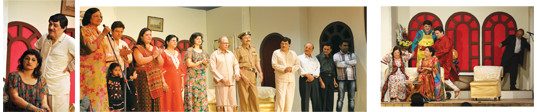
Scenes from Ghar, Ghungro ané Ghotalo performed by the Yazdi Karanjia drama troupe from Surat
"There are a lot of things which to me are disturbing. They keep youth away,” said PhD student Kainaz Shroff originally from Jamshedpur and now a Delhi resident. Noting that this was a thinking, questioning generation that wanted answers, she noted, "Just being told you have to wear a sudreh-kusti or you have to go to the agiary doesn’t mean squat for any of us… If you have certain very barbaric customs like not allowing girls to go to the agiary when they are in their period… I feel if I am segregated from a place for one-fourth of the month why should I go there the other three weeks? When you have a jashan and you distribute fruit to say three people and keep it away from four other people who are sitting over there — these are just segregative and wrong practices. Are these practices relevant today? Do we need to keep non-Parsis out of our rituals? Do we not need to understand what we are praying?”
"There are certain things in the religion which you have to have faith in,” replied Karanjia. "You have to start believing in things spiritual.” He added that barring women during their menses was not "barbaric… Across all religions the idea of menstruation is there. During certain periods a lady has to be segregated… anything oozing out of the body makes the body unclean to a certain extent.” The contamination may not only be physical, it can also be spiritual.
"Much of what we are saying is canon law is not enshrined in the history of our religion,” said Shahin Bekhradnia, president of the World Zoroastrian Organisation. "I’m absolutely in favor of maintaining tradition… I love ritual… I was told by one of the Parsi British scholars that if I walked into a room and I was menstruating, the milk would curdle and that was proof of how polluted my aura was. She attributed the segregation to a time when women did not have sanitary towels or were too poor to afford them so they opted to be separate so as not to have the embarrassment of oozing in public. The standards of hygiene have improved and "now we do not have that problem… I don’t subscribe to the theory of my blood curdling milk. (applause)”
The session was followed by a jashan to which as DPA volunteer Shernaz Italia stated, "All our non-Parsi friends are welcome.” She bemoaned the fact that though "all of us have gone to mosques and mandirs, none of our non-Parsi friends can come” into our fire temple.
As a result of non-Parsis being present at the jashan, Dastur (Dr) Firoze Kotwal, Dastur Khurshed Dastoor and Karanjia sat in the Dharamshala dining room rather than be present for the prayers performed by four mobeds, Ervads Rohinton Sidhwa, Sam Lashkari, Rukshad Panthaki and Nowshirwan Pirojshaw Dastoor led by Ervad Cawas Bagli, head priest of the Katrak Dar-E-Meher.
A rib-tickling Gujarati drama, Ghar, Ghungro ané Ghotalo (house, anklet of metalic bells and mix-ups) was performed by the Yazdi Karanjia drama troupe from Surat which was followed by a dinner.
To be continued
◆ ◆ ◆
From the archive