
Cover Story
Golden glow
The Kaikhushru Pallonji Katrak Dar-E-Meher in Delhi celebrated its 50th anniversary with a two-day program
For 50 years the Kaikhushru Pallonji Katrak Dar-E-Meher has served as a beacon of light and faith for the Zoroastrians of Delhi. Safely ensconced in a close to two-acre complex flanked by the Delhi Parsi Anjuman’s (DPA) dharamshala, community hall and aramgah, the one-storey structure is the only fire temple in India to permit non-Parsi Zoroastrians to worship.
Noting the 700 or so strong Delhi Parsis "are blessed,” DPA president Dadi Mistry told the august gathering on December 19, 2011 "we want (the DPA) to be the most forward looking (anjuman) of its time. We want to keep intact Zoroastrian values and culture... Ethics are the binding force that keep the community together.”
The DPA had organized a two-day meet with talks, discussions, prayers and entertainment on December 18 and 19 to mark the Dar-E-Meher’s golden jubilee. On the morning of December 18 Mistry mentioned that some of the people present were also there when the Dar-E-Meher "was consecrated on Ardibehesht roz, Amardad mah, 1331 AY.”
Noting the 700 or so strong Delhi Parsis "are blessed,” DPA president Dadi Mistry told the august gathering on December 19, 2011 "we want (the DPA) to be the most forward looking (anjuman) of its time. We want to keep intact Zoroastrian values and culture... Ethics are the binding force that keep the community together.”
The DPA had organized a two-day meet with talks, discussions, prayers and entertainment on December 18 and 19 to mark the Dar-E-Meher’s golden jubilee. On the morning of December 18 Mistry mentioned that some of the people present were also there when the Dar-E-Meher "was consecrated on Ardibehesht roz, Amardad mah, 1331 AY.”
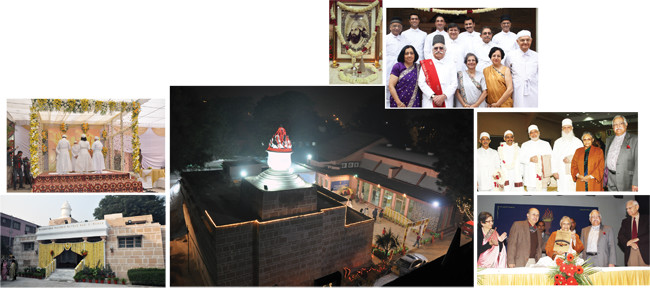
(Clockwise from top right) trustees of the Delhi Parsi Anjuman from left (1st row) Niloufer Shroff, Dadi Mistry, Ava Khullar, Veera Mavalwala and Yezad Kapadia; (2nd row) Marazban Zaiwala, Aspi Sagar, Adil Nargolwala, Rohinton Sidhwa, Navroze Dhondy, Kavas Kapadia and Yezdi Pithawala; Sheila Dixit and Dadi Mistry with (from left) Ervads (Dr) Ramiyar Karanjia and Cawas Bagli and high priests Khurshed Dastoor and Dr Firoze Kotwal; launch of Deepanjali by Dixit with (from left) Khullar, Novy Kapadia, Mistry and Yezad Kapadia ; Evening jashan and overview of agiary complex
Introducing the chief guest, the chief minister of Delhi Sheila Dikshit, Mistry termed her "a great friend of the Zoroastrian community in Delhi.” Addressing "the wonderful members of the Parsi community in Delhi,” Dikshit congratulated them on the jubilee… Before I had not noticed but today the brightness of the ambience around here is beautiful. (I hope this) becomes an iconic place to visit.” Noting the Parsis were "admired, loved and respected,” she added she "had not heard of Parsis involved in any scams” (applause). Some of her "best friends are Parsis” and she admired the "humaneness above all” of the community members. "You have really adapted yourself very well. You have enriched India.” Aside from admiring the sari borders worn by the ladies that day, she mentioned the ubiquitous "Godrej cupboards in each of our homes.”
DPA joint secretary Veera Mavalwala told the gathering that guest of honor Dr Karan Singh was unable to be present on account of ill-health. "We really miss his remarkable contribution to all spheres of national life.” Singh sent a message in which he noted, "Fire is sacred to most religions and especially to Hinduism where there are numerous Vedic hymns to Agni, and where the sacred fire is the messenger between the human and the divine.”
Messages had also been received from the President of India Pratibha Patil, the Chief Justice of India Sarosh Kapadia and Congress party president Sonia Gandhi amongst others. Nergish Mistry read out the messages. Kapadia noted, "On this auspicious occasion the first need is to resuscitate our faith. Without faith, humanity loses its moorings on the bedrock of religion. Faith is the basis of all assumptions, be it in the world of science, economics or philosophy. If so, why not in religion?
"Our priests, who have tended and protected atash padshahs for hundreds of years, deserve the undying gratitude of the laity.”
Gandhi noted, "For the past 50 years, the holy fire has been spreading its blessings, its purity, fragrance and warmth over our capital, and I pray that it will continue to do so in perpetuity.
"The construction of the temple in 1961 was a labor of devotion and love on the part of all those involved, and today it stands as a tribute to the generous philanthropy, the strong community spirit and determination that is characteristic of the Parsi community. Typically too, the temple was made ready in record time, without compromising on quality or aesthetics. Ever since its consecration on December 31, 1961, it has provided solace and guidance to the members of the Delhi Parsi Anjuman, binding them together, keeping alive their distinctive faith, rituals and celebrations.
"The Parsi community and the Zoroastrian faith is a shining jewel in the mosaic that is Indian culture. All Indians are immensely proud of our Parsi community, of the values that they epitomize in their daily lives, and of their rich contributions to every aspect of national life.”

From left Dixit with Anton Zykov, Shahin Bekhradia, Dinshaw Mehta and Mistry; Yezad Kapadia, Dastoor, Dr Shernaz Cama and Kotwal; Roshan Dandiwala reciting a monajat after the evening jashan; Havovi Dastoor, Nergish Mistry, Pansy Mehta and Shernaaz Engineer
Changing roles
Stating it was "a fitting tribute” to start the two-day proceedings with a panel of priests, session chairperson Dr Shernaz Cama noted, "because of the priesthood Zoroastrianism has survived.” The role of the clergy "has changed in every religion, extremely so in ours… the Christian priesthood reinvented itself. Priests became pastors, counselors. Is this what we need: a pastor, confidante and guide? Or do we need hamazori, a spiritual handshake or a spiritual connection?… What is the role of the priest today?”
Dastur (Dr) Firoze Kotwal, former High Priest of the H. B. Wadia Atas Bahram who was present at the Katrak Dar-E-Meher’s consecration remarked, "The ultimate aim of priestly duty is to work towards destroying the evil forces through prayer and ritual practice and to help community members to stay on the path of righteousness in order to attain blessings in the final existence…
"The word ‘pastor’ is derived from Latin ‘pastus’ which means ‘to feed’ and in a sense a pastor who is in charge of a parish has the duty to feed his parishioners with spiritual food and take care of their souls…
"The Zoroastrian Iranian counterpart of parish is termed as Husht or Hust, meaning a diocese, which a priest serves for a particular period of time with the permission of the High Priest, the Dastur Dasturan of Yazd. It is enjoined in the religion that one-tenth of a person’s income should be given to the High Priest for maintaining and sustaining religious institutions. However, the Irani priests of the past complained not too infrequently that this injunction had not been carried out by the Zoroastrians of Iran. Thus it is not surprising that priests and priestly institutions in Iran have over time gone into decline…
"The Parsi term panthak approximates well in meaning with Husht... In earlier times the priests were sent to various diocese or panthaks by their respective anjumans to cater to the religious needs of the Parsis who were not in a position to pay their priest properly. For example, in 1721 CE the devout behdins of Mahuva could not pay an annuity of Rs 32 to their mobed. Hence, they approached the Bhagarsath anjuman of Navsari and requested them to reduce the amount to Rs 21 annually…
"On the other hand there is a historical example of a grand gesture by the mobeds of Gundevi in 1733 CE who voluntarily divided the village clientele into four classes in order to fix rates for ceremonies, viz awwal (wealthy), doum (middle class), narash (poor) and nadar (extremely poor). One must extend all praise to these large-hearted mobeds of yore who did not charge any money for ceremonies performed in memory of extremely poor Parsis. Despite such a meager payment the mobeds in the past lived a more contented and happy life than their present counterparts since they were regularly paid in kind and invited to participate in sacrificial repast on all feast days and death anniversaries…
"In the Avestan scriptures, a Zoroastrian priest is called an athravan which means ‘protector of fire’ from where we get the modern Gujarati term athornan for a priest...
"There is a great concern among the prudent, well-meaning Parsis that something concrete should be done to save the priestly class which is in danger of extinction, and unless each one of us commits ourselves to doing something concrete and tangible for the priesthood we will be eventually endangering our community, our way of life and our ancient faith…
"Fifty years ago I had the honor to consecrate the holy fire jointly with one of the boiwalas of the Anjuman Atash Behram, Bombay, mobed sahib Khurshed Erachji Desai. The ‘aalaat’ was brought from Bombay by road from the Anjuman Atash Behram and the fire was consecrated therefrom. All preparations for the consecration of the fire were superbly made by the then panthaky, Ervad Darius Erachshah Bagli, with full support of the then DPA president Shiavax Nargolwala, and under the guidance and leadership of the late Dastur (Dr) Hormazdiar Kayoji Mirza of Udvada,” Kotwal concluded.
Dastur Khurshed Dastoor, High Priest of Udvada, recalled that his father Dastur Kaikobad had consecrated the Delhi Dar-E-Meher along with others. Speaking of the need for tolerance and compassion he referred to the term hamazori, "a beautiful concept we have forgotten.” Hama means together and zor means strength. "United in spiritual harmony” is how Dastoor interpreted the word.
Stating it was difficult to put it into practice due to people’s ego and personal sense of right and wrong, the High Priest said, "Hamazori works at three different levels.” The first was personal — empathy towards one’s fellow men and women or "tolerance” of others, forgiveness. The second is cosmic, connecting to and respecting nature, the earth, plants, etc, and the third is celestial, spiritual ties with God, the Yazads, the Amesha Spentas, etc. He referred to the handshake during the jashan ceremony, symbolic of harmony and brotherhood.
He called on the community to respect one another and even those who are unable to speak up for themselves. Peace moved in concentric circles from the individual to society to the world at large. "It would then be difficult to hate anyone” because it would be akin to hating oneself. If one extended love one received love, so also with hate. He likened the concept to the oft used phrase referring to data entered in computers — "garbage in, garbage out.”
"The Zoroastrian concept of salvation is (envisioned) as a collective event,” Dastoor noted. Everyone would be resurrected together, "not only human beings but all other creatures.” This was hamazori at its finest.
Ervad Yezad Kapadia who has "a science background” and a "distinguished career with Tatas, Tata Steel,” has also served on the board of several Indian and German companies, observed Cama. He is the vice president of the DPA and "may have a different approach from other priests in trying to bring Zoroastrians back to the faith,” she remarked.
Stating that he had observed a correlation between a person’s level of faith and economic well-being, Kapadia noted, "The more affluent one is, the less one relies on religion.” In Iran where Zoroastrians suffered "centuries of persecution and humiliation” their religious ties were "extremely strong.” The Zoroastrians there "had adapted themselves to circumstances… no religion can survive without adapting itself,” he emphasized. The induction of women priests in Iran is an example of this change.
The practices followed from his grandmother’s time such as carrying "loban around the house” or having a bath after attending funeral prayers or keeping women apart during menstruation "have fallen into disuse. Things we were doing in the past need to change.”
On his visits to Oslo, St Petersburg and elsewhere he said, "It was a great joy to meet one’s fellow coreligionists” and though they may speak different languages, bonds formed. He noted in the past when Zoroastrianism was the state religion of an Iranian empire that extended from the "Mediterranean to the borders of undivided India” the practice of the religion could not have been identical in all these parts with their differing cultures and languages. "It had to be different,” he stressed.
The defining characteristic of Zoroastrianism is "freedom of choice; no diktats, no one to tell us to go to a church on Sunday or not eat meat on a Friday… no commandments.”
While granting "rituals were necessary,” he felt the role of rituals will be "diminished and more emphasis will be placed on being good human beings.” He noted that the Parsi population in India was decreasing and if the trend were not reversed, the community would "vanish.” One possibility to overcome this decline "is to adopt children from the community or even outside, bring them up as true Zoroastrians.” Almost 50 percent of the DPA members were married outside the faith. "Navjotes of such offspring should be encouraged and we should make them part of our religion (applause). Acceptance by free choice is a basic tenet of our religion.”
Regarding the priesthood, Kapadia believes the priest should visit the laity, "assimilate themselves into the community and assist the poor, the sick and the needy. They should not confine themselves to the precincts of the fire temple.” He recalled the past when they had an ailing Christian domestic assistant, her priest came every Friday to offer blessings. By involving themselves with the community, the role of the Parsi priest "would be much more relevant today.”
Stating it was "a fitting tribute” to start the two-day proceedings with a panel of priests, session chairperson Dr Shernaz Cama noted, "because of the priesthood Zoroastrianism has survived.” The role of the clergy "has changed in every religion, extremely so in ours… the Christian priesthood reinvented itself. Priests became pastors, counselors. Is this what we need: a pastor, confidante and guide? Or do we need hamazori, a spiritual handshake or a spiritual connection?… What is the role of the priest today?”
Dastur (Dr) Firoze Kotwal, former High Priest of the H. B. Wadia Atas Bahram who was present at the Katrak Dar-E-Meher’s consecration remarked, "The ultimate aim of priestly duty is to work towards destroying the evil forces through prayer and ritual practice and to help community members to stay on the path of righteousness in order to attain blessings in the final existence…
"The word ‘pastor’ is derived from Latin ‘pastus’ which means ‘to feed’ and in a sense a pastor who is in charge of a parish has the duty to feed his parishioners with spiritual food and take care of their souls…
"The Zoroastrian Iranian counterpart of parish is termed as Husht or Hust, meaning a diocese, which a priest serves for a particular period of time with the permission of the High Priest, the Dastur Dasturan of Yazd. It is enjoined in the religion that one-tenth of a person’s income should be given to the High Priest for maintaining and sustaining religious institutions. However, the Irani priests of the past complained not too infrequently that this injunction had not been carried out by the Zoroastrians of Iran. Thus it is not surprising that priests and priestly institutions in Iran have over time gone into decline…
"The Parsi term panthak approximates well in meaning with Husht... In earlier times the priests were sent to various diocese or panthaks by their respective anjumans to cater to the religious needs of the Parsis who were not in a position to pay their priest properly. For example, in 1721 CE the devout behdins of Mahuva could not pay an annuity of Rs 32 to their mobed. Hence, they approached the Bhagarsath anjuman of Navsari and requested them to reduce the amount to Rs 21 annually…
"On the other hand there is a historical example of a grand gesture by the mobeds of Gundevi in 1733 CE who voluntarily divided the village clientele into four classes in order to fix rates for ceremonies, viz awwal (wealthy), doum (middle class), narash (poor) and nadar (extremely poor). One must extend all praise to these large-hearted mobeds of yore who did not charge any money for ceremonies performed in memory of extremely poor Parsis. Despite such a meager payment the mobeds in the past lived a more contented and happy life than their present counterparts since they were regularly paid in kind and invited to participate in sacrificial repast on all feast days and death anniversaries…
"In the Avestan scriptures, a Zoroastrian priest is called an athravan which means ‘protector of fire’ from where we get the modern Gujarati term athornan for a priest...
"There is a great concern among the prudent, well-meaning Parsis that something concrete should be done to save the priestly class which is in danger of extinction, and unless each one of us commits ourselves to doing something concrete and tangible for the priesthood we will be eventually endangering our community, our way of life and our ancient faith…
"Fifty years ago I had the honor to consecrate the holy fire jointly with one of the boiwalas of the Anjuman Atash Behram, Bombay, mobed sahib Khurshed Erachji Desai. The ‘aalaat’ was brought from Bombay by road from the Anjuman Atash Behram and the fire was consecrated therefrom. All preparations for the consecration of the fire were superbly made by the then panthaky, Ervad Darius Erachshah Bagli, with full support of the then DPA president Shiavax Nargolwala, and under the guidance and leadership of the late Dastur (Dr) Hormazdiar Kayoji Mirza of Udvada,” Kotwal concluded.
Dastur Khurshed Dastoor, High Priest of Udvada, recalled that his father Dastur Kaikobad had consecrated the Delhi Dar-E-Meher along with others. Speaking of the need for tolerance and compassion he referred to the term hamazori, "a beautiful concept we have forgotten.” Hama means together and zor means strength. "United in spiritual harmony” is how Dastoor interpreted the word.
Stating it was difficult to put it into practice due to people’s ego and personal sense of right and wrong, the High Priest said, "Hamazori works at three different levels.” The first was personal — empathy towards one’s fellow men and women or "tolerance” of others, forgiveness. The second is cosmic, connecting to and respecting nature, the earth, plants, etc, and the third is celestial, spiritual ties with God, the Yazads, the Amesha Spentas, etc. He referred to the handshake during the jashan ceremony, symbolic of harmony and brotherhood.
He called on the community to respect one another and even those who are unable to speak up for themselves. Peace moved in concentric circles from the individual to society to the world at large. "It would then be difficult to hate anyone” because it would be akin to hating oneself. If one extended love one received love, so also with hate. He likened the concept to the oft used phrase referring to data entered in computers — "garbage in, garbage out.”
"The Zoroastrian concept of salvation is (envisioned) as a collective event,” Dastoor noted. Everyone would be resurrected together, "not only human beings but all other creatures.” This was hamazori at its finest.
Ervad Yezad Kapadia who has "a science background” and a "distinguished career with Tatas, Tata Steel,” has also served on the board of several Indian and German companies, observed Cama. He is the vice president of the DPA and "may have a different approach from other priests in trying to bring Zoroastrians back to the faith,” she remarked.
Stating that he had observed a correlation between a person’s level of faith and economic well-being, Kapadia noted, "The more affluent one is, the less one relies on religion.” In Iran where Zoroastrians suffered "centuries of persecution and humiliation” their religious ties were "extremely strong.” The Zoroastrians there "had adapted themselves to circumstances… no religion can survive without adapting itself,” he emphasized. The induction of women priests in Iran is an example of this change.
The practices followed from his grandmother’s time such as carrying "loban around the house” or having a bath after attending funeral prayers or keeping women apart during menstruation "have fallen into disuse. Things we were doing in the past need to change.”
On his visits to Oslo, St Petersburg and elsewhere he said, "It was a great joy to meet one’s fellow coreligionists” and though they may speak different languages, bonds formed. He noted in the past when Zoroastrianism was the state religion of an Iranian empire that extended from the "Mediterranean to the borders of undivided India” the practice of the religion could not have been identical in all these parts with their differing cultures and languages. "It had to be different,” he stressed.
The defining characteristic of Zoroastrianism is "freedom of choice; no diktats, no one to tell us to go to a church on Sunday or not eat meat on a Friday… no commandments.”
While granting "rituals were necessary,” he felt the role of rituals will be "diminished and more emphasis will be placed on being good human beings.” He noted that the Parsi population in India was decreasing and if the trend were not reversed, the community would "vanish.” One possibility to overcome this decline "is to adopt children from the community or even outside, bring them up as true Zoroastrians.” Almost 50 percent of the DPA members were married outside the faith. "Navjotes of such offspring should be encouraged and we should make them part of our religion (applause). Acceptance by free choice is a basic tenet of our religion.”
Regarding the priesthood, Kapadia believes the priest should visit the laity, "assimilate themselves into the community and assist the poor, the sick and the needy. They should not confine themselves to the precincts of the fire temple.” He recalled the past when they had an ailing Christian domestic assistant, her priest came every Friday to offer blessings. By involving themselves with the community, the role of the Parsi priest "would be much more relevant today.”
Priests "forgotten”
During the question answer session Dastoor observed that in Udvada the priests do not charge for the first four days’ funerary prayers for anyone who expires in that town. In Navsari the priests go to assist when called. In Dadar, principal of the Athornan Institute Ervad (Dr) Ramiyar Karanjia is often called to help families. "When people are sick he goes and prays for them.” But the High Priest added in contrast "the laity has forgotten the priests completely.” He observed at weddings at Colaba agiary, families spend lakhs of rupees on the flower decorations, pay thousands of rupees to the photographers, Rs 10,000 to Rs 15,000 to the person who drapes the saris, but the priest performing the ceremony "gets Rs 1,500.”
He said all the mobed schemes mooted by the various anjumans were there "only for the show.” He said people expected the priests to perform their duties free of charge. "We are prepared. But who will look after our children?” When his father required surgery for his knee, he told his son he could not undergo the operation "because ‘I don’t have that much money.’ He had to appeal to charities. They gave Rs 2,000… Rs 5,000… We are ready to perform our duties. It is for you all to accept us and see to it that we also have a standard of living for ourselves.”
Cama recalled that when she was at the Meherji Rana library in Navsari, the late Dastur Meherji Meherjirana arrived there seated on the back of somebody’s bicycle! When priests go for medical check-ups, the doctors ask them if they are "heavy smokers;” the result of having to work closely with the sacred fires, she noted.
Dr Ava Khullar, a trustee of the DPA, said her maternal grandfather was the head priest of the Nagpur agiary. "In those days the sethias treated the priests with scant respect so he saw to it that three of his sons never became navar-martabs so that they would not take to the priesthood.”
Shernaz Italia spoke of the need to induct women priests. "Change is important for survival.”
Dastoor: "First take care of the male priests.”
Italia: "Women should have the option. It should be open to both.”
Dastoor agreed and noted that in many homes it was the women who recited prayers such as the farokshi and satum. He also observed the laity often wanted a male priest to pray as they had faith in him. People may not accept female priests easily.
Dr Homi Dhalla of the World Zarathushti Cultural Foundation noted that in the last 20 years the community had produced only three PhDs in Zoroastrian studies, namely himself, Ramiyar Karanjia and Ervad Rooyintan Peer.
To be continued
During the question answer session Dastoor observed that in Udvada the priests do not charge for the first four days’ funerary prayers for anyone who expires in that town. In Navsari the priests go to assist when called. In Dadar, principal of the Athornan Institute Ervad (Dr) Ramiyar Karanjia is often called to help families. "When people are sick he goes and prays for them.” But the High Priest added in contrast "the laity has forgotten the priests completely.” He observed at weddings at Colaba agiary, families spend lakhs of rupees on the flower decorations, pay thousands of rupees to the photographers, Rs 10,000 to Rs 15,000 to the person who drapes the saris, but the priest performing the ceremony "gets Rs 1,500.”
He said all the mobed schemes mooted by the various anjumans were there "only for the show.” He said people expected the priests to perform their duties free of charge. "We are prepared. But who will look after our children?” When his father required surgery for his knee, he told his son he could not undergo the operation "because ‘I don’t have that much money.’ He had to appeal to charities. They gave Rs 2,000… Rs 5,000… We are ready to perform our duties. It is for you all to accept us and see to it that we also have a standard of living for ourselves.”
Cama recalled that when she was at the Meherji Rana library in Navsari, the late Dastur Meherji Meherjirana arrived there seated on the back of somebody’s bicycle! When priests go for medical check-ups, the doctors ask them if they are "heavy smokers;” the result of having to work closely with the sacred fires, she noted.
Dr Ava Khullar, a trustee of the DPA, said her maternal grandfather was the head priest of the Nagpur agiary. "In those days the sethias treated the priests with scant respect so he saw to it that three of his sons never became navar-martabs so that they would not take to the priesthood.”
Shernaz Italia spoke of the need to induct women priests. "Change is important for survival.”
Dastoor: "First take care of the male priests.”
Italia: "Women should have the option. It should be open to both.”
Dastoor agreed and noted that in many homes it was the women who recited prayers such as the farokshi and satum. He also observed the laity often wanted a male priest to pray as they had faith in him. People may not accept female priests easily.
Dr Homi Dhalla of the World Zarathushti Cultural Foundation noted that in the last 20 years the community had produced only three PhDs in Zoroastrian studies, namely himself, Ramiyar Karanjia and Ervad Rooyintan Peer.
To be continued
◆ ◆ ◆
From the archive