
Religion
Golden glow - III
Union minister Salman Khurshid praises the liberal approach of the Delhi Parsis at the closing of the two-day celebrations to mark the Katrak Dar-E-Meher’s 50th anniversary
The tall, affable minister of legal affairs Salman Khurshid and his wife Louise Fernandes were at home with the genial Parsis of the country’s capital. "I look forward to the food you will be serving. I starve myself for a couple of days before I come here,” the lanky, white haired, St Stephen’s College and Oxford educated politician remarked jocularly. "It’s sad there are so few of you,” he told the large audience gathered at the Delhi Parsi Anjuman’s (DPA) Pirojsha Godrej Cultural Center hall to celebrate the 50th anniversary of the Kaikhushru Pallonji Katrak Dar-E-Meher on the concluding night of December 19, 2011. He urged them to have "a common minimum program” to increase their population. The two-day festivities were kicked off the day before with a visit by the Delhi chief minister Sheila Dikshit.
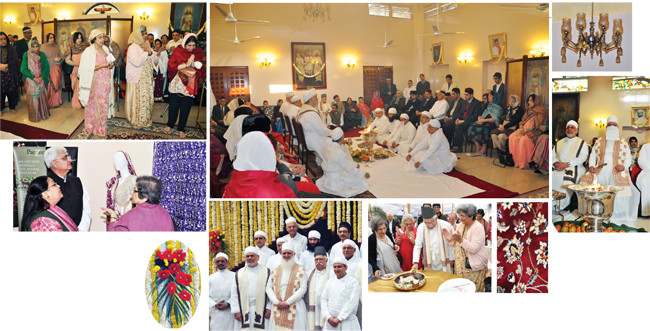
Clockwise from top left: prayers in agiary led by Roshan Dandiwala following jashan; jashan in progress; chandelier in agiary; Dasturs (Dr) Firoze Kotwal and Khurshed Dastoor; carpet design; Nergish and Dadi Mistry celebrating birthday and Ava Khullar; priests who performed jashan with Mistry; Salman Khurshid and wife Louise Fernandes viewing artifacts at exhibition
Some of the photographs published in the three installments have been provided by the Delhi Parsi Anjuman, Navroze Dhondy and Navroz Behramfram
Commenting on the exhibition of garas and other embroidered works and artifacts on display on the second floor of the Dharamshala in The Noshir Jungalwalla Hall, Khurshid encouraged the gathering to "set up a full-fledged museum of Zoroastrian culture.” He found the embroidery reflected the artisans’ "dedication and attention to detail. I really respect Zoroastrian and Parsi culture.”
Referring to India, the minister noted, "All of us are enlightened, liberal and open-minded. Our institutions have served the country well, served democratic purposes. It is very easy to override the aspirations of people who are not vocal. (Their voices) are drowned by others. Democracy is not only about numbers (though it is) mainly numbers.” The democratic "framework has to (deal) with morality. Laws that are not in consonance with morality are difficult to sustain.”
Referring to the moral base underlining religious belief, Khurshid observed, "In some minority communities there are too many priests — in some like yours, too few.” He believed the priesthood and the rest of the community "have not responded to change as fast as the DPA has. You must find the right balance between your intrinsic values and opening the doors for others to come in.”
Amongst interfaith married couples, his observation was "the Parsi (spouse’s) influence is more.” In conclusion he went on to state, "You as a community are a great institution. I pay my tribute to the most outstanding people. (You have) beautiful, wholesome traditions. Keep them alive.”
In his welcome address, DPA president Dadi Mistry referring to the minister as "aapro (our) Salman,” said, "Whenever he is invited he always finds time” to come. Mistry noted that the Delhi Parsis "were moving in the opposite direction to the Bombay Parsis who have very closed minds. (Delhi) had taken the leadership in opening up without conflicting with any community laws. We hope Delhi will continue its leadership role.”
He was referring to the DPA permitting children of Parsi women married to non-Parsis entry to the Anjuman’s dadgah. The board at the entrance of the agiary states entry is permitted to Zoroastrians and not "Parsi Zoroastrians” as is the case in the rest of India. The Privy Council judgment in the Saklat vs Bella case empowered the trustees if they so wished to permit non-Parsis to enter the Rangoon fire temple. The Karachi anjuman has also permitted entry to the children of Parsi women married to non-Parsis citing the judgment. In Iran, entry to the fire temples is open to all.
The DPA had invited an Iranian high priest and a woman mobedyar to the two-day festivities but they "did not get their visas in time,” lamented Mistry.
DPA trustee Adil Nargolwala thanked Khurshid for "endorsing that Delhi are the leaders for change.”
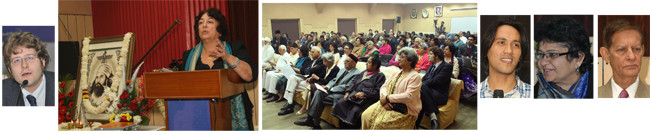
From left: Anton Zykov, Shahin Bekhradnia, section of the audience, Dr Reza Hosseini, Savita Bhandari and Dr Homi Dhalla
Irani and Parsi views
The second day festivities started with a jashan in the Dar-E-Meher premises performed by High Priests Dasturs (Dr) Firoze Kotwal and Khurshed Dastoor, DPA trustee Ervad Yezad Kapadia and Ervads Ramiyar Karanjia, Cawas Bagli, head priest of the Katrak Dar-E-Meher, Rohinton Sidhwa, Sam Lashkari, Rukshad Panthaki and Nowshirwan Dastoor.
Following the jashan a panel discussion was held on "The Persian Homeland: Perspectives” chaired by Anton Zykov, Weidenfeld scholar, Oxford and attache, Embassy of Russia in India. Zykov had written an MPhil thesis titled "Corpse-bearers (nassessalars) in the Zoroastrian communities of India and Iran” in which he noted, "We assume that one of the reasons for the low social status of the nassessalars is likely to be caused by the fact that many of the nassessalars from the beginning of the 20th century were the descendants, fully or partly, of the Zoroastrian converts from the nassessalars outcaste group, known as halalkhor, that were embraced into Zoroastrianism in the second half of the 18th century.” He noted in Iran today "religious freedom is only within the four walls: of one’s residence” or community halls.
The first speaker was Shahin Bekhradnia, president of the World Zoroastrian Organisation (WZO) who spoke on "Some differences between Iranian Zoroastrian and Parsi practices and beliefs.” As she had delivered a similar talk before the Association of Inter-Married Zoroastrians (AIMZ) on December 21, 2011 in Bombay, sections of which were published in Parsiana (March 7, 2012), we reproduce here other portions.
"Poverty and desperation drove Iranians to India between the mid 19th and early 20th centuries and since so doing, they have lost most of their ties with Iran, successfully integrating into mainstream Parsi culture,” noted Bekhradnia. Following this migration the newcomers "are really not Iranis at all and no longer think like Iranian Zoroastrians,” she claimed. Many no longer speak Farsi and do not have close ties with Iran.
She queried, "When there is such an evident sentimental respect for Iran as the fount of all inspiration, (why) is the Iranian tradition so ignored and undiscussed among Parsis and why have they assumed the high ground in terms of religious authority? (Parsis) speak as if they alone have a monopoly on Zoroastrian identity… Why is it difficult to understand that a Parsi is just one of the several groups of Zoroastrians which exist today just as the Christian church has many sub-divisions such as Catholics, Methodists, Orthodox, Anglican, etc? It is in fact one of many Zoroastrian cultures.”
At a youth congress in California in 1993 a senior Bombay mobed who was a guest of honor was questioned why the Iranian traditions were so divergent on their approach to mixed marriages. He replied, "The Iranian mobeds were ignorant and lacking in scholarship.” This sentiment was echoed by "a speaker at the Eighth World Zoroastrian Congress well known for his conservative views,” who told the audience that "the Iranian mobeds lacked education and knowledge.”
When the Iranian Zoroastrians’ numbers were less than the Parsis’, the Parsi voice "dominated… More importantly Parsis have had the advantage of being raised in an English speaking environment in India/Pakistan. In contrast, until the Islamic revolution compelled whole families to leave Iran, Iranians did not have a large number who were fluent and competent to present their point of view in English at international academic circles, at conferences, in international publications or with foreign governments or international agencies so their voice was not heard and the doctrinal differences were not appreciated…
"(Today) with so many Iranian Zoroastrians living in North America and Europe for so many years, where they have acquired mastery over the English language, the time has indeed come for the Iranian voice to be heard, understood and respected.”
She referred to the Rivayats, questions and answers exchanged between the priests in Iran and India starting around the 15th century. The clergy in India desired to know the customs and practices of the Zoroastrians in Iran so they could incorporate them in India. "The responses from the Iranian priests on these occasions and all future exchanges right up till the last visit in the late 18th century constantly confirm the views of the Zoroastrian clergy of Iran that it is right, proper and meritorious and fully in the spirit of the message of Zoroaster that our faith should welcome those who have chosen of their own free will to heed the message of our religion…
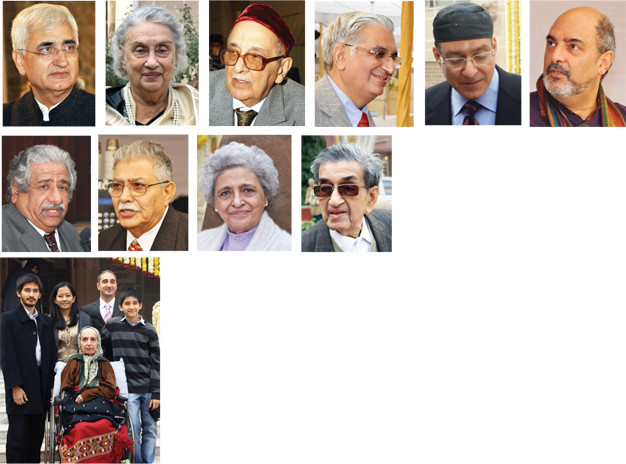
Prominent faces at celebrations: (from left, top row) Salman Khurshid, Bhicoo Manekshaw, Fali Nariman, Drs Noshir and Cyrus Shroff and Dadi Pudumjee; (second row) Dinshaw Mehta, Keki Gandhi, Dhun Bagli and Rustom Gae; (below) former DPA trustee Nergish Nargolwala (seated) with Adil and Rinchen Nargolwala and family
"We have always welcomed into our community a spouse from a different background and naturally the children of such unions. A similarly welcoming approach applies to children who are adopted of non-Zoroastrian birth and who are raised within a Zoroastrian household to go on to marry within the community. Our priests have never had a difficulty with this matter and have only refused to conduct such marriages if it is evident that problems will arise from such a union — a view voiced back in 1599 in the Mahyar Kaus Rivayat. We certainly find it quite inhumane and unnatural that some Parsis are so dogmatic as to prefer to reject their own children and grandchildren by cutting off relations with them rather than using the Zoroastrian qualities of wise thinking to accommodate them into the community.”
Regarding the disposal of the dead she noted that use of the Towers of Silence was given up around the 1950s. "As cremation became available, many Iranians opted for this sort of disposal rather than putrefaction within the earth which was seen as un-Zoroastrian since the earth was provided to give forth life-sustaining crops and flowers, etc. There was no question of defilement of fire as nothing can defile something which is inherently self purifying by its very nature.”
Bekhradnia noticed the shift in funerary practices "was not resisted by the majority and clearly did not cause major trauma for the community” unlike the approach by the Parsis in India. "Even though the dakhmas in Bombay and other towns are now dangerously close to, if not in the midst of, urban populations and regularly give rise to embarrassing incidents of body parts dropping onto nearby residents’ properties” the practice of dakhmenashini continues.
"Iranians do not get very excited about whether the fire in their temples is fed by natural gas or sandalwood and recognize that if there is shortage of one material, then a sensible, rational solution must be sought through a new channel of thinking,” she noted.
Regarding the segregation of women during menstruation and the ban on their entering houses of worship Bekhradnia stated, "This mumbo jumbo is rejected and was not part of the Iranian tradition.” Modern day availability of sanitary towels changed people’s outlook "while at the same time modern gadgets reduced the physical fatigue of women.”
In conclusion she noted, "The loss of a few ritual practices, while retaining other traditions that have true meaning and retain the dynamic message does not diminish the distinct notions of identity and values which makes us Zoroastrian.”
The second speaker Dr Reza Hosseini, in his presentation on "Archaeological excavations in ancient Afghanistan” spoke of Zoroastrian artifacts and influences that existed in Afghanistan earlier.
"Create a balance”
The second panel discussion on ecology and Zoroastrianism was chaired by Parsiana editor Jehangir Patel. He cited statistics obtained from bawal wood dealer Farroakh Govadia. His family firm H. Sidhwa and Son in Bombay supply kathi to most of the agiaries and atash bahrams in Bombay and parts of southern Gujarat. On an average an agiary consumes six to seven tons of kathi in a year while an atash behram consumes around 50 tons, Govadia estimated; Iranshah utilizes around 60 tons per annum.
Two trees provide a ton of kathi, stated Govadia and estimated around 2,000 tons are consumed annually in fire temples all over India. This means 4,000 bawal trees are cut every year. A bawal tree takes 15 years to grow to maturity. On a plot of 200 to 300 acres, 60,000 trees can be planted, enough to meet the community’s requirements in the years to come. Patel suggested that if wood is continued to be burnt in the fire temples, the least the community could do was to plant new trees.
Savita Bhandari, additional commissioner (landscape), Delhi Development Authority (DDA) spoke on "Delhi’s natural riches: protecting biodiversity in an expanding city.” She mentioned the DDA looked after 60 percent of Dellhi’s green area and had an annual budget of 120 crore rupees (US $ 24,000,000). DDA rendered "a noble service free of cost to the citizens.” Entry to the numerous city parks was without charge on the rationale "why charge people to breathe oxygen?” Personally though, she favored charging a token amount which would contribute towards maintenance and sustainability of the city’s green cover.
The DDA had to "fight against urbanization. Many times we lose the battle.” The building of roads, bridges and other infrastructure take precedence. "We have to create a balance.” Delhi has many ancient monuments but only a few are protected by the Archaeological Survey of India. The other relics are looked after by other agencies which may not be as well funded and staffed.
Delhi has two major, natural features, a river and the ridges. Preserving their ecology was essential. Biodiversity parks have been created in the city as a result of which much of the flora and fauna that had diminished or disappeared has returned. "The butterflies are returning… flowers are coming back…snakes and other reptiles are returning…Delhi is the greenest city in the country. Bangalore is called ‘The Garden City’ but Delhi is greener than Bangalore,” she observed.
In his talk on Zoroastrian approach to nature, Dr Homi Dhalla who initiated the solar panel installation at doongerwadis in Bombay and elsewhere quoted Prof John Hinnells of UK as stating Zoroastrianism was "the world’s first ecologically conscious religion…”
Dhalla noted, "Among the first prayers taught to Parsi children is the confession of faith (Jasamé Avanghé Mazda) which emphasizes the principle of non-violence (nidhasnaithishem) towards all living creatures...
"Prof Mary Boyce explains that the rituals enacted by the priests with plants and animals were man’s contribution to the advancement of the world... By daily rites they consciously purified, blessed and strengthened every one of the seven creations: earth in the ritual precinct, water in a vessel, fire burning in a vase, the sky represented by the metallic implements, plant life by the flowers and fruits, the animal kingdom by milk…
"Herodotus in his History (completed before 445 BC) informs us ‘the Persians revere the rivers; they would neither... spit nor wash their hands therein, nor suffer anyone so to do’…
"The Khorshed Niyayish (litany to the sun) refers to the rising sun, which purifies not only the earth, but also the moving waters, and the entire holy creation. In the short prayer ‘Homage unto the waters,’ a Zoroastrian whilst praising the pure and beneficial waters asks for pardon for any sin which may have been committed in polluting them. There is an entire yasht (hymn) dedicated to the waters, Avan Yasht…
"It is interesting to note that the Vendidad devotes a whole chapter to the dog commending it as an excellent animal. It discusses its food, the breeding of dogs with particular reference to their treatment during the gestation period…
"The Patet Pashemani, a prayer of penitence intones, ‘I repent for all sins that I may have committed against cattle and against all sorts of animals’… At the end of every niyayish and yasht, a devotee prayerfully acknowledges the beneficence of… plants.”
John Chardin, a French merchant traveling in Persia during 1665-77 observed, "Their priests teach them that the most virtuous action is to beget children and after that to cultivate a piece of waste land, or to plant a tree.”
"Yasna 1.16 eulogizes the pure air, and the Khorshed Niyayish speaks of the beneficent wind. There is an entire yasht dedicated to vayu (wind).”
Dhalla noted that if global religious leaders "crusade for an ecologically balanced earth there may still be hope for us… Our priorities, demands and lifestyles need serious revaluation.”
Noting the concern for the environment by the house of Tatas, Dhalla stated that Jamsetji Tata in a letter written to his son in 1902 while Jamshedpur was being planned stated, "Be sure that there is plenty of space for lawns, playgrounds and parks… and to lay wide streets planted with shady trees, every other of a quick growing variety.”
When the company celebrated its golden jubilee in 1958, it gifted to the citizens of Jamshedpur the 237-acre Jubilee Park with its exquisite Moghul Garden, observed Dhalla.
In April 1984, J. R. D. Tata wrote to a friend, "There is still considerable scope for most industrial ventures to extend their support not only to human beings but also to the lands, to the forests, to the waters and to the creatures that inhabit them. If your ecological security is destroyed, all forms of security are destroyed. It’s the mother of all securities. If you destroy the environment, you destroy your own future and that of future generations.”
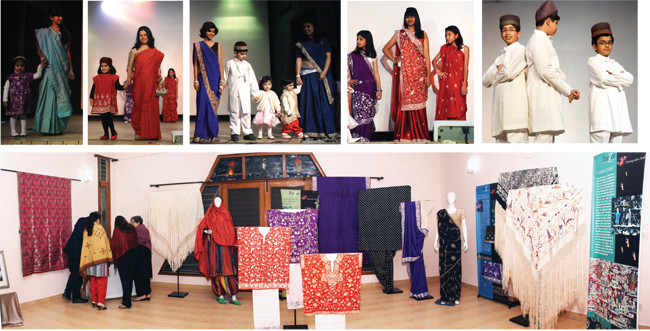
Young Farohars performing; overview of the embroidery exhibition
"Generosity of donors”
After the evening talk by Khurshid, a fashion show and entertainment by the Young Farohars — the DPA’s youth group — was held followed by a lucky draw for prizes, introduction to the board of trustees and a vote of thanks by DPA trustee Navroze Dhondy. He acknowledged "the amazing generosity of our donors,” the major ones being Merwanji D. M. Jeejeebhoy Trust, Nergish and Dadi Mistry, Mehrab and Jahan Nargolwala, Adil and Rinchen Nargolwala, Jamshed and Shirin Guzder Trust, Navaz and Zubbair Aria. Sterling and Wilson contributed for the agiary’s electrification. The Program Committee comprised Shernaz Cama, Nergish Mistry, Ava Khullar and Veera Mavalwala under the guidance of Dadi Mistry. Dinner followed the festivities.
◆ ◆ ◆
From the archive