
Books
Not just a ‘Parsi novel’
It was an event to celebrate. After a silence of almost seven years, Cyrus Mistry launched his latest novel Chronicle of a Corpse Bearer published by Aleph Book Company (promoted by Rupa Publications). That Mistry needs no introduction was evident from the well known faces from the world of books as well as the performing arts who were present at the Little Theatre at the National Centre for the Performing Arts for this occasion. This comes as no surprise as Mistry published his first play Doongaji House when he was just 21. This was followed by a second play, The Legacy of Rage and a novel The Radiance of Ashes which was published in 2005. Though his novel deals with the cruelty of man to man against the background of the Hindu Muslim riots, it was not well publicized and distributed and, hence, sadly dropped into oblivion.
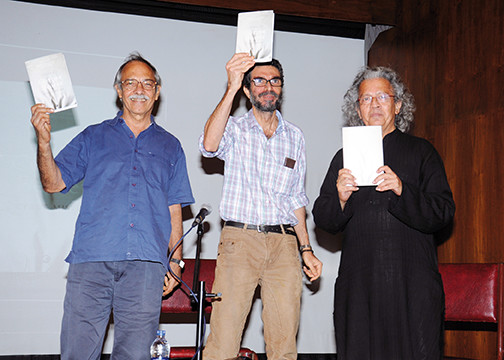
From left: Gieve Patel, Cyrus Mistry and Anil Dharkar at the launch
Chronicle of a Corpse Bearer was released by Anil Dharkar and Gieve Patel. This was a happy coincidence as Patel had launched The Radiance of Ashes and his late wife, Toni, had directed the brilliant and sensitive performance of Doongaji House which was staged at the Alliance Francaise.
After Mistry read from his book, Dharkar questioned him about the Parsi ethos of the novel, a world of nassessalars and khandhias. Mistry mentioned that he would not like the novel to be seen as one written by a Parsi for a Parsi audience. Though the protagonist and the milieu are Parsi, he stressed that the novel is basically a love story which moves beyond the limitations of caste, community and creed.
After choosing a large canvas for his first novel, Mistry decided to concentrate on a microscopic section of the Parsi community — the nassessalars and the khandhias — "corpse bearers” who are employed to carry the dead bodies of the Parsis into the Towers of Silence. They were not "untouchables” as Dharkar suggested but merely "impure” as a member of the audience irately corrected him. They lead isolated lives, segregated from the other members of the community. They are shunned and are certainly looked down on, on account of a common belief held amongst Parsis that dead matter gives out poisonous and noxious elements and pollutes those that come into contact with it. Dharkar pointed out that he found this behavior of the Parsis a strange contradiction in a community which is generally known for their kindness, generosity and compassion.
Jehangir Patel, editor of this magazine, drew attention to the fact that, in the present day, the condition of the khandhias has substantially improved. They are now unionized and earn around Rs 20,000-Rs 25,000 per month and their children often choose not to follow the profession of their parents. However, in the 1940s during which period this novel is set, the condition of these pallbearers was extremely dismal. Though Mistry alludes to events like the Quit India Movement and Mahatma Gandhi’s speech at Gowalia Tank, which is a stone’s throw away from the Towers of Silence, these do not have any impact on the lives of the khandhias. There is little contact with the outside world, unless it is the fetching and carrying of corpses across the city of Bombay and, if these national events percolate their lives, it is through a radio, the power for which has been illegally tapped from a nearby electric pole.
When Dharkar questioned Mistry as to why he wrote about Parsi characters when he did not want his fiction to be categorized as "Parsi novels,” Mistry mentioned that every author chooses to write about a social milieu he knows best which does not imply that his fiction should be limited to that audience. He mentioned that the work of the Russian novelists Anton Chekhov and Fyodor Dostoevsky have resonances not only in Russia but also for readers in the world at large. In fact, Chronicle of a Corpse Bearer touches on larger questions, on good and evil and a universal morality, and though Phiroze Elchidana, the protagonist of the novel, is a Parsi, he can be seen as an existential hero who faces his suffering with endurance and fortitude.
Dharkar said that he found it strange that Phiroze, a high school dropout, could express himself in such a flawless, literary and almost poetic prose. Mistry suggested that there is a poet within many an ordinary person and a member of the audience even remarked that one does not need a degree to be a poet. It is not so much ideas per se which Mistry wants to depict in his fiction but the portrayal of emotion which he learnt from the great Russian writers whom he read at the age of 11 and whom he thankfully revisited when he was older. Mistry juggles with the time scheme in an effortless manner, blending present, past and future almost seamlessly. Though one knows that Sepideh, Phiroze’s wife, has passed away in the first few pages of the book Mistry skillfully manages to make her presence felt throughout Chronicle of a Corpse Bearer. It is qualities such as these which make the novel a pleasure to read.
FIRDAUS GANDAVIA
◆ ◆ ◆
From the archive