
10WZC
Literary leanings
Parsi Gujarati poetry, theater and novels were the theme of this 10WZC session
"This is the tail end of the evening. It shows how much importance is given to poetry and literature!” began poet and author Keki Daruwalla to much laughter from the audience. He was chairing the concurrent session on Parsi Gujarati literature, theater and Parsi authors on December 28, 2013 in Room C. Using the dais as his stage, Daruwalla demonstrated a predilection for the dramatic, enthralling his audience with a hilarious enactment of a scene from a Parsi natak, resulting in Nergish Mistry of Delhi exclaiming that though she had known him for many years, this was a totally new and unexpected facet of his personality! Daruwalla’s rationale was that "setting the scene” was important in the grammar of literature.
Admitting that though not an authority on Gujarati literature, he is now in the process of translating the famed laureate Narsi Mehta’s poems from Gujarati to English. Daruwalla made reference to the award winning Mistry brothers Rohinton and Cyrus who have made a name for themselves, the former as a novelist and the latter as both playwright and novelist. Daruwalla opined that Cyrus’ recent novel, Chronicle of a Corpse Bearer illustrates the necrophilic tendency in the community. The poet later read from his own latest collection, Fire Altar which was released at the 10th World Zoroastrian Congress (see "Tilting at empires,” Books, Parsiana, April 7, 2014), reciting some verses from the book.
Admitting that though not an authority on Gujarati literature, he is now in the process of translating the famed laureate Narsi Mehta’s poems from Gujarati to English. Daruwalla made reference to the award winning Mistry brothers Rohinton and Cyrus who have made a name for themselves, the former as a novelist and the latter as both playwright and novelist. Daruwalla opined that Cyrus’ recent novel, Chronicle of a Corpse Bearer illustrates the necrophilic tendency in the community. The poet later read from his own latest collection, Fire Altar which was released at the 10th World Zoroastrian Congress (see "Tilting at empires,” Books, Parsiana, April 7, 2014), reciting some verses from the book.
.JPG)
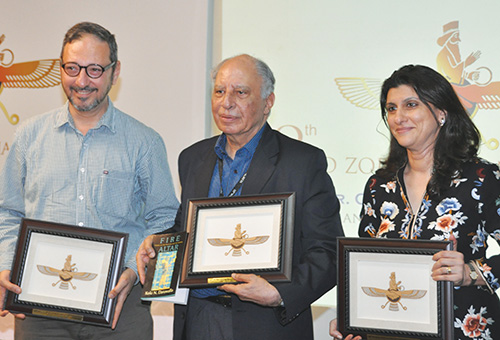
Firdaus Gandavia, Keki Daruwalla and Meher Marfatia; Nergish Mistry
Panelist Meher Marfatia, who has compiled a book each on Parsi theater (Laughter in the House) and Parsi Gujarati phrases (Parsi Bol) along with photographer/scriptwriter Sooni Taraporevala, read a paper in which she admitted that "digging even a little deep into one’s community language roots works wonders.” Parsi Gujarati drama has "touched the hearts and minds of a huge multitude of playgoers over the last half-century… To integrate and adapt has always come naturally to us. Parsi theater sportingly ran parallel with theater put up in a richness of regional languages — Hindi, Marathi, Urdu and Hindu Gujarati. Despite this variety Parsi Gujarati scored an edge” because our language went down very well with more than merely the Parsi population and "at least three ethnic Gujarati speaking communities came to clap delightedly at these plays...
"A major reason for the popularity of plays scripted by Adi Marzban, Pheroze Antia and Dorab Mehta was the freedom of thought and expression that they uninhibitedly displayed,” the theater chronicler elaborated. "Parsi theater saucily stood apart from plays of the day presented by other Gujarati-fluent communities. Its themes were bolder, relationships between the sexes more fluid and deliciously sly innuendo held promise of further tempting treats!” Marfartia paid tribute to talented performers like Dinoo Nicholson, Piloo Wadia, Dinshah Daji, Dadi Sarkari, Jimmy Pocha, Ruby and Burjor Patel and later husband-and-wife duos like Dolly and Bomi Dotivala and Scheherazade and Rohinton Mody who worked with doyen Marzban until his death in 1987.
Describing her tryst with Parsi Bol in partnership with Taraporevala, Marfatia said they "enjoyed soaking in some fine Gujarati patterns of speech. Mischievous and malleable, our language is imagistic, wicked and inventive, comparing wildly opposite things. Besides crazy contrasts, Parsi Gujarati throws around mad metaphor, purposeful alliteration and rhyme, and an often brazen beat.”
Literary critic and chief financial officer of the Sir Ratan Tata Trust, Firdaus Gandavia, introduced to the delegates as frequent reviewer of books for Parsiana, posed this question to the audience: "What are the distinctive characteristics of a Parsi novel or a play? Must the author be a Parsi? Several Parsis have written novels which do not have a single Parsi character.” He cited Daruwalla’s For Pepper and Christ, set in the times of Vasco da Gama, Bapsi Sidhwa’s The Pakistani Bride and Farrukh Dhondy’s adultery and other stories, all of which are devoid of Parsi characters. Then there are novels written by non-Parsis about Parsis. "Would their work constitute a Parsi novel?” he queried. When characters are Parsi but the author/playwright’s themes do not solely pertain to the community, would those be deemed Parsi novels or plays?
Another much overused aspect Gandavia aired a grievance about was: "Do Parsi novels always have to contain the story of milk and sugar… Do they have to minutely describe every navjote and Parsi custom?” Rohinton Mistry generally portrays a "grim picture” of the community, showing it "warts and all,” he said, wondering why "one seldom finds the sterling virtues of the community described in fiction — the honesty and the integrity of the Parsis, the avoidance of bribery and corruption as one finds with several Parsi business houses, the natural inclination towards doing the right thing.”
Ending his talk with a reference to Amitav Ghosh’s River of Smoke, Gandavia shared that he found it "strange that much of what I feel constitutes the basic characteristics of the Parsis appear in a serious novel written by a non-Parsi.” The character of Bahram Modi is "superbly etched” with "just the right touch of Parsi eccentricities… which do not obfuscate or overwhelm his Parsi virtues.” Involved in the opium trade with China, he is faced with a "more complex and ethical problem (when) he has the casting vote to decide the course which the traders have to take and he is forced to choose between good and evil… Our heart goes out to this man who is put in the awkward situation of having to choose between the welfare of his beloved family and his own ‘well-being in the hereafter’ as he seeks the reassurance of his kusti. Ghosh succeeds in portraying Bahram as intelligent, capable, resilient, God fearing, loyal and above all a human character.”
◆ ◆ ◆
From the archive