
Into the mind of Mary
The Prospect of Miracles by Cyrus Mistry. Published in 2019 by Aleph Book Company, 7/16 Ansari Road, Daryaganj, New Delhi, 110002. Pp: 201. Price: Rs 599.
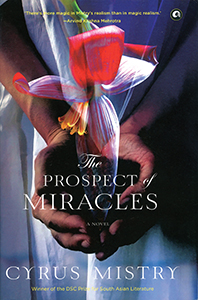
A new novel by Cyrus Mistry (pictured) is an event to celebrate. He won the DSC Prize for South Asian Literature in 2014 for his Chronicle of a Corpse Bearer. He has now moved away from Parsi characters and situations to present a powerful and moving novel, The Prospect of Miracles, which is set in Kerala and deals with a charismatic Protestant priest, Pastor Pius Philipose and his wife, Mary Agnes. Mistry’s choice of names is significant: Philipose was the emeritus Metropolitan of the Malankara Mar  Thoma Syrian Church where he was a bishop for more than 67 years; Mary needs no explanation, and Agnes means "pure” or "holy.”
The novel begins with a first person account by the recently widowed Mary Agnes, seated on "a hard plastic chair in a large air-conditioned room” waiting to hear a eulogy for her husband whose coffin "squatted” in the aisle nearby. The vigil had been "long and tiring” and from the sensitive choice of words, Mistry makes it clear that there is no great sadness in the heart of the widow. The usual flowery tributes are paid to the dead pastor and we are informed that a volume of his finest sermons will soon be published. Our sympathies, at this point in the novel, seem to be with Mary who is haunted by the unpleasant spirit of her husband.
In Mistry’s adept hands, the novel seamlessly moves backward and forward in time. He sensitively portrays Mary’s lonely childhood and her parents, especially her father, who was very against her marriage to "that charlatan,” considering Philipose was a Syrian Christian who had converted to Protestantism. We also learn about Mary’s innocuous habit of speaking to herself, something she has been doing since she was a child and which now gradually appears more acute; Mistry seems to be casting doubts about Mary’s role as a reliable narrator. As a result, though she speaks about Philipose’s bad temper we seldom encounter it in the course of the novel. One wonders how much Mary’s problems are exacerbated by the guilt she feels about letting down her parents by marrying a man they disapproved of; abandoning her Syrian Christian religion; her intense loneliness, not only as a child, but also after her relationship with Philipose dies rather prematurely and her son, Mark, leaves home unable to come to terms with his father; and finally her culpable role in the death of Philipose. As is often the case with unreliable narrators, Mistry makes it ambivalent for the reader to sift fact from fiction. Mary has always worshipped her father yet it is evident from her narration that he was involved in a sexual relationship with Keshri, a tribal girl, as he weeps uncontrollably on her death. Mistry makes this very clear to the reader; what is left in doubt is how much Mary understands of the situation and to what extent is she willing to accept the truth.
 Mistry moves from Mary’s first point of view to a third person perspective when he shifts the novel to Attappady where we learn about the difficult lives of the tribals: Kishori, her daughter Nirmala, and a cousin, Chandrika. History seems to repeat itself and the liaison between Mary’s father and Kishori seems to be parallel with Philipose’s secret trysts with Nirmala and possibly Chandrika. We are told that most nights Philipose retreated to his study till the early hours of the morning and he is seen by a servant consorting with Nirmala (a relationship he had started before he had even married Mary). On one occasion, Mary is surprised to catch a whiff of alcohol on his breath.
To describe the effect all this has on Mary’s frame of mind and the resulting sequence of events would reveal the denouement of the novel. In an interview with writer and novelist Darleen Ramos, mid-day (November 2, 2019), it was suggested that the novel reminded the interviewer of George Cukor’s film Gaslight. Mistry admitted that he enjoyed the film very much and that it probably made its way unintentionally into his novel. In the film, the characters are rather simplistically portrayed in terms of black and white; the husband, realizing that his wife is very wealthy, consciously manipulates her into believing she is going insane. Mistry, on the other hand, probes into the mind of Mary and her obsessions to present an enigmatic and complex character.
In his novel, Mistry deals with the idea of faith and how far it can push an individual to the borderline of insanity, of "just how thin the dividing line between sanity and madness is when one decides to embrace conviction.” On the one hand is the historical truth that faith has ”not stirred a single pebble,” and on the other it is believed (and probably hoped) that it can move mountains. There is a suggestion that life may be unlivable, were it not for the prospect of miracles.
FIRDAUS GANDAVIA
Gandavia holds a doctorate in English literature and is a retired chartered accountant. He is a compulsive reader of fiction.