
Drama/Cinema/Theatre
Love, lingerie and liberation
Through her film Shirin Farhad Ki Toh Nikal Padi director Bela Bhansali Sehgal seeks to reinforce that even those past their prime can enjoy romance
She was standing on the steps of Sterling cinema house and observing the exuberant Zoroastrian cinegoers who had come to enjoy the late evening show of the newly released Shirin Farhad Ki Toh Nikal Padi in the presence of lead stars Farah Khan and Boman Irani on August 25, 2012. Neither introduced nor recognized, Bela Bhansali Sehgal had come to determine the pulse of the audience and was gratified with the "very good response” to her maiden directorial venture, she conveyed during a brief interview with Parsiana.

Boman Irani and Farah Khan as Farhad and Shirin
Members of the community could empathize with the frustration and angst of the 45-year-old hero Farhad Pastakia, played by Irani, who has been unable to find a Parsi wife. The fact that the bachelor works as a salesman in a lingerie store and insists on being disarmingly honest at every matchmaking endeavor detracts from his matrimonial prospects and causes embarrassment to his dominating mother Nargis, enacted by Daisy Irani and doting grandmother Silloo, portrayed by yesteryear actress Shammi (Nergish Rabadi). With passage of time, "there will be only widows and divorcees available,” warns his mother.
Hope for Farhad comes in the 36C or 38D form of Shirin Fuggawalla, a Parsi Trust secretary played by Farah Khan, who walks into his shop in search of an undergarment and causes a flutter in his heart. Destiny brings them together yet again over the issue of an illegal overhead tank in his flat that the Trust secretary wants removed but which his mother insists on retaining as a memory of her deceased husband.
This rom-com (romantic comedy) sees a passionate arousal in Farhad as he gets entwined with his lady love while drifting apart from his hawk-eyed mother. With her he can share his special hideout when he needs to seek refuge, or his "underworld” dream of owning a multistoreyed lingerie boutique. True to a Bollywood movie, this Hindi film too is replete with song and dance, the only difference being words like "gadhéra (donkey)” and "ghélsappa (stupid)” interwoven in the melody. An undemanding storyline of superficial conflicts and peace alliances predictably result in wedlock.
As noted a review in The Times of India of August 25, "This is no epic love tale but it’s worth a watch for those who like their cinema as buttered as their bun maska.” To see a profusion of their coreligionists on screen the Zoroastrians in the audience are very happy, more so when they are dressed traditionally, go to Irani eateries and make a laughing stock of ghér jamais (sons-in-law residing in the wife’s household).
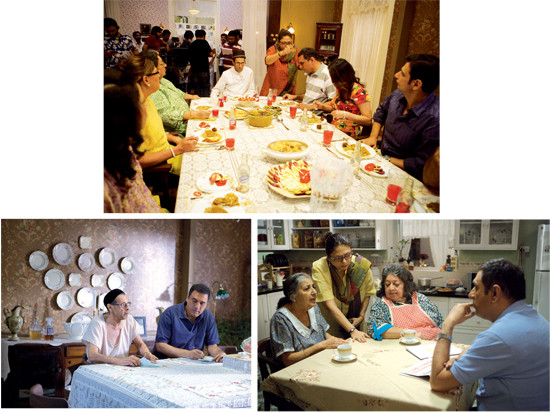
(above) on the sets of the film directed by Bela Bhansali Sehgal
Whilst giggles and guffaws were intermittently heard from certain sections of the audience, there were some who were critical of the "random gags and toilet humor that isn’t even funny.” When Soli Marker as the deranged neighbor Feroze insists that Indira Gandhi has got married to the wrong Feroze and sees his beloved’s visage in every charming lady, it is hilarious, but when he equates his constipated condition in hospital with a national emergency, it sounds ludicrous.
That bellicose members of the community can create pandemonium and run to the nearest police station over trifles is not unknown, but when the film shows them as degenerating into violent ruffians at a matrimonial meeting or a housing colony assembly with even a vintage rifle toting conscience keeper amongst them, there is no cause for amusement. The director explains that since such scenarios are familiar at Parliament sessions in India, she decided to introduce them in this film.
Who would have expected that just when the not-so-young lovers are all set to kiss over the motionless body of Shirin’s comatose father who has been lying in a comatose condition at home, he would stir from his vegetative state to demand a Mangola! Thereafter there is no stopping the celebration and jubilation.
The 112-minute film is believed to have collected between six to eight crore rupees at the box office over the first weekend. Whilst some may view it as a poor show, Sehgal maintains that she had never set her mind on any financial returns. Co-produced by her brother Sanjay Leela Bhansali who also wrote the story with Muncher Wadia, the cost of this low budget film, made within 54 days, was around 10 crore rupees. "Originally Sanjay had written the story with Parsis in mind,” says Sehgal but when things did not fall into place they considered adapting it to a Punjabi scenario before finally deciding that they would continue with the Parsi theme since there are such few films made on Parsis.
"I have lived and grown up with Parsis. My kaka (paternal uncle) is married to a Parsi. I wanted to show the community as being loving, affectionate, zestful, full of beans, full of emotions… Everyone has drama in their life and home,” Sehgal told Parsiana.
The main casting was done by Sehgal who wanted as many Parsis in the lead roles as possible to give the film an authentic look. With Farah’s mother Menaka being a Parsi, Farah was chosen to be the heroine. With help from Rayomand Noble other familiar names selected as supporting actors were Kurush Deboo, Soli Marker, Rushad Rana, Nauheed Cyrusi, Mahabanoo Mody-Kotwal, Shernaz Jehani. Kavin Dave was the only exception who was selected because "of his rolly-polly, cute looks,” adds the director. "Bela infuses her characters with charm and irreverence and brings together an eccentric but endearing ensemble,” noted a review in the Mid-Day of August 25.
Khan, a film director and dance choreographer, having chosen to make her maiden attempt at acting in this film, Sehgal appreciates, "She gave me respect as a director. She would do everything that I told her.” If hesitant or unsure of the outcome, "she would give me a quizzical look and I only had to tell her ‘trust me’ and she would do it.” The only thing difficult for the mother of young triplets was doing "night shoots when at times she would fall asleep in the middle!” relates Sehgal. Khan’s costumes were designed by Dilnaz Karbhary.
To name the central character Shirin was Sehgal’s choice. "I have a friend by that name,” she says, referring to Shirin Umrigar whom she knows since their school days at the Alexandra Girls’ English Institution. Naming the male character Farhad was in recognition of the 1931 film Shirin Farhad directed by J. J. Madan which was the first Hindi talkie under the banner of Madan Theatres. When naming her film Shirin Farhad Ki Toh Nikal Padi she wanted to suggest that as a couple "Shirin and Farhad had taken off or taken flight.”
Cusrow Baug, that was used as a location for shooting, was idyllic, felt Sehgal, happy that after 15 years Cusrow Baug’s precincts were once again available for shooting. The residents too she felt were "very cooperative” and referred to one who went out of her way to "make cutlets for us.” She was particularly appreciative of her friend Farida Jal and her husband. The film crew ensured that they caused minimal disturbance and "instead of using microphones would only use walkie- talkies and clean up after the shoot even when things were not dropped by us!”
Reiterating her fondness for the Parsi community, Sehgal wanted to urge them "to remain the way you are...fall in love...enjoy romance... Love has no expiry date.”
◆ ◆ ◆
From the archive