
Books
Love and life amid death
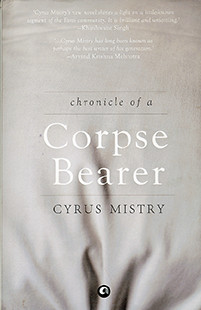
Chronicle of a Corpse Bearer by Cyrus Mistry. Published in 2012 by Aleph Book Company, 7/16, Ansari Road, Daryaganj, New Delhi 110002. Pp: 247. Price: Rs 495.
Cyrus Mistry’s latest novel, Chronicle of a Corpse Bearer deals with an unusual subject which, I think, has never before been the focus of a novel. Not only does Mistry explore the world of the nassessalars and the khandhias but also has as a central character, Phiroze Elchidana, who has chosen this profession and not been born into it, as generally is the case. Difficult to believe? Well, while researching a documentary for UK Channel 4, Mistry came across the germ of this idea which later grew into a novel. He was told about a young man who fell in love with a khandhia’s daughter whose father made it a condition that the boy should also become a khandhia if he wanted to marry her. Once again, Mistry found a passing reference in a "tidbit” from Sapur Desai’s The History of the Parsi Punchayet which gave him the idea of a wealthy family living ironically in a house called Mon Repos with a son born of a mixed marriage — a Parsi father and an Irish mother — who had never been initiated into Zoroastrianism and who wanted to be taken to the Towers of Silence as his final resting place. Mistry has fleshed out the bare bones of these episodes to create a convincing and fascinating novel which takes place in the 1940s against the backdrop of the Quit India Movement and India’s struggle for Independence.
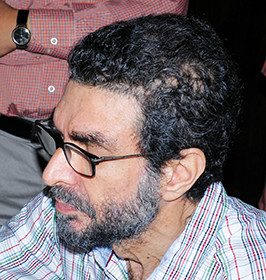
Author Cyrus Mistry
The corpse bearers of the title are the khandhias and the nassessalars who are in charge of accompanying the corpses during their final journey to the Towers of Silence. They are ostracized from the rest of the community and lead isolated and empty lives, living in wretched conditions. They have to wake up early to attend to funeral ceremonies and, as the only hearse that the Towers of Silence possesses is in repair, they trudge all over the city whether it is Lalbaug or Cusrow Baug to collect corpses in biers which alone weigh 80 pounds. Often they do not have the time to have a meal and they suffer from fatigue, dehydration and exhaustion performing this thankless task. On one occasion, Phiroze collapses while transporting a cadaver across the city and there is a humorous incident in which the corpse turns turtle and rolls off the bier.
It is not merely the physical strain of the job but the contempt they receive from the rest of the community which makes their lives impossible. The word nassessalars means ‘Lord of the Unclean’ a word from the ancient Avestan, Mistry tells us. We are also informed that for the Parsis, dead matter is considered unclean and one of the duties of the nassessalars is to isolate "the living from the contamination supposedly spewed by corpses.” There is also the belief that the nassessalars absorb all the evil and the rot which emanates from cadavers. Hence, it is no wonder that "the smell of sickness and pus endures; the reek of extinction never leaves the nostrils.” They are almost treated as untouchables. When they are summoned to the offices of the Parsi Punchayet, the employees cast covert glances as if they would be defiled by even looking at the corpse bearers. The engagement of Vera, the daughter of a khandhia, comes to an abrupt end when the groom’s family finds out about her origins. During a funeral ceremony, Phiroze accidentally brushes against the shoe of a mourner and causes much agitation and furor amongst the people present. If he were not "unclean,” the wrath would have taken the form of physical abuse. This sort of behavior seems strange, as at some time the khandhias would be the only persons permitted to handle the dead bodies.
The grim and sordid lives of the nassessalars and the khandhias and the squalor and poverty in which they live are a direct contrast to the beauty of the gardens of the Towers of Silence with "the shapes, smells and colors of nature, the magnificent trees, birds, bushes and all that rocky wilderness.” It is here that Phiroze comes across Sepideh, the daughter of a khandhia and falls madly in love with her. Phiroze belongs to a priestly family and his father, Framroze, is the head priest of a small fire temple on Forjett Hill; consequently, he has to incur not only the wrath of the father but also ostracism from the community.
Phiroze’s life is a reaction to the pious and conventionally religious atmosphere in which he is brought up. Over the years, as Framroze gets older, his attitude is "congealed into a grim religiosity” and we are given hints of his ruthless behavior when he slaps a chasni bearer for eating some of the finest fruits and lying subsequently that he had not done so. It is only later do we realize why his wife, Hilla, calls him "selfish.”
The family has a beloved parrot called Hormaz and Phiroze’s first words, are "muss-muss” which the family happily interprets to be Hormaz. Phiroze tries to "fly” Hormaz as if he were a kite and ties the sharp string around his neck. When the bird protests, Phiroze panics and holds on to the string even tighter eventually resulting in a pool of blood and feathers. One wonders whether the accidental death of Hormaz, the almighty creator, is a premonition of the course Phiroze’s life will take as he revolts against all that the priestly family holds sacred. Phiroze fails his matriculation examination and roams the city aimlessly. He visits, "slums, shanty towns, areas in which low life and sin and poverty flourished” and even pays a buxom banana seller a paltry sum of three rupees and five annas for favours received. If the reader finds it improbable that a high school drop-out like Phiroze can express his thoughts in such a poetical manner, it should be remembered that Phiroze is after all a son of a head priest and though he revolts against "bookish” knowledge and living in the perpetual shadow of his academically inclined elder brother, Vispi, it is rather unlikely that he would be unintelligent.
One of the remarkable achievements of the book is Mistry’s skill in describing Parsi occasions and rituals and blending them seamlessly into the fabric of the novel. Whether it is the description of the navjote, or Framroze’s ceremonies in the fire temple or the initiation of nassessalars or the performance of their duties — all are welded into the book and seem to flow naturally providing a suitable background for the reader, both Parsi and non-Parsi alike.
What is very striking is the compassion with which Mistry portrays most of the characters. There are almost no villains. Framroze, who disowns Phiroze, is exceedingly protective of his infant son and carries him with extreme caution, clasping him tightly when they peer into the holy well. Temoorus, Sepideh’s father who exacts revenge on Framroze and Hilla by forcing their son, Phiroze, to become a khandhia is a pathetic figure at the end of his life in his striped pyjamas, worn-out vest with a ripped sleeve who helps Phiroze to take care of his daughter, Farida. Even Nusli Kavarana, alias Buchia, rises above his cruel and sadistic treatment of the khandhias and becomes almost human in his physical encounter with Phiroze which underlines the alienation and lonely lives of the corpse bearers.
Mistry is not so much a Parsi novelist as a novelist who happens to be a Parsi. Chronicle of a Corpse Bearer does not merely deal with khandhias and nassessalars or the limited concerns of a single community. It is a very moving and humanistic love story, with universal appeal, about a love that transcends all kinds of odds — social dissension, caste and class, family vendetta, intrigue, pettiness and jealousy — and finally even death itself and it is for this very reason that the novel will appeal to all readers irrespective of community, caste or creed.
◆ ◆ ◆
From the archive