
Politics and Policy
Priestly somersaults
Over a period of 12 years two of the high priests have twice contradicted their stand on the aviary project
"We, the undersigned high priests, see no religious impediments in the building of an aviary over and around the dakhma in order to strengthen our dakhmenashini mode of disposal of the dead.” So wrote Dasturs (Dr) Kaikhusroo M. JamaspAsa, (Dr) Firoze M. Kotwal, (Dr) Peshotan H. Mirza and Cyrus N. Dastur in a letter dated September 10, 2012 on the letterhead of JamaspAsa addressed to the Bombay Parsi Punchayet (BPP) chairman Dinshaw Mehta.
"The BPP trustees have been given the mandate to uphold and maintain the dakhmenashini system and therefore bringing back the vultures is a step in the right direction.
"A project such as this, will create doubts and misgivings in the minds of some, however, you have dispelled these doubts with your clarification… and therefore we are confident that the majority of the community will remain united in wanting to bring back the vultures to our Doongerwadi grounds.
"Moreover, we are fortunate to have the support of the Government of India and other important organizations such as the Bombay Natural History Society and International Union for Conservation of Nature, which we have learnt are solidly behind this project, after having carefully evaluated it.
"We would like you, as the trustees of the BPP, to expedite this important project for the sake of our religion and the community.”
The support of the four high priests runs counter to the point of view expressed by JamaspAsa and Kotwal and the fathers of Mirza and Dastur in a letter addressed 12 years ago to the BPP trustees.
Initially, on June 21, 2000, JamaspAsa and Kotwal wrote to the trustees supporting the aviary, but reversed their stand five months later.

From left: Dasturs (Dr) Hormazdiar Mirza, (Dr) Kaikhushroo JamaspAsa, (Dr) Firoze Kotwal, Meherji Meherjirana, Noshirwan Dastur, Kaikobad Dastoor and Hormazdiar Dastoor
Their letter of June 21 states, "We would like to affirm our position yet again, which is to strengthen the system of dakhmenashini through the bringing back of the natural scavengers to be housed in Doongerwadi. As we have reiterated, repeatedly, this is the only long-term solution we see in order to bring the system back on track.
"We have confidence in the abilities of the vulture expert Jemima Parry-Jones (JPJ), director of the National Birds of Prey Centre (Newent, UK) and would urge you to follow her professional advice and implement what she has recommended, as a long-term solution to our present religious problem appertaining to the disposal of the dead. Once the vultures are captively reared, using the expertise available to us, our ensuing problems of decomposition and odor will be issues of the past.
"We are pleased that the trustees have decided to go ahead with the aviary project at long last. It is unfortunate that valuable time has been lost in arriving at this decision, however, all efforts should be made to move ahead swiftly with this project by bringing it to fruition.
"We see no objection to providing alternative diets for the vultures within the aviary complex, provided it is done discreetly, without affecting the visual sentiments of our people. We recognize that the natural scavengers in the wild have always eaten a varied diet of what the birds have foraged when hungry. After all, even presently, the kites and crows do eat whatever is available to them within the environs of the dakhmas and hence an alternative diet offered periodically, to the captive birds, should, in our view, pose no theological problem. Moreover, by building the aviary a greater good will be achieved, namely, of strengthening the system of dakhmenashini, in a natural way, by using innovations which are in consonance with the beliefs and practices of the faith.
"Whilst we are given to understand that the solar panel experiments are on in Baroda, we reserve our rights to opine on this project until a proper report and evaluation are given to us for theological considerations. We are keeping an open mind on this project, but our apprehensions still remain of both excessive heat and possible burning or charring of the corpse...
"Please note that our views are based upon what we believe to be theologically right and in harmony with the customs and traditions of the faith, which we, as prelates, are duty-bound to uphold, even if it is at the cost of displeasing those who choose to ignore our advice.
"It is actions and not mere words which our community are now clamoring for from the apex body of our community.”
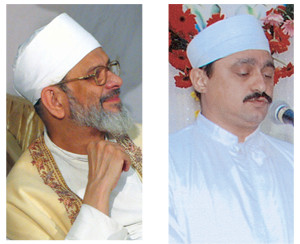
Dasturs (Dr) Peshotan Mirza (left) and Cyrus Dastur
Two days later, on June 23, 2000, Dastur Hormazdyar Mirza, Ervads Rooyintan Peer, Parvez Bajan and Peshotan Mirza and Dhalla wrote to the BPP trustees: "We had been invited to an emergency meeting called by you on June 20. You stated in your letter dated June 19, that as ‘one or two doctrinal issues remained unresolved,’ you sought ‘a final advice from the head priests so that we could go ahead without any doubt or hesitation.’
"The main issue discussed on that day was whether the placing of animal carcasses inside or even outside the dakhmas could have religious sanction.
"Of all the priests present at the meeting, Dastur (Dr) Kaikhusroo JamaspAsa was the only one who gave his opinion, although hesitantly, that placing of carcasses outside the dakhmas is permissible. Hormazdyar Mirza expressed his objection, but in the melee, he was hardly heard. All of us voiced our dissent too. We would like this to be minuted.
"To eliminate all doubts in this matter, we would again like to state very categorically by placing it on record, that we certainly do not accept the view expressed by JamaspAsa.
"We very emphatically state that the practice of placing carcasses in the precincts of the Doongerwadi is totally irreligious, most objectionable and unacceptable. Moreover, it would be against our customs and traditions. The very purpose of placing a corpse (nasa) in the dakhma is to contain the decomposition and putrefying matter and hence prevent its adverse effects from spreading to the environment. By placing carcasses outside the dakhma, it would be tantamount to doing exactly the reverse — the decomposing carcasses would only help in spreading the nasa and its adverse effects into the environment. This act most definitely violates the very principle of dakhmenashini and is, therefore, objectionable.
"We would, therefore, urge you to note that this drastic step cannot and should not be taken on the advice of one single priest. This shall certainly be opposed by the large majority of the community.
"At the conclusion of the meeting, it was announced that a ‘unanimous decision’ was taken in the matter. We would, however, place it on record that it is not correct to state that the decision was ‘unanimous,’ as we the undersigned have expressed our views strongly against the decision mentioned above. The decision announced at the meeting shall certainly lead to a bitter controversy in the community.”
On June 30, 2000 JamaspAsa wrote to the BPP trustees:
"In view of the letter dated 23 June 2000, written by my revered colleague, Dastur (Dr) Mirza, and others, I do not wish to be involved in the present Doongerwadi controversy.
"However, I wish to clarify once and for all that I have always maintained and strongly preferred that the dakhmenashini system should continue, that is to bring back the vultures to Doongerwadi; though I am not happy at the thought of an aviary.
"I am under great stress and strain and my doctors have advised me complete peace of mind.
"Hoping to be excused.”
Seven oppose aviary
On November 9, 2000 all the seven high priests, Mirza, JamaspAsa, Kotwal, Meherji Meherjirana of Navsari, Noshirwan Dastur of Surat, Kaikobad Dastoor of Udvada and Hormazdiar Dastur of Poona voiced their "serious protest” at this "questionable project.
"Due to the scarcity of vultures at Doongerwadi, the trustees of the Bombay Parsi Punchayet have supported and encouraged the experimentation of four different projects. One of these is the setting up of an aviary for breeding vultures in captivity…
"The trustees invited (JPJ)... to Bombay to evaluate the situation. After studying the problem, she submitted a detailed report to the trustees of the BPP.
"It is, however, a matter of deep concern to the undersigned that she (JPJ) proposes to have carcasses or pieces of animal flesh placed inside the dakhmas in order to encourage/teach the birds to eat corpses. The relevant parts of the report that deals with their ‘food’ and ‘training to feed them’ are as follows:
"Food
‘As stated in the interim report, no bird does well in captivity if fed on the same food at all times. I suggest that supplementary feeding of the vultures will be needed. Twice a month, maybe more often, perhaps on days when the normal food supply is less available, fresh dead goat, cow or buffalo can be included in the birds’ diet. This must be fresh… It is advisable to make sure that the birds have vitamin and calcium supplements. Probably the only way to do this is on the days when the vultures’ diet is changed to goat, cow or buffalo. These supplements usually come in a powder form and are easy to apply to the meat being fed to the vultures.
"Training the vultures to feed
‘One problem is going to be that the young vultures will not be able to get into the Towers until they have reached full growth and have learned to fly. So until that time they will have to be fed fresh food and a great deal of it outside the Tower. Once the vultures are able to fly and enter the Towers the food source will be in the Tower. However, to encourage the birds to learn to feed in the Tower it may be advisable to place some of the food that they have been used to — i.e. goats and calves, etc inside the Tower until they realize that this is where they will be feeding.’
"It is of course out of the question to have pieces of flesh placed inside the dakhmas. The proponents of the aviary have now suggested that carcasses/pieces of flesh be placed outside the dakhmas. What we wish to emphasize here is that this cannot be permitted even outside the dakhmas. It is irreligious, objectionable and unacceptable. It would also be against our customs and traditions. The very purpose of placing a corpse (nasa) in the dakhma is to contain the decomposition and putrefying matter and hence prevent its adverse effects from spreading to the environment. By placing carcasses outside the dakhma, it would be tantamount to doing exactly the reverse — the decomposing matter would only help in spreading the nasa and its adverse effects into the environment. This act most definitely violates the very principle of dakhmenashini and is, therefore, objectionable.
"On September 22 JPJ was invited by the trustees to Bombay. On that day Dr Homi Dhalla who was also present, drew her attention that this practice of placing pieces of animal flesh within the precincts of the Doongerwadi would not be acceptable to the priestly class and to a majority of the community. Her reply was: ‘Then, there will be a problem.’ This clearly indicates that although JPJ knows that this would be objectionable, it being a sine qua non of this project, it would have to be implemented.
"Before any money of the community is spent on this questionable project, we urge the trustees of the BPP to take note of our serious protest to this most obnoxious practice which is proposed to be introduced on the Doongerwadi premises.
"Moreover, you should also be informed that this certainly will not be acceptable to the members of the community at large.”
Availability of diclofenac
A crucial factor for the survival of the aviary project is to ensure no Parsi has any traces of the painkiller diclofenac. This drug is lethal for vultures when ingested. While the drug is banned for veterinary use in India, diclofenac is freely available for humans in over a thousand different formulae. A move was also contemplated to totally ban the drug to safeguard the decimated Indian vulture population. But The Times of India of September 27, 2012 states that the group of ministers led by Union Agriculture Minister Sharad Pawar is "to examine options under the market price based mechanism to cap prices of drugs which may lead to reduction ranging from 25 percent to even 90 percent in some cases.” The newspaper mentions the possibility of the price of a diclofenac 50 milligram tablet reducing as much as 74 percent. Such a move could be another nail in the coffin of the scavenger birds.
The threat to vultures from the drug diclofenac and other theological issues have caused two high priests, Dasturs Khurshed Dastoor (see "Surprised and perturbed,” pg 34) and K. N. Dastoor Meherjirana (see "Vulture venture to take flight -- III” Parsiana, September 21, 2012) to oppose the aviary project.
◆ ◆ ◆
From the archive