
Demography
Deciphering the decline
Demographers and researchers continue to shed light on the real reasons for the dwindling number of Parsis, debunking many myths
The population figures for the Parsis in India as per the 2011 census "will be available only in early 2013,” says noted demographer Prof Ashish Bose in an article titled "Parsis on the verge of extinction” in Power Politics, June 2012 issue. Bose had spoken to the Census Commissioner Dr C. Chandramouli who told him "the table on religious distribution of population is not yet available.”
Cover illustration from Parsiana, June-September 1976 issue by Manjula Padmanabhan
But according to estimates worked in 2004 when the National Commission for Minorities constituted a Demographic Expert Committee under Bose’s chairmanship with four other demographers, the projected figure for 2011 is 61,000, a decline of 12.35 percent over the 2001 figure of 69,601.
The projections for 2021 are 54,000, a decline of 11.48 percent, for 2031: 47,000 a decline of 12.96 percent; for 2041: 40,000 a decline of 14.9 percent and for 2051: 34,000 a decline of 15 percent. Bose had presented these figures in 2004 in New Delhi at a seminar hosted by the Parzor Foundation.
"Several scholars at the International Institute for Population Sciences (IIPS) have worked on the declining Parsi population,” states Bose. "According to them the main cause for the decline is the very low Total Fertility Rate [(TFR) number of children born per woman]. This is 1.12 among Parsis, about four children lower than the average for India…
"Other causes are late marriage and voluntary and involuntary childlessness... One out of every 10 Parsi women is childless in the age group 45-49, compared to one among every 20 women childless for the total Indian population, as per the 2001 census.
"It must be noted that according to IIPS researchers the marriage behavior of the community combined with historical and cultural factors are responsible for a tremendous decline in fertility among Parsis comparable to many European communities in the recent past,” observed Bose.
According to the Agence France-Presse (AFP) wire service (DNA of July 30, 2012) the 2011 Iranian Government census puts the total population of Iran at 75.2 million of which 25,271 are Zoroastrians; 99.4 percent are Muslims, 1,17,704 are Christians and 8,756 are Jews. AFP stated the statistics were placed on the website of the presidency’s planning and strategic supervision department. The data was collected in 2011.
The subject of demography in the community has been also recently studied by two other Parsi scholars, Dr Zubin Shroff, a doctoral student at the Department of Global Health and Population, Harvard School of Public Health and Dinyar Patel, a doctoral student in History at Harvard University. Former Bombay Parsi Punchayet (BPP) and trustee of the World Zoroastrian Organisation Trust Funds Dinshaw Tamboly also has written a paper titled the "Decline of Parsi community in India.”
At the XVI North American Zarathushti Congress to be held in August this year in New York speakers will also present estimated global demographic figures for the community.
"Remarkable accurate”
Noted demographer C. Chandra Sekar of the All India Institute of Hygiene and Public Health Centre, Calcutta, in 1948 had projected "sometime between 1951 and 1961 the population will start diminishing in numbers. In 1961 the population strength will be 113,250 and by 1971 it will be reduced by about four percent to 108,648.
"From 1971, every 10-year interval will diminish the population size by six to seven percent, and in 2001 the strength of the community will be 89,218 or approximately the same as the Parsi population in India in the year 1891.” The actual figure was 69,601 according to the Government census figures.
"Chandra Sekar’s predictions can be considered as remarkably accurate,” state Shroff and co-author Marcia Castro, an assistant professor of demography at the Harvard School of Public Health. Their paper titled "The potential impact of intermarriage on the population decline of the Parsis of Bombay, India” was published in the August 26, 2011 online journal Demographic Research.
"This concern was first articulated in 1948 by Sapur Desai (former secretary of the BPP), who argued that current demographic trends of the Parsis, if unchanged, would lead to the decline of the Parsi population in India,” state Shroff and Castro relying on the works of several demographers and scholars. "Studies have shown several reasons for this trend. First, fertility has been declining for over a century: the TFR among the Parsis in Bombay was 4.41 in 1881, declining to 0.94 in 1999. Deaths have exceeded births in every year since 1955 and 1961-70 was the first period when the TFR was found to be below replacement level (2.2 babies per couple)…
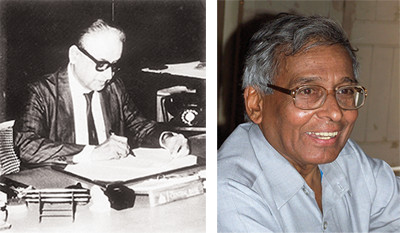
Sapur Desai (left) and Prof Ashish
Bose: gloomy predictions
"Speculation within and outside the Parsi community suggested that sub-fecundity due to cousin marriages (a common occurrence among Parsis) could be contributing to low fertility. This hypothesis was investigated, and results showed the opposite: marriages among cousins led to a higher mean number of children, after adjusting for duration of marriage…
"The first drop in Parsi fertility appears to have happened around the end of the 19th century, and was related to the rapidly increasing rate of female education in the community after 1870. A glance at enrolment in educational institutions in Bombay is revealing in this regard. In 1860, out of 635 girls enrolled in school and college in the city, 485 were Parsis, at a time when they accounted for less than 10 percent of the population of the city. By 1909, out of 73 women enrolled in college, 34 were Parsi. This was accompanied by a systematic shift in the age of marriage. In 1890 most women married between the ages of 16 and 20, while, according to the 1901 census, about half of them married at ages over 20 in the year 1901. By the 1940s the age group of 25-29 was the preferred marriage age.
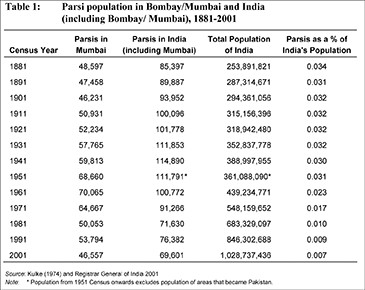
"In addition, there was an increasing trend of non-marriage. While between 1901 and 1941 the Parsi population of Bombay rose by 29 percent, marriages rose by only 22 percent. In 1881 close to 76 percent of all adult Parsis were married, but by 1931 only 41 percent were married. This is corroborated by the fact that the proportion of women never married by the end of their reproductive period rose from less than one percent in 1881 to 17 percent in 1971. This trend has only got more pronounced, with a 1999 survey conducted by the Tata Institute of Social Sciences (TISS) for the BPP showing that 30 percent of Parsi women remained unmarried throughout their lives. While urbanization is often blamed for the low nuptiality of the community, the Parsis in rural Gujarat had similar demographic patterns when compared to those in Bombay…
"A study (by Perin Cabinetmaker) in 1991 reported that out of a sample of 1,000 never-married Parsi males and females each, 400 males and 150 females reported low income as the reason for not marrying… Another closely linked and widely cited reason for not marrying is lack of accommodation… Unlike other Indian communities, Parsis tend to be averse to living in extended families, and a study reported that almost 90 percent of the Parsis believed that a couple should have a house of its own, reflecting a Western mindset on this issue…
"In cohorts born before 1906, 67 percent of marriages were arranged (states Paul Axelrod), but for cohorts born between 1946 and 1950 arranged marriages had fallen to 31 percent... The freedom of choice along with increased interaction with members of the opposite sex of other communities, largely as a result of increased female participation in the workforce, has also led to a substantial increase in intermarriage in the past few decades…

Dr Zubin Shroff (left) and Asst Prof Marcia Castro: Population decline to continue
Interfaith marriage
"We assessed the potential impact of intermarriage as a contributing factor to the sharp decline of the Parsi population of Bombay. Our results indicate that, irrespective of the acceptance of children of intermarriage, the Parsi population will decline sharply over the next few decades, assuming that current fertility trends remain unchanged. Our findings also show that the main factor behind the dramatic decline of the Parsi population is the abysmally low fertility of the community…
"If social acceptance of intermarriage remains unchanged (scenario ‘current trends’), the projection predicts that the (Bombay) population would decrease from the 2001 figure of 46,557 to 20,122 in the year 2051. Including all children of intermarriage (scenario ‘accept all children’) has only a marginal role in stemming this decline, resulting in a projected population of 20,535 in 2051. However, considering that no children of intermarriage (male or female marrying outside the community) are accepted (scenario ‘no acceptance of intermarriage’), the projected population would be reduced to 19,136 individuals in Bombay in 2051. These findings suggest that changing social norms, on their own, have a negligible impact on slowing the population decline.”
The results of this study indicate that intermarriage is not the principal driver of this sharply declining population trend, and an acceptance of female intermarriage can play, at best, a marginal role in stemming the decline, even under the most optimistic assumptions…
"Instead of focusing the discussion around intermarriage, the community should consider other strategies that could impact fertility levels. Attempts to increase fertility would have to address, among other things, the cultural and social determinants of the Parsi fertility decline. Specific measures, such as providing subsidies for rearing children and providing support for working women and housing for young couples, can be brought about through funding from within the community and from the state. In Sweden financial incentives, day care allowances, and an enabling working environment have been important explanations of an increase in fertility from 1.6 to 2.02 between 1983 and 1989, although an economic downturn and withdrawal of benefits brought the TFR back down to 1.5 in 1999. The Swedish example is corroborated by a recent cross-country study which suggested that at extremely high levels of Human Development there is a slight increase in fertility, attributed to governments creating ‘institutions to facilitate work-family balance and gender equality.’
"It is important to note, however, that even under the most optimistic scenario these schemes have a limited ability to bring about a sustained and sufficient increase in fertility rates. A scenario with a sustained increase of 25 percent of TFR, as achieved by Sweden in the late 1980s, would fall far short of the quantum of fertility increase which is needed by the Parsi community to reverse its dramatic numerical decline…
"In conclusion, our findings confirm previous studies that identified low fertility as chiefly responsible for the dramatic decrease in the Parsi population. Therefore, only a dramatic increase in fertility can arrest this trend and bring about the existence of a viable and demographically stable Parsi community in Bombay.”
Demolishing myths
"I am not a professional demographer,” states history doctoral student Patel in his paper titled "Jaago (wake up)/Bidaari (wakefulness): Rescuing our community from a demographic crisis” presented at XV North American Zarathushti Congress held from December 29-31, 2010 in Houston, Texas.
But "after wading through the mountain of evidence on Parsi demographics, I can say with full confidence that common Parsi conceptions — that the population is not declining; that professional demographic studies are biased or unreliable; and that, even if the Parsi community disappears, Zoroastrianism will somehow survive — have completely no basis whatsoever.”
Below is a list of both census figures and estimates for Zoroastrian populations in various countries:
Iran (current estimates) 15,000-24,000 United Kingdom (2004 estimates) 5,000 Australia and New Zealand (2004 estimates) 3,000 North America (2004 estimates) 15,500 Elsewhere (2010 crude estimate) 2,500 Pakistan (2010 figures) 1,766 India 69,601 Total 1,12,367 to 1,21,367 "Outside of India and Pakistan, we really have no reliable population figures and must instead rely on crude estimation…

From left: Dinyar Patel and demographic researchers Dr Ketayun Gould, Paul Axelrod, Leela Visaria
and Sayeed Unisa
"Population estimates become particularly difficult after the Islamic Revolution. Mobed Mehraban Firouzgary of Tehran informs us that the first census taken after the revolution, in 1981, returned a Zoroastrian population of over 92,000. This is, to say the least, a gross overestimation…
"In subsequent censuses, the Islamic Republic of Iran has not counted people by their religious affiliation. As a result, we must rely on assumptions and broad estimates in order to arrive at an approximate Zoroastrian population in Iran in 2010. In 2004, Firouzgary contributed to a special edition of the FEZANA Journal on demographics, estimating that the Iranian population stood at 24,000, a figure that seemed to corroborate well with recent electoral statistics.”

Shahin Bekhradnia (left) and Mobed Mehraban Firouzgary: Citing demographic estimates
"There have been rumors of potentially thousands of so-called ‘lost Zoroastrians’ in Central Asia in addition to converts there and in Russia. All indications point toward there being an extremely small number… perhaps a 100 people or so in total. In a paper that she delivered to the University of Kent in England in 2010, for example, Shahin Bekhradnia (president of the World Zoroastrian Organisation)… found precisely 14 Tajik individuals who had converted to Zoroastrianism and formed an anjuman; unfortunately, the anjuman has collapsed since its leader was killed in 2001. I seriously doubt that any Zoroastrian convert faces an easier time in less liberal countries such as Uzbekistan.
"Scholars such as Leela Visaria and Sayeed Unisa state that migration might be a contributing factor for India, but caution that it is extremely difficult to measure and assess. Furthermore — and more importantly — it does not appear to be that significant… Given the tone of debate in India, Unisa, et al, decided to look for tell-tale signs of large out-migration within datasets on Parsi age distribution. They found ‘no significant distortions in the age pattern’ between 1961 and 2001 — ie, unusual drops in the population of age cohorts of young adults. Therefore, they concluded that ‘migration does not appear to be a reason for the decline in Parsis.’
"Overwhelming evidence points towards late marriage and non-marriage being the prime reasons for dropping fertility rates, a phenomenon that bears the most responsibility for cutting the Indian Parsi community nearly in half in five decades. We have seen how late marriage and non-marriage have led to fewer and fewer births per year, skewing the age distribution and creating a community where one out of every four people is elderly.”
Demographer and professor emeritus at the School of Social Work, University of Illinois, "Ketayun Gould asserts that ‘the proportionate number of single people in the community might be one of the highest in the world.’ In 1982, the BPP commissioned (the late) Malini Karkal, a demographer at the IIPS, to study the demographics of the community. She found that 45 percent of all adult males and 38 percent of all adult females surveyed were never married. Another BPP commissioned study, conducted by TISS in 1999, found that 40 percent of men and 30 percent of Parsis in Greater Bombay remained unmarried throughout their lives. According to Unisa, et al, who presented their paper in 2009, one out of every five Parsi Indian males, and one out of every ten females, is still unmarried by the age of 50.”
"National calamity”
"On the basis of world population (7,000,000,000), Parsis residing all over the world (120,000) account for 0.0017 percent of the world population,” states Tamboly in his paper dated March 2012. "On the basis of the population of India (1,200,000,000), Parsis residing there (69,601) account for 0.0058 percent of the population of India…

"It is considered to be a national calamity if 12 percent of the population of any country is more than 60 years of age. Japan has 10 percent of those over 60 years of age, whilst Canada has 12 percent in this category. Whilst India has less than five percent of the population over 60 years, the Parsi community, an integral part of India, has 24.1 percent of their members over 65 years of age, probably the highest ratio anywhere in the world.
"There is no remedy to reverse the biological process of aging. Parsis are known to have higher longevity than other communities in India… The logical step would therefore be for local leadership in all cities wherever there is a fair sprinkling of youth to introduce fertility treatment for young couples.
"The solution to the vexed problem of rapidly diminishing numbers is not one that requires only infusion of funds but also that of the willingness of the mind to realise reality and read the clear writing on the wall...
"If any race wishes to survive, it is necessary that it must first display that it has the will to do so.”
◆ ◆ ◆
From the archive