
Disturbing demographics
In less than a decade the global strength of the Zoroastrian population shows a decline of over 10 percent
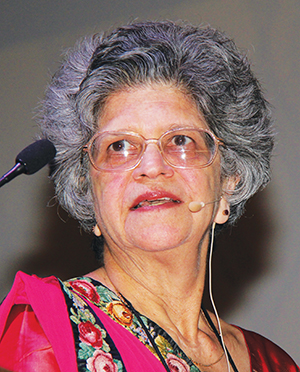
Roshan Rivetna: "heart-breaking" Photo: Jasmine D Driver
Results of this study, along with comparison with a similar study published in FEZANA Journal, Winter 2004, are published in FEZANA Journal, Fall 2013 (see www.fezana.org). A brief summary is presented below:
At the outset, it should be stressed that, while every effort has been made in good faith, to seek out reliable sources for each country, state and province, this compilation is at best, a ‘magazine survey’ and not an official, statistically correct census. The data may be inconsistent, inaccurate and incomplete. We present the data here, as received, to get a flavor of the Zoroastrian world, and leave it to the demographers and statisticians to determine its credibility and level of confidence, and draw conclusions.
Population
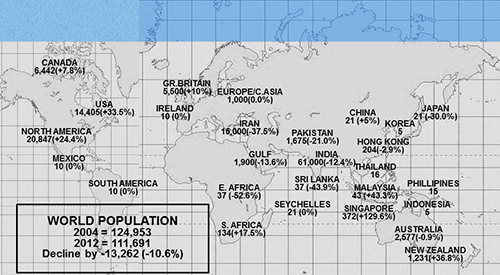
The world’s Zoroastrian population has declined from 124,953 as estimated in 2004, to a 2012 estimate of 111,691. In 2012 our survey shows 13,262 fewer Zoroastrians in the world than in 2004, i.e. a drop of -10.6% in less than a decade.
Of the total population of Zoroastrians, 77,712 (about 70%) live in the homelands of Iran and the Indian sub-continent (India, Pakistan and Sri Lanka), and 33,979 (about 30%) are spread in countries around the world. Countries with estimated populations over 200 are shown below, along with growth/decline since 2004:
India 61,000 -8,601 (-12.4%)
Iran 15,000 -9,000 (-37.5%)
(The government of Iran census figures place the number around 25,271)
USA 14,405 +3,611 (+33.5%)
Canada 6,442 +467 (+7.8%)
Great Britain 5,500 +500 (+10%)
(The Office for National Statistics in UK placed the figure at 4,105)
Australia 2,577 -24 (-0.9%)
Gulf region 1,900 -300 (-13.6%)
Pakistan 1,675 -446 (-21%)
New Zealand 1,231 +331 (+36.8%)
Europe approximately 1,000
Singapore 372 +210 (+129.6%)
Hong Kong 204 -6 (-2.9%)
The combined population of all remaining countries where Zoroastrians reside (Africa, Far East and South/Central America) is 385 Zoroastrians.
Decline in the homelands of Iran, India, Pakistan and Sri Lanka (which declined from 66 to 37 Zoroastrians) adding up to a total decline of 18,076 Zoroastrians, overshadows by far the large growth in USA, Great Britain, Canada, New Zealand and Singapore. Though the percentage growth is high, these countries, because of their small numbers, added only 5,119 Zoroastrians to the world population.
While the elephant has been in the room for some time, it is heart-breaking to see the actual numbers from the homelands. In Iran, while the 2011 census from the Statistical Center of Iran (SCI) reports a population of 25,271, Member of Parliament Dr Ekhtiyari, Zoroastrian representative on the Majlis, through personal knowledge and analysis of SCI’s province by province breakdown, estimates "no more than 15,000 Zoroastrian born population,” down from an estimated 24,000 in 2006. Mobed Mehraban Firouzgary, longtime director on the board of the Tehran Anjuman-e-Mobedan, concurs, citing reasons for the decline as primarily "continued emigration of behdins out of Iran,” which peaked between 2006 and 2011, and "an aging community, where death figures exceed birth figures significantly.” He adds, "Our population is so widely scattered and facilities as well as expectations for getting married and bringing up children have become so demanding and out of reach. There will be some respite if our youth would be less choosy in getting married, marry at a reasonable age, and reproduce in reasonable numbers” and makes a soulful plea: "Who can put forward an effective and preventive solution to this calamity?”
Likewise Toxy Cowasjee of Pakistan, where population has declined from 2,831 in 1995 to 1,675, reports large numbers of youth leaving Pakistan for universities abroad, "never to return.”
The rueful numbers from India, based on the Government of India (GOI) census data provided by Profs Armaity Desai and Siva Raju of the Tata Institute of Social Sciences (TISS), shows a decline of about 10% per decade since 1941, down to an estimated 61,000 (pending availability of the 2011 GOI census data). According to Desai, and corroborated by history scholar Dinyar Patel, this devastating loss is attributed to "late marriage, no marriage and fertility problems.” Demographer Zubin Shroff agrees: "The main factor behind the dramatic decline of the Parsi population is the abysmally low fertility … as expressed by a total fertility rate of only .89 in 2001.” World Zoroastrian Organisation Trust Funds trustee Dinshaw Tamboly also cites the high death-to-birth ratios, and sadly concurs: "… For a community to sustain itself, it must have a fertility rate of at least 2.1 … Can there be any doubt that the Parsi community of India is headed towards extinction?”
Through concerted efforts of
UNESCO-PARZOR (Dr Shernaz Cama), TISS (Prof Desai), Bombay Parsi Punchayet (BPP), and others, the Jiyo Parsi scheme, recently launched by the Government of India will give financial stimulus for a two-pronged approach providing counseling and fertility treatment to Parsi couples. This will bolster BPP’s fertility clinics program, and hopefully arrest, if not reverse the decline.
Very sad stories of a thriving population, now almost extinct, were received from East Africa. Only 35 Zoroastrians now remain in Kenya (Mombasa and Nairobi) and just one family of two, Diana Darukhanavala and her 83-year old father, on the island of Zanzibar, in Tanzania. After the revolution in 1963, almost all of the 250-300 Zoroastrians of Zanzibar left for India, UK, Canada or USA; the agiary and aramgah grounds were sold to a Muslim family a few years ago.
The diaspora
Population trends in the diaspora appear very encouraging, as the large percentage growth especially in USA, Great Britain, Canada, New Zealand and Singapore (see above) indicates, and should be cause for jubilation. However, the numbers need to be tempered with caution. While there are no available measures of "late marriages, no marriages and fertility rates” in these countries, the elephant in the room here is the threat of assimilation, exacerbated by small numbers, widely dispersed population, rising number of intermarriages, and their children not following the religion. FEZANA is aware and concerned, and has initiated surveys and discussions with association leadership and Zoroastrians of the first and ‘next’ generation,’ to address these concerns.
Intermarriages
There has been a very significant upward trend in the percentage of interfaith marriages. The percentage in Bombay has increased from 20.5% in 1992 to 38.9% in 2011 as reported by Parsiana. In North America, the percentage has increased from 23.7% in 1991 to approximately 60% for the last three years, 2009-2011, as reported by FEZANA Journal.
Data received from a few US states and Canadian provinces indicates that at least 25% of children of intermarriages do not follow the Zoroastrian religion. While the level of confidence in this data may not be high, this should be cause for grave concern, especially in succeeding generations.
A compilation of the percentage of non-Zoroastrian spouses in the Zoroastrian population yielded almost zero (in Iran) to a high of 43% in Seychelles. Very high percentage of non-Zoroastrian spouses were noted in countries with very small populations — South Africa (20%), Sri Lanka (22%) and Malaysia (25%). The percentages for western diaspora countries were USA (9.9%), Canada (5.6%), Great Britain (5.2%), Australia (4%) and New Zealand (2.6%).
Conversions
Conversions to other faiths do not appear to be significant. Seven US states, representing 25% of the US population responded to the survey, and reported a total of 15 Zoroastrians converted to other religions, mostly Bahaism and Christianity.
Age distribution
The highest percentage of children, 18 and under, were reported by Singapore (39.4%), Hong Kong (27.2%), Middle East (27%) and New Zealand (24.4%). The highest percentage of seniors, 65 and above, were reported by Malaysia (37.8%), Australia (surprisingly at 29.6%), Sri Lanka (27%), South Africa (25.4%), India (24.1%) and small populations like Mombasa in East Africa, with (pop. 15) reports: "There are nine (i.e. 60%) over 65, and there is no one below 40.”
Births and deaths
The situation in India is exacerbated by a very significant increasing trend in the deaths-to-births ratio as reported in Parsiana. For Bombay, the ratio increased from 303.2 in 1992 to 740.8 in 2011 — i.e. there were 741 deaths for every 100 births! During the 20-year period (1992-2011) there were 3,456 births and an alarmingly high number of 17,715 deaths in Bombay. [Parsiana birth figures are incomplete. The current figures to take would be those of the Bombay Municipal Corporation which show around 200 births as versus 850 deaths (death figures from BPP + one crematorium) in a year.] In North America, during the 21-year period (1991-2011) FEZANA Journal reported 1,022 births and 706 deaths (the actual numbers could possibly be double those announced in FEZANA Journal).
Origin — Parsi or Iranian
In USA, Canada and Australia, the percentage of Parsis is more than double that of Iranians (with exceptions, such as the state of California). The countries with small populations, all reported their populations were almost all Parsis and "data on Iranians was not available.”
Immigration
Rudimentary estimates indicate about 2,500 new immigrants to North America, mostly from Iran, between 2004 and 2012. This hardly compensates for the large losses in India and Iran.
While not an official, scientifically conducted census, this compilation does serve to give a demographic picture of the Zoroastrian world. We urge community leaders to take note of some rather alarming trends worldwide, seek the help of professional demographers, and implement actions tailored to the unique situations in each country, to reverse the trends, and bring about a Zoroastrian renaissance.
Committed to perpetuating the Zoroastrian religion in the diaspora, Roshan Rivetna was the editor of FEZANA Journal for many years. The FEZANA publications The Legacy of Zarathushtra and Zoroastrian Connections with Judaism and Christianity, edited by her, have been widely used for showcasing Zoroastrian history, religion and culture. She pursued a career in science at the Tata Institute of Fundamental Research, Bombay, Argonne National Laboratory and AT&T Bell Laboratories in Chicago.