
Music
Standing Up for Music
The resident conductor of the Symphony Orchestra of India, Zane Dalal, strikes a chord to attain greater heights
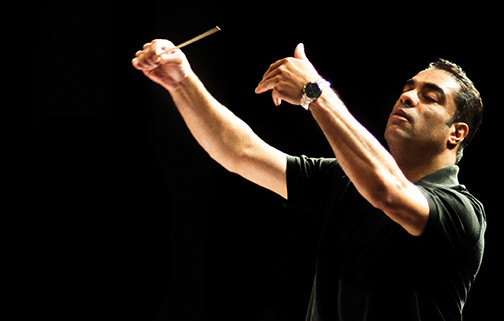
Above: Zane Dalal wielding his baton at a rehearsal
Music is alive and well in
people’s hearts. All of us who
make music have the same mission, the same instinct to offer opportunity to create music and to engage people in it. At the end of the evening we hope that the audience is as uplifted as we are. How you deal with the administrative differences is a matter of detail but the overall mission is the same no matter where you are in the globe,” says Zane Dalal resident conductor of the Symphony Orchestra of India (SOI) based in Bombay. Dalal explains that "I feel that all music performances worldwide only reach 33 percent of perfection. Music is different to different people and is highly individual. Music goes to where it belongs (as he looks to the heavens), we cajole music and hope and pray that we don’t damage it too much.”
"SOI has developed, spreading its wings and yes, has international standards,” he asserts. Responding to how SOI is faring today, the optimist says, "We will be able to do it. No question in my mind. It’s a young orchestra and the time spent together is so limited.” He talks of an institutional memory and adds, "We have not been around long enough for that… The next few years are crucial and must be managed well and understood by all (involved in music in Bombay).” Dalal is all praises for Khushroo Suntook chairman of the National Centre for the Performing Arts (NCPA), who "makes it possible and allows Marat (Bisengaliev, the music director of the SOI) the musicians and me to work on the music.”
Managing the SOI "Is like managing the United Nations Security Council and without the benefit of a gavel.” Upbeat he adds "…the rewards are better than the challenges.” There are several nationalities represented here and Indians figure in single digits. However, the uncompromising worker is certain he does not want the audience to say "that’s a good orchestra, for India.” He wants to hear "that’s a good orchestra. Full stop… After all the New York Philharmonic performs with a majority of Israelites and Russians and the Berlin Philharmonic is strung with the Chinese and Japanese.” SOI has two avenues open he recognizes — they "can create a fresh orchestra and invite back non-resident Indians in pursuit of music and make a core.” Dalal adds that would be the quick fix solution. Or they could grow talent at home and until then, have it subsidized by the NCPA, as is being done currently. "Indian musicians in India have no conservatory to hone them from age five years to 25 and deliver them as musicians.” This perfectionist is clear that "quality of the Orchestra cannot be short changed. They must be first rate and must be within the budget — that is a bit of a compromise already. Join only for music standards not for the nationality. Already we see movement from the back desks to the middle and front of the section (referring to the Indian musicians). They contribute in a spectacular way. The training given has made them the best of musicians.”
The foreign members of SOI return season after season as they enjoy being here. Dalal shares that they have a list of players who want to come to India on a two-year contract. The best from the list will make it, as will those who have been coming back — all within budgetary constraints. And that is another spin off altogether. Finances are garnered privately from patrons, well-wishers, like-minded individuals and some corporates. Dalal’s business sense wants more formalized subsidy — from the city, the government or an "established fund-raising methodology.” This pragmatic idealist believes in institutions; in long-term relationships which are not dependent on interpersonal equations, which are fraught with fragility and may be short-lived. His passion seems to be to put SOI on a firm footing, create a legacy. He laments the lack of synergy between already existing western music groups in the city.
To a question whether he faces criticism from people who say he is bringing in ‘foreign’ culture, he enters with a bang: "Nobody would dare...subverting Indian culture is not possible unless you have a political axe to grind.” He believes Bollywood has already overridden all classical music and even Hollywood (in popularity)!
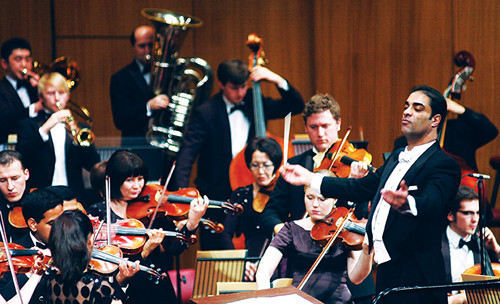
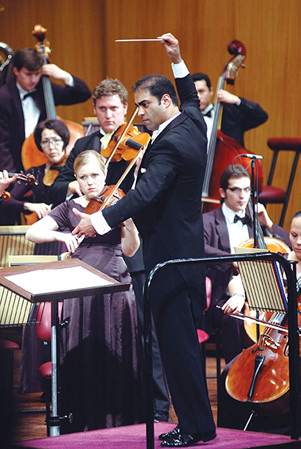
Zane Dalal (standing right) conducting the Symphony Orchestra of India
He thoroughly enjoyed his last concert with composer-singer Shankar Mahadevan in early 2012 and was all praises for the Indian vocalist. He however believes that fusion "doesn’t work. It’s a bit of hype and can become gimmicky.” After a pause he explains his position – "western classical music is like a beautiful piece of Swarovski crystal. You can replicate it with the same precision. Indian music is an individual style and not produced by pre-written note on note. The Indian musician is cheered on during the concert, the wah-wahs are encouraging. The western classical musician is irked by clapping mid piece. A classical Indian music concert can never be the same again.” Referring to a tabla concerto written by maestro Zakir Hussain, he feels that when Indian classicists exposed to western music experiment with the western rigor of beat and timing the outcome is great music. He validates how Mahadevan restricted his alaps (a melodic improvisation) at their last concert so that Dalal could bring in the orchestra at the appointed notation. One more or less alap, would have thrown Dalal off the podium and the orchestra off the center! This kind of experimentation and expertise seems to enthuse him.
He talks animatedly of Dr Suvarnalata Rao, the programing head and research scientist at the NCPA, Bombay who works in the area of computational musicology, trying to find notation to Indian music. He is looking forward to collaborating with her in articulating differences between the two genres.
Dalal came to India from the USA, as his uncle Nariman Irani informed him of a vacancy for an assistant conductor in Bombay. Irani told him that his friend Suntook had formed a professional orchestra in Bombay "…and Khushroo would not take on anything without having a standard.” Dalal flew down to Bombay to explore. The SOI was performing Tchaikovsky’s Fifth Symphony during the second season when he requested to be allowed to conduct the SOI for 20 minutes and found the Orchestra to be of a high standard. His decision was made. Five years later he is still here to stay.
Dalal believes that his musical instinct and talent come from his father Phiroze who played the harmonium and won an all India prize at a competition. Young Phiroze earned the prize but never received it as partition happened and he had returned to his hometown Karachi. Mother Dhunmai is a western music buff and Zane and his brother Hormazd were exposed to Bach, Beethoven and Schubert from an early age. Hormazd is an information technology specialist in the US.
Music seems to have happened to Dalal. He narrates how he has been told that he sat underneath the piano after the music period refusing to march off to class with the rest in kindergarten. This self-willed ‘squatter’ ultimately grew up desirous of reading Medieval history for graduation studies but ended up with a music scholarship to Oriel College, Oxford "... and you do not refuse a scholarship to Oxford.” Formal study of music started in England where as choir master he found his feet. "Feet” — the word makes Dalal recount how he was discouraged at the age of seven from pursuing the organ as his feet did not reach the pedals and was persuaded to play the piano instead. Piano and conducting, it was.
Conducting is his métier, but he is mentally exhausted, especially after a concert. "Too animated,” he says "can’t sleep after a concert, unless you swallow a sleeping pill! The body is tired. The mind is spark. Music-making is so elusive. Music needs to be conjured or the muse will not come...” He likens music to faith and is aggrieved if either is denied to those in pursuit — "There’s a direct reaction to music. We should not be so foolish as not to put it in front of people. We have no right to deny it to anyone. Music is not elitist. This is true of faith as well...
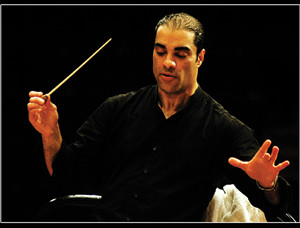
"There’s a direct reaction to music... We have no right
to deny it to anyone. Music is not elitist. This is true of
faith as well”
"Some of the strictures forced on us as a religious group are far divorced from what the Gathas tell us. At the Bombay Parsi Punchayet elections, where dirty linen was washed in public, it was distasteful to say the least. Faith comes to individuals as a gift of Ahura Mazda and it is personal to each. You may not take your version of it and impose it on others. Religion is not ‘because priests say so or mummy and daddy say so’ — it comes from above.” He continues, "Where there is no precedent, to be told what to do is morally offensive.” This comes from a man who recites a stanza from the Hormazd Yasht before he goes up on stage.
"I am a man of faith,” Dalal avers. "How can I not be when something is going on on stage which is bigger than all of us? My religion is in the Gathas as everyone concedes. Yasna 33 clearly states that each of us chooses for themselves the right path, as given in their wisdom. All other texts – the Vendidad, the Visparad have been added later and cannot and should not compete with the weight of the Gathas. It is like the Old Testament — it is not a religious text. It is historic and social. The only comparison to the word of Zarathushtra — the Gathas, is the Gospel and nothing else is significant. They have been added by man...
"Music, like faith (he never refers to the word ‘religion’) is meant to lift us. It makes us tolerant, liberal and reach for a higher purpose.” To drum in his point he talks of the ‘group effect of music.’ To quote Dalal: "An orchestra is a wondrous thing. Music goes after that which is elusive. It is not just teamwork which will get you to the top. Each one executes what they practiced in private and contributes it as a single unit. All of them are separate and one at the same time. There is no hierarchy... each person has a valid, organic equality. After years you come out of the black hole of your practice room. All of the other 45 odd persons have their own history and yet, the same history... You hope you are led by someone who inspires you to your best.” He ends with what he learnt from his mentors, that it’s important to make the group sound better than they believe they are, and better than they actually are.
◆ ◆ ◆
From the archive