
Music
Orchestrating music in Bombay
The Bombay Chamber Orchestra trumpets in its golden year
"A lot of the musicians get up at 5 a.m. to be at rehearsal at 7 a.m. They then rush out at 8.30 to get to their places of work. I am so, so proud of my people…” shares Jini Dinshaw, one of two founders of The Bombay Philharmonia Orchestra (BPO), now termed the Bombay Chamber Orchestra (BCO), the only Indian orchestra to date with foreigners playing gratis. The octogenarian musician cannot stop admiring the spirit of young India and how these artistes are completely dedicated to music. "No honorarium is paid — except travel costs,” she says. Even today, 50 years later, the Orchestra boasts of 55 strings with support from musicians from the police as well as the Indian Navy.
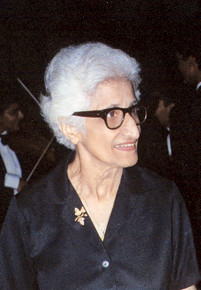
Jini Dinshaw
She wants this golden year to be special. November 11, 2011 already heralded in the first concert with Dilshad Posnock playing the Mozart flute concerto in D major and Dushyanthi Perera playing the Dvorak cello concerto in B minor. The next concert in April will see Farhad Billimoria playing Bruch’s violin concerto. The second half of this program will be light classics and a surprise for the Bombay audience. Two more performances are in store in August and November 2012 where BCO hopes to invite a soprano from Russia and musicians to perform Russian works.
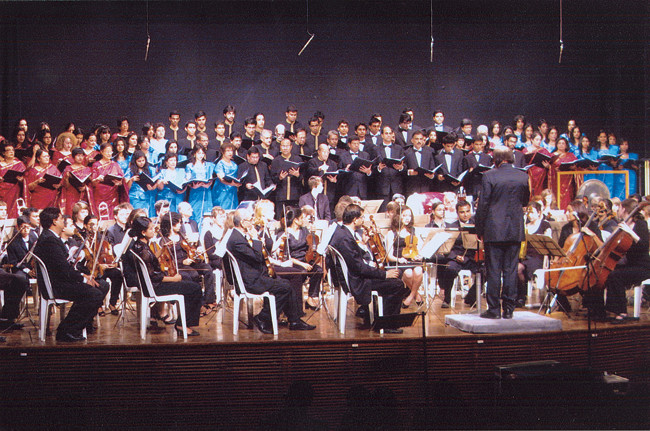
The BCO and local choirs performing The Armed Men by Carl Jenkins conducted by Dr Hans Jürgen Nagel
How it was all strung together
The BCO has performed under the baton of more than 50 conductors, given opportunity to more than 100 soloists and all the well known choirs of Bombay. Infusing spirit and finance into the orchestra has not been an easy task. Dinshaw recounts how she brought back the orchestra from near closure two or three times. One such instance was in 1975 when she cried help from a young cellist whose performance she was forced to cancel as there was no conductor. This young British cellist was so moved by the plight of western classical music in Bombay that he identified Dr Charles Darden and financed his visit for nine months as BCO’s guest conductor. Being the excellent trainer he was, Darden trained the orchestra to perform a superb rendition of Dvorak’s Serenade for Strings. Those who played in the rear desks then are still performing in the BCO, but now are the front desks or lead players.
Putting up a concert has now gone up to a hefty Rs 5,00,000 — of this only a quarter of the expenditure is retrieved from the sale of tickets. The highest expenses go toward hiring the hall and taxes. Dinshaw gratefully acknowledges the donations of well wishers, especially in the absence of organized patronage. Her regular donors are philanthropists who choose to remain anonymous, she notes.
The BCO owes support to the British Council which came to its aid several times as did the Goethe Institute (The Max Mueller Bhavan in India). These institutes have helped the BCO to survive by giving space for practice, finance, teachers, trainers and even musical scores which are very difficult to come by and are expensive. Till the early 1980s, oboe and bassoon players, and clarinetists were in short supply and rare to find, till trainers came to Bombay from various countries, sponsored by well-wishers. Winds and brass were often ‘borrowed’ from the Services. Dinshaw reminisces, "those days when Navy people were sent off on ship and police people were suddenly transferred and gone” are now in the past. "There are always tense moments. At last, I’ve got over it,” she trails off.
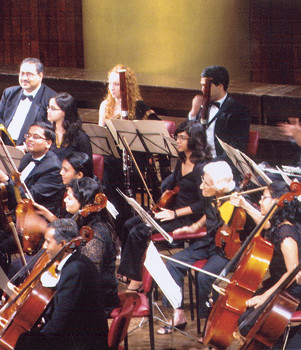
Cello and wind sections of the BCO performing gratis
Meeting at Waterloo…
It all started at London’s Waterloo station in 1948 waiting for a train back to the family’s summer rental where Dinshaw spied a lady seated on a station bench with a violin case. "I wormed my way next to her and asked her if she was a teacher.” When the answer was no, Dinshaw asked the unknown lady if she was tutored privately, as music schools require a distinction in the eighth grade for entry. The enthusiastic Dinshaw was delighted to discover that a teacher was located only a station away from their rented home. So off she went to the home-studio of Gladys Noon, who not only accepted this determined young Indian as her student but also offered her board and lodging for three-and-a-half years in her spare room. Dinshaw also lodged with Noon a few years later when she studied under Antonio Brosa.
As the name ‘Philharmonia’ suggests, the BCO comprises of amateur musicians as opposed to the philharmonic orchestra which has professionals. Dinshaw and Pervez Doctor saw a need for an orchestra in the mega city of Bombay in 1962. Dinshaw still heads and orchestrates BCO’s functioning.
Around 1975, there seems to have been a conflict of interests between the two founders and Doctor moved on to do other things. He has founded the B P Ensemble which gives concerts during the two Parsi new years. The two founders presented the music loving audience of Bombay "with every important concerto — Bach, Liszt, Beethoven, Schumann, et al. The BCO has been in concert for the Double and Triple Concerti of Beethoven as well.”
Dinshaw, a lady with brass has been teaching using the Orff Schulewerk method which combines music, movement, drama, and speech into lessons that are similar to a child’s world of play. Most of the current players are her pupils of the Orff school. When cellists — Lester, Aarons, Shroff all had to stop due to advanced age or death a few decades ago — she decided to learn the cello and went off to Europe. Dinshaw asked her Swiss viola player friend for a quick fix cello solution but could afford only four lessons. She returned to Bombay with a teach yourself manual and completed the job only as someone with her tenacity can.
"With support and our own dedication the first performance of Adam’s ballet Giselle was up on stage. It has been the only ballet performed with live music in India. Conductor Emanuel Young prepared the musicians and Branwell Tovey conducted the performance which was televised and broadcast all over India on April 6, 1985.” Dinshaw sums it up: "All I can say is it was a great experience.” Ernst Hoetzl also has a long standing relationship with the BCO, having had the orchestra under his baton for 10 concerts. Bombay shall hear him again this coming season.
Performance plus
The city’s orchestra has survived half a century and promotes Indian players, bringing in foreign artistes only when unable to find talent at home. The Symphony Orchestra of India (SOI) founded in 2006 has several artistes from Kazakhstan and is nurtured and funded by the National Centre for Performing Arts. Dinshaw is proud that almost all the current musicians of the SOI are former musicians of the BCO. She is convinced that a school of music is a must to sustain an orchestra in any city.
The musician has often turned fund raiser; she has convinced government officials at Mantralaya to waive entertainment tax and industrial houses to raise advertisement rates after 15 years. She wrote to the late prime minister Indira Gandhi — who was a great lover of Bach — about waiving tax altogether for the BCO. She obliged. She also pleaded with Gandhi to set aside the 300 percent duty on import of instruments, which resulted in her getting one-pedal timpani free from Germany.
The founder relates how the music company Furtado’s called her to meet an official from Yamaha, Japan. Her convincing abilities got Yamaha to donate a set of brass and woodwind instruments. Before the dispatch, they asked if the BCO had support of the Government. When the answer was in the negative, "this bonanza was diverted to Colombo, Sri Lanka and we lost it all!” However, a decade or two later Dinshaw has replaced the 75 years old instruments with a new set — two French Horns and one bassoon. The oboes still need repairs and she does not know whom to turn to!
Her eclectic taste is also reflected in her vintage classic maroon Rover car, her pride and joy. Even the lift in her building plays classical music as you ride in it to the top floor where her studio is. She greets you with a topi on and is unaware that she is wearing it. Dinshaw takes her religion as seriously as her music. Her navjote was done inside a fire temple and she prays every day. She laments the divisive ways of the community and chides fundamentalism.
The violinist-turned-cellist has no time for anything else apart from teaching and playing music — no hobbies, no other way of replenishing herself… It is a far cry from the days when no hostel would permit her to practice an instrument. Noon’s spare room saved the day for her when she was a student as does her studio today, located at the top of her residence. The hustle of the road beneath remains muted, as music wafts through the air a few flights up from commercial Bombay beneath.
◆ ◆ ◆
From the archive