
Cover Story
Striking a new chord
NCPA chairman Khushroo Suntook refers to his cultural and financial plans to put India’s performing arts on the world stage
"To make the NCPA (National Centre for the Performing Arts) a vibrant production house that programs and presents world-class events in the area of Indian and international music, dance, theater, etc” is the cherished goal of chairman Khushroo Suntook. His ultimate dream is to see talented Indians make "a career in music and art apart from IT (information technology) and cricket.”
He strongly believes that the facilities at the NCPA are unparalleled not only in India but in all of South Asia, and these magnificent spaces need to be used productively. Besides the imposing Jamshed Bhabha Theatre the NCPA complex at Bombay’s Nariman Point has four other auditoriums — Tata Theatre, Experimental Theatre, Godrej Dance Theatre and Little Theatre. The Piramal Gallery, the library, rehearsal rooms, recording studio, audiovisual archives and the four gardens that are hired for performances and functions are the other attractions of this sea-facing property. To make it a leading and pulsating center Suntook has introduced changes to vitalize this venerable institution. Observing that a centralized management was not the most efficient manner to run the NCPA he divided the organization into five heads: Theatre and film, Indian Music, Dance, International Music and Photography, each of the verticals being headed by a competent individual and supported by a competent committee of experts. The NCPA has recently added a sixth art vertical — Jazz.
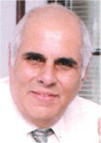
Khushroo Suntook
In 2006, two years after he took over as vice chairman of NCPA, Suntook gave this city The Symphony Orchestra of India (SOI), India’s first fully-professional orchestra. In the beginning, there were only seven or eight Indian members which has now increased to 16 or 17. "At first there was scepticism whether a professional orchestra would survive,” he recalls and "criticism that there were too many foreigners in it.” Observing the dynamic presence of Indians in other institutions too, Suntook comments, "In the past, you would not dream of an all-American apple pie organization like Citibank being headed by an Indian.” The absence of a conservatoire in India makes it extremely difficult to find Indian nationals who are of the required standard to join the SOI. To create a first class international orchestra, there is need for top class players and teachers, he explains, citing the example of all orchestras overseas that have members of all nationalities. For the SOI, "Ample opportunities to train with the best are given. Of one thing I am certain: there can be no compromise in quality,” Suntook is determined.
The commitment of the organizers and performers, the appreciation of the audiences in Bombay and sponsorship support from Citibank have all contributed to SOI’s growth. At the last press conference for the ninth season in September 2010, Citibank announced that they would support the SOI for another three years. The other two orchestras they support are the New York Philharmonic and the Boston Opera. "So, as you see, we were in very august company,” states Suntook.
On June 11, 2010, the SOI made its presence felt internationally by playing at the Fifth Festival of the World’s Symphony Orchestras in Moscow, and earning fine reviews particularly in the Moscow Times. They played Beethoven’s 9th Symphony on the concluding night, as part of the grand finale, in the presence of the highest echelons of Russian society.
Efforts are also being made for promoting Indian music which has always been based on a teacher-pupil relationship (guru-shishya parampara). Students and teachers will both be in residence and there will be facilities for talented pupils to stay in dormitories. Advanced students may get full tuition at a reasonable cost.
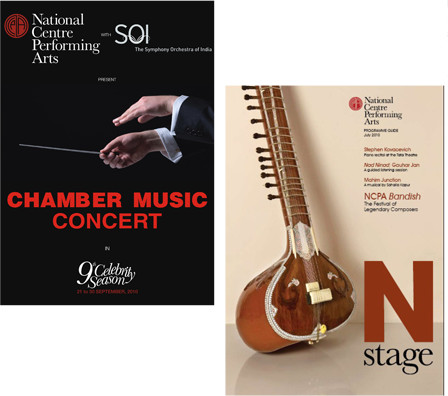
Western and Indian music programs announced by NCPA
To familiarize children with musical instruments, Suntook has introduced the Suzuki initiative where 287 children between the ages of four and seven are being trained to play the violin. Since the Suzuki method needs very good teachers for it to be effective, Suntook has devised a plan: initially five teachers would be selected who in turn would each train five teachers in the first year. Then 25 teachers will each train another 25 teachers. Those children who learn to play the violin by the Suzuki method may subsequently progress to Western classical, Hindustani or Carnatic music.
Music was a very vital part of Suntook’s growing up surrounded by the music of great singers and instrumentalists like Caruso and Rubinstein. Tutored by a piano teacher very often an impromptu concert would be held at home where his grandfather used to sing. He has fond memories of music and singing being taught in school and the awe-inspiring Friday evenings from 5 p.m. to 7 p.m. at St Xavier’s College where Fr Raphael and Fr Corbello played old fashioned 16" long playing records (LPs) of western classical music for students. He is an internationally known record collector, and counts amongst his friends famous personalities such as Vivian Liff and Michael Henstock.
An extensive collection of more than 20,000 books (many of them signed by celebrities) and recordings is housed in the NCPA Library, Bombay’s only specialist arts library, recently expanded to include the magnificent Stuart/Liff Collection, containing 6,000 books and 11,000 recordings — a unique collection in the world of opera and Western classical music. "So impressed was Anooshah Golesorkhi, the singer who performed Scarpia in Tosca (see "His roles and his roots,” page 16) that he wanted his bed to be put in there,” reveals Suntook.
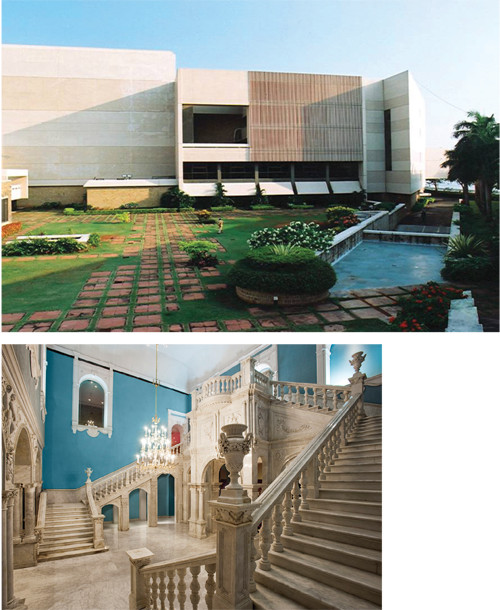
(Above) NCPA complex; (below) imposing stairway of Jamshed Bhabha Theatre
The NCPA also has a fully equipped recording studio at the Little Theatre. Five thousand hours of memorable Indian music (the recording being started 30 years ago in the house of Bhulabhai Desai at Warden Road even before the NCPA was built at Nariman Point) have been preserved under carefully controlled conditions of humidity and temperature. An agreement has just been signed with Sony Music to make these available to the general public whilst ensuring that the artistes or their families receive commensurate royalties.
A lawyer by profession, and a Fellow of the Company Secretaries of India, Suntook’s career has impacted several industries: he was one of the founders of India’s first mineral water company, Bisleri; was president of Tata Services Limited; chairman of The Associated Building Company Limited; and has been on the board of Trent Limited, Tata Oil Mills Limited, National Peroxide, Tata McGraw-Hill Publishing Company Private Limited, Tata Investment Corporation Limited, Lakme Limited. His interests though are not limited to the world of commerce: he has served as executive committee member of the Cricket Club of India and chairman of its sports committee. He was a State-ranked tennis player and has not only won several titles but has also been actively involved in organizing many tennis events in Bombay, including the Davis Cup, and was the youngest secretary of the exclusive and prestigious International Lawn tennis Club of India.
Since 2008 he has been the chairman of NCPA after the passing away of Dr Jamshed Bhabha who was his mentor. Farsighted in his outlook even at the age of 91, Bhabha had commissioned the building of an opera house at the NCPA (later named the Jamshed Bhabha Theatre). When nearing completion the theater was accidentally burnt down in December 1997. "The next morning he called a meeting and his opening statement was, ‘When can we start rebuilding?’ There was no fault finding or recriminations; he was certain that would be done in due course, but there was the sense of looking forward and a job to be successfully completed, and while the embers were still burning he was already planning to rebuild it,” recalls Suntook.
For the many plans that Suntook has for NCPA, much money is needed. He firmly believes that the art community should organize itself and lobby with the Government of India that culture is as important as any other area and needs support. "We have a wonderful cultural secretary in the central government in the form of Jawahar Sirkar who has been very supportive about promotion of culture.” While, the NCPA is hoping to get support from the government, Suntook is not losing sight of international funding models for performing arts organizations, arts centers and orchestras. In Europe for instance, performing arts organizations get up to 25 percent of their funding from the government and up to 40 percent from box office, which, as Suntook points out, "is difficult to match in India. At NCPA, box office revenues are a mere 10-12 percent and there is no government funding. In fact we pay a tax of 25 percent on all international music and dance performances.” In the USA all arts centers and great orchestras are run independently with most of the funding done though private endowments and bequests. "This is the business model we need to follow, hoping that patrons will be forthcoming,” Suntook emphasizes.
Western music in India needs to be professionalized, insists Suntook. "I have the greatest respect for the amateur groups who work with remarkable enthusiasm and passion, but if I’m working at an office from 9.30 a.m. to 5.30 p.m. and then I’m expected to go at 6 p.m. for a rehearsal and return at 7 p.m. after office then I’m not going to be at my best,” he realizes. There is little time to practise, no money to rehearse as halls are expensive. "The whole infrastructure just does not support quality. This is why some of our best musicians left India,” he says referring to Mehli Mehta, Zubin Mehta, and many others who are successfully employed in orchestras and arts centers. Zarin Mehta is the CEO of the New York Philharmonic. Rich Parsi institutions like the Parsi Punchayet and large business houses should take up this role of encouraging the teaching and promotion of culture on a professional basis, ensuring artistes earn a decent livelihood, opine many musicians. While Parsis have always been in the forefront of western music, they have not taken sufficiently to Indian music and dance.
As Suntook asserts, "People have appreciated classical music for 300 years worldwide so there must be something right with it; these are not mere pop groups which come and go. This is great music and like great literature you have to ensure that you have sufficient knowledge of this genre, which helps make a well-rounded personality and thereby a civilized society.”
◆ ◆ ◆
From the archive