
Music
“Our colorful orchestra”
The National Centre for the Performing Arts aspires to prepare young music talent to international standards
Leah Divecha who plays the violin and Soli Nallaseth, pianist, were the two budding Zoroastrian artists at the National Centre for the Performing Arts’ (NCPA) Special Music Training Programme (SMTP) on June 25, 2015, featuring students learning various instruments from strings to wind to brass. From a total 27 SMTP performers, 10 performed solo with an average age of 12.
On both sides of the stage the children were exemplary in behavior. The young players had no false starts, no audible mistakes and no gauche moments. The youth orchestra was not in formal uniform per se but in a riot of solid colors, causing Suntook to urge the viewers to "enjoy our colorful orchestra.”
Aware of the universal apathy to practice, NCPA chairman Khushroo Suntook lauded the young musicians for all their hard work. Welcoming the audience at NCPA’s Tata Theatre, Suntook acknowledged the parents’ role in pushing the young musicians to practice two hours a day as they were "goaded, encouraged by parents…all worth it for this accomplishment.”
The other neophyte soloists were on quartersize cello, double bass and violins — small enough for the players aged in single digit numbers. Before the intermission were strings and a flautist, who darted into the wings without receiving his bouquet of flowers, throwing off the nonplussed youth presenter, to laughter all round! The first solo was a French dance Gavotte by Dmitri Shostakovich on the violin by a nine-year-old.
On both sides of the stage the children were exemplary in behavior. The young players had no false starts, no audible mistakes and no gauche moments. The youth orchestra was not in formal uniform per se but in a riot of solid colors, causing Suntook to urge the viewers to "enjoy our colorful orchestra.”
Aware of the universal apathy to practice, NCPA chairman Khushroo Suntook lauded the young musicians for all their hard work. Welcoming the audience at NCPA’s Tata Theatre, Suntook acknowledged the parents’ role in pushing the young musicians to practice two hours a day as they were "goaded, encouraged by parents…all worth it for this accomplishment.”
The other neophyte soloists were on quartersize cello, double bass and violins — small enough for the players aged in single digit numbers. Before the intermission were strings and a flautist, who darted into the wings without receiving his bouquet of flowers, throwing off the nonplussed youth presenter, to laughter all round! The first solo was a French dance Gavotte by Dmitri Shostakovich on the violin by a nine-year-old.
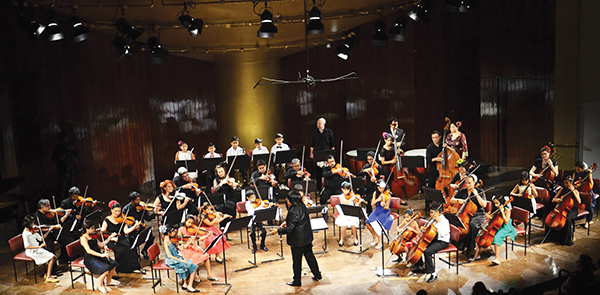
The Symphony Orchestra of India with students of the Special Music Training Programme of the
National Centre for the Performing Arts
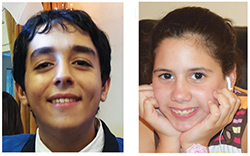
Soli Nallaseth (left) and Leah Divecha
After the intermission were the pianoforte students — mainly taught by Aida Bisengalieva. Nallaseth’s piece was the only full work played that evening. He set the pace for the orchestra with his opening bars of a piano Concerto by Johann Sebastian Bach accompanied by the Symphony Orchestra of India (SOI). Cavas Bilimoria, the administrator of the Programme, had requested the audience not to clap between the three movements and his request was well adhered to.
The entire evening was conducted by founding music director Marat Bisengaliev — a Kazakh from the undivided Soviet Union, who has recorded and performed internationally on the violin. Nine years of his stint with the SOI in Bombay, is referred to. "Apart from the SOI…” he mentions two other orchestras he has founded.
The students learn the Russian music method for an hour, twice a week. This method is rigorous, disciplined and precise. There seems to be no alternative to hard work, in fact practice is the operative word. Bilimoria expanded that "the Russian system of music education pays great attention not only to the technical mastery of the instrument, but also to the interpretation of the music — to phrasing, to nuance, and to the intelligent use of the dynamic markings.”
The NCPA’s SMTP, launched in 2012, offers "holistic music education that is inspired by the Russian Conservatoire method. Students receive substantial one-to-one tuition on their primary instrument, second-study piano lessons, group-singing taught via the Solfeggio method, music theory classes and history of music lectures,” their website states.
Bilimoria explained that music for smaller groups was often more difficult to play than for larger groups as the grandeur of sound of larger orchestras replaces the intricacies of the music. His informative tidbits made the music fun for the audience and especially for the crowd of children in the audience who had come to applaud their kith and kin. Bilimoria narrated the Russo-Slavic legend of Baba Yaga during the piano piece of the same name of a witch who flies around in a mortar and wields a pestle. She is said to live in a mobile hut which stands on chicken legs.
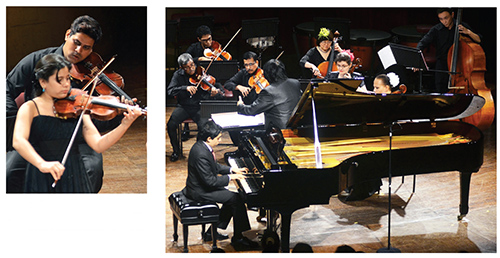
Leah Divecha with violin (left); Soli Nallaseth at the piano
The penultimate piece of the evening of classical and light western classical music had an arrangement of the old Bollywood hit Lakdi ki kathi (frame of wood) which is a children’s popular song from the film Masoom (the innocent). It got loud applause for its popularity and familiarity.
Divecha started playing the violin at the NCPA four years ago at age seven. She responded to questions from Parsiana and excitedly added, "I now learn with the best, nicest and most wonderful teacher of all time. Her name is Dina Seminova.” This comment underlined and in bold in her response.
Semenova and Olga Lyapina teach the violin, Stuart Potter the flute. Bakir Utepbergenov teaches the double bass to the diminutive string player, who is half the size of her quartersize cello — not that it interfered with her bowing and or musicianship. Yulya Gallyamova prepares the cellists.
Divecha’s aspirations are specific and this schoolgirl of J.B. Petit High School knows her mind as she mentioned: "I plan on playing in Carnegie Hall someday and going all over the world to play my violin.” The youngster lets us into how she is more fearful during her examination than during a concert as "you are actually getting marked on your performance.” She also informs us, "I just say a few words to Dadar Hormazd and try my best.” Divecha ends with "Zoroastrianism is a religion which does not force us to do anything except use our right mind and always try to do the right thing.” Neither she nor Nallaseth have any religious compulsions. Practice is the only one.
Nallaseth says a general short prayer as he slips from the wings onto the stage. He adds, "I am very proud to be a Zoroastrian… The Zoroastrian people are also some of the most generous and wonderful (and fun!) people that I’ve ever met and this is what appeals to me the most about our community.”
Nallaseth practices five to seven hours a day, which he had to bring down to his chagrin, to one or two hours during his 10th standard board exams. The Bombay International School student seems to thrive on music as he talks of his future plans. At the Musica Mundi in Belgium on a full scholarship for the summer festival in July 2015, Nallaseth was one among 250 applicants. Later he will attend piano summer school at Chetham, UK prior to the two-year program where he will be trained academically and musically. "I feel that this step is essential for my musical development so that one day, hopefully, I can become a pianist, as I have aspired to be since I was 10 years old,” he informed us in response to our questions. However, it did not stop the 16 year-old from doubling up as the percussionist of the orchestra in the Radetzky March of Johann Strauss. The instrumentalist feels a special connect with the piano — especially his first B. Steiner upright, as he "waved farewell to an old friend,” only to welcome his Shigeru Kawai grand piano, which he loves.
"I currently learn with Ms Aida Bisengalieva, who is officially the most wonderful human being in the world. She never shouts at anyone… is an unbelievably kind person and one who I feel honored to know,” he responds to a question on his teacher. He also fills us in on how she celebrates students’ birthdays with chocolate hand-outs on their special day.
Asked about nervousness on stage, he responds, "I manage my nerves by accepting that they are there! ... and work even harder in practice knowing that in concert I’ll be playing with only around 60% of my real ability due to nervousness.”
Both the musicians string along with their music and academics hoping to make a career of it. They play seriously… not play along.
◆ ◆ ◆
From the archive