
Events & Personalities
‘Poor’ Parsis
When The Times of India (TOI) reported on June 12, 2012 that the Bombay Parsi Punchayet (BPP) had told the Bombay High Court (BHC) that its definition of a poor Parsi is one who earns up to Rs 90,000 per month, it led to incredulous, even outraged, reactions from all quarters. There were immediate comparisons with the Planning Commission of India’s figures which had been pegged at Rs 29 per day to define a person as being below the poverty line.
Speaking over the telephone to Parsiana, BPP chairman Dinshaw Mehta explained that family income aggregating Rs 90,000 has always been the upper limit for ownership flats offered by the BPP and not for rented housing. Since the BPP’s ownership flats cost about Rs 20 lakhs, factoring in repayments on housing loans (capital and interest), maintenance and other outgoings (of about Rs 5,000), a family would need to fork out between Rs 25,000 and Rs 30,000 per month. How would this be feasible unless their earnings were adequate to cover the costs? The figure of Rs 90,000 does not define a "poor” Parsi, Mehta averred.
The confusion arose when Mehta filed an affidavit in the BHC on June 11, 2012 mentioning the cutoff figure as Rs 90,000 in a petition filed by 65-year-old Rohinton Taraporewala, a resident of Dahanu, whose application for a house in the BPP managed B. S. Panthaki Baug in Andheri had been rejected. Alleging corruption in the BPP, Taraporewala had submitted names of persons who had been allotted flats despite earning over Rs 50,000 per month, noted TOI on June 12. The applicant claimed that as he and his wife were ailing they needed to be in Bombay where medical help would be near at hand. Mehli Colah, chief executive officer of the BPP clarified to Parsiana that the figure of Rs 50,000 applies only to eligibility for allotment of rental accommodation.
In his reply of April 17, 2012, Mehta had nixed Taraporewala’s contention that he was a "poor, needy and deserving Parsi,” as he allegedly owns 17 acres of land in Vangaon, Dahanu, along with a two-storeyed bungalow measuring 2,000 sq ft which "on a conservative estimate would be valued at Rs 1.5 to 3 crore,” reported TOI, which also mentioned that tax returns show that Taraporewala’s income exceeded Rs 90,000 per month, according to the BPP. In the affidavit the BPP mentioned that they do not consider applications for ownership housing if persons earn more than Rs 90,000 per month. Also, among the criteria for BPP ownership housing it is stated that applicants who are newly married or about to get married would be given preference.
Speaking over the telephone to Parsiana, BPP chairman Dinshaw Mehta explained that family income aggregating Rs 90,000 has always been the upper limit for ownership flats offered by the BPP and not for rented housing. Since the BPP’s ownership flats cost about Rs 20 lakhs, factoring in repayments on housing loans (capital and interest), maintenance and other outgoings (of about Rs 5,000), a family would need to fork out between Rs 25,000 and Rs 30,000 per month. How would this be feasible unless their earnings were adequate to cover the costs? The figure of Rs 90,000 does not define a "poor” Parsi, Mehta averred.
The confusion arose when Mehta filed an affidavit in the BHC on June 11, 2012 mentioning the cutoff figure as Rs 90,000 in a petition filed by 65-year-old Rohinton Taraporewala, a resident of Dahanu, whose application for a house in the BPP managed B. S. Panthaki Baug in Andheri had been rejected. Alleging corruption in the BPP, Taraporewala had submitted names of persons who had been allotted flats despite earning over Rs 50,000 per month, noted TOI on June 12. The applicant claimed that as he and his wife were ailing they needed to be in Bombay where medical help would be near at hand. Mehli Colah, chief executive officer of the BPP clarified to Parsiana that the figure of Rs 50,000 applies only to eligibility for allotment of rental accommodation.
In his reply of April 17, 2012, Mehta had nixed Taraporewala’s contention that he was a "poor, needy and deserving Parsi,” as he allegedly owns 17 acres of land in Vangaon, Dahanu, along with a two-storeyed bungalow measuring 2,000 sq ft which "on a conservative estimate would be valued at Rs 1.5 to 3 crore,” reported TOI, which also mentioned that tax returns show that Taraporewala’s income exceeded Rs 90,000 per month, according to the BPP. In the affidavit the BPP mentioned that they do not consider applications for ownership housing if persons earn more than Rs 90,000 per month. Also, among the criteria for BPP ownership housing it is stated that applicants who are newly married or about to get married would be given preference.
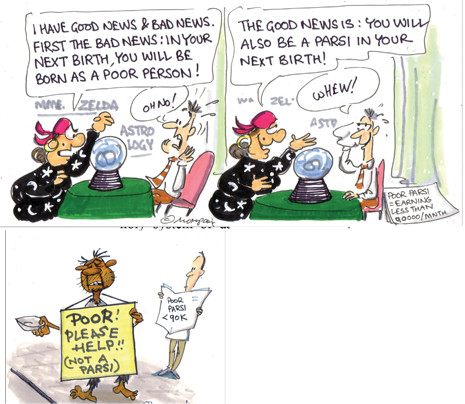
Cartoons reprinted from Mumbai Mirror with permission from Dr Hemant Morparia
The BPP is also planning steps to ameliorate the lot of priests. Because of penury faced by priests, the profession does not attract the young. In his message to readers of The BPP Review of April 2012, BPP chairman Dinshaw Mehta has spelt out schemes and incentives to assure that they have both security and a decent livelihood.
The BPP has been providing subsidized housing for priests, as in the Mobed Building at Godrej Baug. It now plans to ensure that each priest receives at least Rs 20,000 per month as take-home pay. It will also subsidize the education of their children up to the graduation level and provide free medical care for them and their immediate families. Initially a sum of one crore rupees will be set aside for these measures which it is hoped will ensure that there is always someone to tend our holy fires and that "our glorious religion will not only survive but also thrive.”
The BPP has been providing subsidized housing for priests, as in the Mobed Building at Godrej Baug. It now plans to ensure that each priest receives at least Rs 20,000 per month as take-home pay. It will also subsidize the education of their children up to the graduation level and provide free medical care for them and their immediate families. Initially a sum of one crore rupees will be set aside for these measures which it is hoped will ensure that there is always someone to tend our holy fires and that "our glorious religion will not only survive but also thrive.”
In the same issue of The BPP Review Mehta has reiterated the Punchayet’s commitment to "the preservation of our holy system of dakhmenashini” and "made great efforts for the preservation of vultures whose existence has been medically threatened.” He and fellow BPP trustee Khojeste Mistree were invited by the Central Zoo Authority of the government of India to participate in a symposium on the conservation of endangered vulture species held in Delhi on May 3 and 4, 2012. Also invited, at their request, was Dr Homi Dhalla who is on the Doongerwadi Committee but is a sceptic on vulture breeding in captivity. Bangkok based Aban Kabraji, regional director of International Union for Conservation of Nature, made special efforts to organize the symposium. Mistree was slated to make a presentation on "Vultures in the Parsi tradition” followed by a report by Homi Khusrokhan, president of the Bombay Natural History Society, on its initiative of breeding vultures in captivity. "Once this becomes a viable and feasible proposition there is no reason why an aviary cannot be a possibility in the Tower of Silence,” conveys the chairman.
◆ ◆ ◆
From the archive