
Politics and Policy
Planning to please
The second Anjuman meet called by the Bombay Parsi Punchayet trustees was a subdued affair
"Last May we were two groups (during the trusteeship elections.) We are now one team. We are going to work together,” said Bombay Parsi Punchayet (BPP) chairman Dinshaw Mehta addressing an Anjuman meeting of nearly 2,000 at the Rustom Baug grounds in Byculla on November 12, 2011. The battle scarred trustees have been warring with one another since the October 2008 general elections held for the first time under adult franchise.
"No intermediate elections will be held until the code of conduct is ready,” said Mehta in his 40-minute talk which was followed by an 80-minute question answer session in which the other trustees also provided responses. The BPP intends to move the court to ensure no mid term elections are held whenever a trustee exits office subject to a minimum of five trustees continuing to serve on the board. He also wanted all trusteeship elections to be held once in seven years so that the trustees who are elected in between would only serve the remaining years till the election.
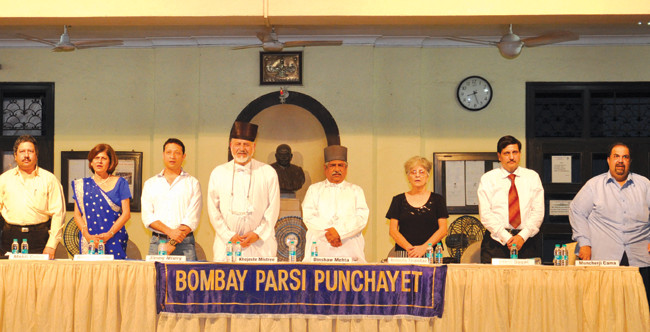
At Rustom Baug (from left): BPP’s Mehli Colah and trustees Arnavaz Mistry, Jimmy Mistry, Khojeste Mistree, Dinshaw Mehta, Armaity Tirandaz, Yazdi Desai and Muncherji Cama
BPP trustee "Muncherji Cama has his own views” on the subject, noted Mehta. Cama was elected in July 2011 and if the proposed amendment is approved by the court, he would only serve a little over four years instead of the full seven-year term.
The Merit Rating Scheme (MRS) for deciding on eligibility and priority after flat allotments is to be revised allowing for the higher income levels of couples. "The first priority for allotting flats will be to those (about) to be married,” said Mehta. The BPP hopes thereby to bring down the median age of marriage and also encourage couples to have children early. Mehta said that the average age of marriage for women was 25 and for men 32. (The Parsiana statistics show the median age of marriage for 2009 to be 25 for brides and 27 for grooms; in 2010 the figures were 28 for women and 30 for men.) Mehta observed that Harvard University PhD student Dinyar Patel had attributed the dwindling population of the community to "late marriages and no marriages.” Regarding the matrimonial meets held under the guidance of BPP trustee Arnavaz Mistry, Mehta said "four matches have occurred. We are hopeful more will take place (polite applause).” Mehta noted that Surat had increased their population by six percent (presumably by offering flats. Parsis from nearby areas may have migrated to the city — editors). Remarking that earlier the BPP built "cubby holes,” the new policy was to construct flats with two and three rooms plus the kitchen, he stated.
The BPP balance sheet shows a surplus of income over expenditure. The trust was therefore going to increase the subsidy for every third child born in 2012 onwards to Rs 5,000 till the age of 21. For the second child a subsidy of Rs 3,000 is given. Pointing out that the BPP had doubled the charitable doles in 2009, Mehta said, "We will double the amount again in 2012; funds for scholarship are also to be increased.” Mehta mentioned they would request the income tax department to permit them to accumulate the surplus income for future expenditure and projects. He stated the BPP has a corpus of Rs 233 crores (US $ 46,000,000) of which "94 crores is a refundable deposit which is tantamount to a corpus.” As and when flats change hands, the new licensee would be giving a deposit, claimed Mehta. "There is a massive increase in the corpus,” he said noting that a donation of Rs 10 crores had been given "without any strings attached” by the late Farokh Irani (son of the late noted lawyer and scholar Dinshaw Irani and brother of Prof Emeritus Kaikhosrov Irani of the City College of New York. The proceeds were mainly from sale of property — editors).
Contrary to media reports the amount spent for the renegade priests case was Rs 32 lakhs, said Mehta. He did not clarify if he was referring to the expenditure incurred in the last fiscal year or the year before and the current year as well. The hearings took place before a single judge of the Bombay High Court (BHC), a divisional bench and the Supreme Court which referred the dispute to mediation.
Doongerwadi maintenance shows a two crore nine lakh rupee deficit including the amount spent on the renegade priests litigation. The balance sheet shows an additional Rs 1,45,00,000 as legal expenses. The priests case for some reason is clubbed with the Doongerwadi expenses though the ban also extended to the Godvara and Jokhi agiaries. "The basic duty of the BPP trustees according to the trust deed is to safeguard and look after Doonger-wadi and the system of dakh-menashini,” said Mehta. The BPP spent 11.5 crores on the maintenance of the various baugs but earned an income from rents, parking charges, etc of 5.5 crore rupees. The BPP managed baugs "are subsidized to an extent of six crores,” said Mehta. (The BPP however receives several crores from transferring flats in most of their baugs. The 94 crore rupee refundable deposit is earned from transfers — editors.)
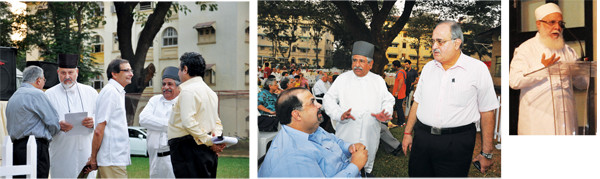
From left: BPP’s Cawas Panthaky, Mistree, Burjis Taraporewala, Mehta and Colah; Cama, Mehta and property developer Zarir Bhathena; Ervad Asphandiar Dadachanji reciting the invocation
Regarding the construction of 300 flats at B. S. Panthaki Baug as promised to the BHC in 2009, Mehta noted an extension of time is being requested from the Court as the Bombay Municipal Corporation (BMC) permission for the plans submitted was awaited. "He also said that the proposed development plan (DP) road would divide the colony into three parts and hence the matter was under negotiations, presumably with the BMC. Mehta carped at the opposition that had filed a contempt petition in the BHC on account of the delay in building the promised flats.
Around 1,200 people are on the housing waiting list. "Whether all are bonafide applicants we don’t know. Six hundred to 700 may be genuine,” contended Mehta. He said the BPP plans also included bringing Parsis from the outskirts of Bombay such as Vasai and Virar closer to the heart of the city.
At Nowroz Baug, development plans are on hold as the tenants were asking for 50 percent more space. "We replied ‘only 20 percent is possible,’” said Metha. The offer is based on existing premises plus balconies and passages.
As regards the proposed ownership building under construction at Godrej Baug, Mehta said the BMC has given permission for nine floors but the BPP had made an application for increasing the number of floors by five to six. "We are awaiting the BMC’s largesse.”
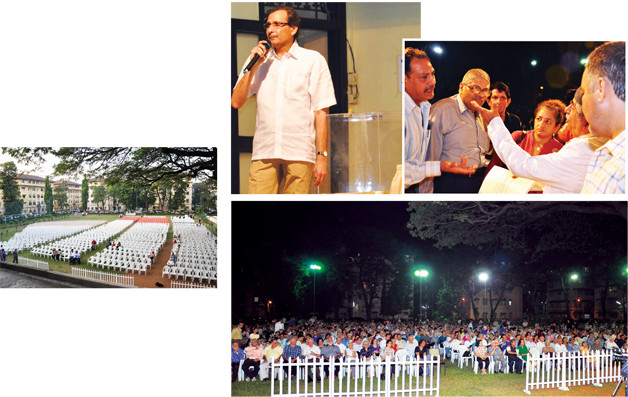
Clockwise from above: venue prior to meet; Taraporewala next to acrylic drop box for questions from the audience; Mehernosh Fitter (ext left) in a heated discussion with Mehta; section of the audience
He pooh-poohed the efforts of community activist Mehernosh Fitter in obtaining copies of the BPP’s audited accounts from the Charity Commissioner (CC) and also the trust deeds. The accounts, he noted, were published in the current issue of the BPP Review and copies of the trust deed were available for Rs 200 from the BPP office. (Earlier when former BPP trustee Noshir Dadrawala had asked Mehta for a copy of the BPP accounts, Mehta reportedly directed him to the CC — editors.) Fitter alleged the BPP had not filed returns for 2010. The BPP reportedly had filed them but as the CC was not able to locate the papers, they were not handed over to Fitter when he made his Right To Information application. Subsequently copies were obtained from the BPP and given.
Mehta also spoke about the oft repeated plan of setting up senior citizens centers and crèches in each colony. The neglected Nirlon Colony in Goregaon which has the largest number of children is to get a 1,500 sq ft club house for which Cama has donated money for equipping the gymnasium. There are moves "to construct an agiary over there.” Plans have also been submitted for constructing an additional 100 flats at the Nirlon Colony, said Mehta.
Plans for constructing 100 flats at S. B. Bha-rucha Baug have been approved. A 22-storied building is to be constructed. But differences with some tenants are holding up the project, explained Mehta.
The BMC is conducting a structural audit of all buildings over 50 years old and Mehta requested the tenants in the various baugs to cooperate with the officials should they come to inspect flats.
Regarding the painting of Doongerwadi bunglis courtesy the Maharashtra Legislative Assembly (MLA) funds allotted through Bharatiya Janata Party MLA Mangal Prabhat Lodha, Mehta noted that MLA funds have been used in the past for several community properties including repair of roads. "I don’t see anything wrong” in utilizing government funds.
Mehta noted he had been in London for a Global Working Group (GWG) meeting that coincided with the felicitation by the Zoroastrian Trusts Funds of Europe (ZTFE) to His Royal Highness Prince Philip, the Duke of Edinburgh. The next GWG meeting is tentatively scheduled in New York in August 2012 [to coincide with the hosting of the 15th North American Zarathushti Congress marking 25 years of the existence of the Federation of Zoroastrian Associations of North America (FEZANA)]. If the talks "fructify” the GWG may metamorphose into the first world body of Zoroastrian federations, Mehta proclaimed. (The racial definition of Parsi Zoroastrian only may be violative of US laws — editors.)
The Zoroastrian Youth for the Next Generation (ZYNG) this October hosted a youth meet for 400 youngsters from all over India with residential accommodation being provided for at the Taj Lands End hotel at highly subsidized rates courtesy the Taj Group of Hotels, the chairman noted.
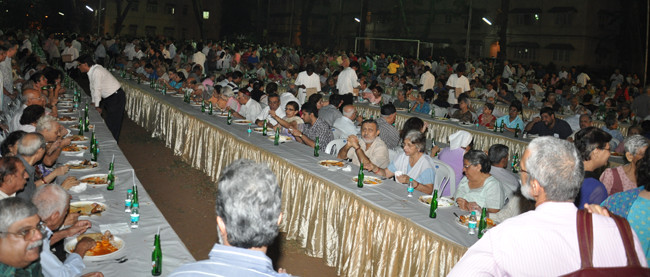
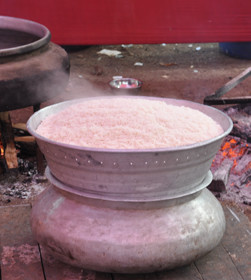
Gathering at dinner catered to by Tanaz Godiwalla. Top: a vessel of freshly prepared rice
"Eleven drafts of a mobed scheme have been exchanged between us and (industrialist) Nusli Wadia,” said Mehta adding that the scheme would ensure every mobed "got not less than Rs 25,000 (income) a month.” A new mobed trust may be formed or it may be a part of the BPP. Wadia is reportedly donating a crore of rupees ($ 2,00,000) for the project.
A Doongerwadi Advisory Committee had been formed and the second meeting was scheduled for the next morning to determine "how to strengthen this system.” The Committee consisted of all the trustees, the high priests of the community and others. [Dastur (Dr) Firoze Kotwal had sent a three-page resignation letter but the trustees are expected to write a joint letter to him requesting him to withdraw his resignation from the committee — editors.]
Regarding the Parsi Lying-in Hospital (PLIH) managing committee proposal to develop the property into a super specialty orthopedic hospital, Mehta said "no public auction or notice” had been issued. He termed it "a private deal with one Dr Khubchandani. The property is in our (BPP) name.” He added however that "we are still discussing the pros and cons” of the proposal. Though the Hospital lease expired 18 years ago, Mehta was confident "the BPP will be able to renew the lease and come to terms with the managing committee.”
Regarding the children with special needs project that at one time the BPP had considered housing at the PLIH premises, Mehta said the Masina Hospital’s Dr Dossibai and J. R. D. Home for the Aged could be utilized with the Hospital trustees’ consent. "We will work out some scheme,” he stated.
Referring to a letter from residents of A. H. Wadia Baug that appeared in the Parsi Times weekly on the day of the meet, Mehta stated the article was full of untruths and the BPP and Dr Porus Turner’s name were maligned without cause. "Please do not put the BPP into trouble,” Mehta appealed to the gathering.
"No debate”
The question and answer session was ably compered by Rustom Baug resident Burjis Taraporewala who stated that questions had to be written on a slip of paper, folded and put in an acrylic box placed on the stage. "Write in a legible manner. There will be no debate. No two-way communication. Further questions can be asked later when everyone is having dinner,” he instructed the audience. While he noted that some may judge the trustees harshly "to brand them in a negative manner is unethical and very, very wrong.” Names of those submitting the question were called out and on the persons identifying themselves the question was read out to the gathering.
Would an applicant who was getting married be allotted a house? BPP trustee Khojeste Mistree replied 56 percent of flats are alloted to this category. Regarding the filming at Doongerwadi Cama replied, "I personally feel we should not allow the use of Doongerwadi grounds for commercial purposes.” His answer drew the loudest applause of the evening. What is the effect on vultures of the drug diclofenac if consumed by humans? Mistree said "the painkiller has been used over the last 50 years and at that time the vultures were not affected.” He wanted to therefore verify the effect of the drug on vultures who consume human corpses. "The vulture project is on hold till then.” [Wikipedia states "diclofenac originated from Ciba-Geigy (now Novartis) in 1973 (and) was first introduced in the UK in 1979.” In India it was probably introduced in the early 1980s. According to Wikipedia, the "decline of vulture populations in India was first recorded at the Keoladeo Ghana National Park, Rajasthan during mid 1980s to mid 1990s, followed by Northern India... Declines have been projected in excess of 97 percent over a 12-year period in India — editors.]
About the divorce rate, Mistree noted, "divorces have gone up to 11 to 13 percent in the community. (In 1973 and for decades after it was around 10 percent — editors.) In contrast the American divorce rate was 62 percent, alleged Mistree. [According to Wikipedia, "It is estimated that 40 percent of all (US) marriages have ended in divorce as of 2008… In 2009 the overall divorce rate was in decline in the US, but so was the marriage rate.”] Mistree stated that when the couples were not willing to accept counseling, there was nothing that BPP could do to alleviate the situation.
A person wanted to know whether the M. F. Cama Athornan Institute in Andheri had reportedly halted the ex-students association refresher courses for mobeds. The questioner alleged the trustees have leased the property to non-Parsis. BPP trustee Jimmy Mistry replied that "whenever community functions” are to be held, the premises would be made available.
To a question regarding religious activity "to be started in all Parsi baugs,” Mistree responded that religious education, "is not a high priority” with parents. The family would rather go to Lonavla for a weekend holiday than attend religious classes. "You can take a horse to water but you can’t force him to drink,” he said.
Someone commented that Mehta’s talk referred to plans "that he hoped would fructify,” what had the trustees actually done he inquired that had "fructified?” "We inherited a mess, inherited court cases,” said Mistree. "Everything takes time... policy has fructified.” He likened the situation to a pregnancy. "It takes nine months for a baby to come.” The trustees had been in office only "two-and-a-half years” (according to the Gregorian calendar the trustees have been in office for three years — editors). "Give us time.”
Mehta added that the trustees "are trying our best. Allow us to work.” He referred to the contempt case file against the trustees in the BHC for not constructing flats at Panthaki Baug as promised. They asked the court to "sentence them (the trustees) to six months jail. Imagine the problems we are facing. Allow us to work in peace,” pleaded Mehta.
To a comment that the Masina Hospital was in "bad shape” and that Parsi women were begging at the Bhikha Behram Well, BPP trustee Armaity Tirandaz replied, "the Hospital is not in a bad condition. The patients are well looked after. The place is not messy.”
To another question on the condition of dogs at Doongerwadi and the sweepers not receiving pensions, Tirandaz replied she "was an animal lover and also on the SPCA (Society for the Prevention of Cruelty to Animals). The dogs are looked after and vaccinated on the premises.” Adequate food is also provided. Regarding the workmen, Mehta said that there was a "union settlement” and that all needs and benefits were attended to.
To the question whether mobeds should be exempted from wearing helmets while riding a motorcycle, Jimmy Mistry replied "the mobeds are divided.”
To a question alleging a drug problem in the colonies BPP trustee Yazdi Desai stated, drinking, drugs and gambling were part of urban existence. "The community is not living in isolation. Good counseling” was required to counter substance abuse. He mentioned he was on the Kripa trust which assists those habituated to drugs, alcohol, etc.
To a question as to why shops on BPP property are given to non-Parsis, Mehta replied the tenants want to "sell for the highest price. We cannot ask for a concessional rate for Parsis.”
Mehta noted that on the State Minorities Commission he is the only existing member and that the committee has not held a meeting "since the last six months.”
Another questioner inquired if the photographs and CDs circulated by Dhun Baria showing the putrid state of the interiors of the Towers of Silence was "true or false.” Mistree responded that the photographs and video shooting were "illegally” done "and there was doubt on their authenticity.” The interiors of the dakhma "are not a pleasant site… it’s not a tea party… the dakhmas are working well.”
[At the Dongerwadi Advisory Committee meeting the next morning the members reportedly were told by the pallbearers that corpses are pushed into the central pit, body remains shoved about and flesh fused to the pavis is scraped off. Godrej Baug residents complain about the obnoxious stench emanating from the dakhmas. Due to the heat "charbi pighlé (the fat melts).” Women seated on the benches outside the Jokhi agiary cover their noses with handkerchiefs — editors.]
A person inquired why Mehta has reneged on his promise to convert leave and license agreements into tenancy. Mehta said the BPP had approached Small Causes Court lawyer K. K. Nariman who told them under the tenancy laws they "will not be able to enforce the Parsi only covenant. Every fourth marriage is a mixed marriage,” said Mehta (it’s every third marriage — editors). The chairman also added "that there is no victimization, no undue advantage taken” of licensees.
Amongst the last comments to be read out by Taraporewala was one by a woman who said she just wanted to say "Thank you” to the trustees for all their efforts, causing a member of the audience to remark loudly "she must have got a flat!”
◆ ◆ ◆
From the archive