
History
When tea was not a party and opium was a trade
How a stimulant and a narcotic built Parsi fortunes, and led to two wars, a revolution and ongoing terrorism into the present day
A cup of tea constitutes a happy break from work around the world, and a refreshing drink whose cultivation and distribution may employ upwards of eight million persons worldwide. But the globalization of tea is a relatively recent 19th century story, with a darker underside to it. Tamil refugees who fled the just-concluded civil war in Sri Lanka, or the grieving widows of policemen killed in the northeastern Indian state of Assam by Bodo terrorists, or Chinese nationalists still smarting over occupation of parts of China by Western powers, may seem to have little in common with Parsis or tea.
Each refreshing cup represents the happier aspects of international business which built Parsi fortunes. But the globalization of tea also carried with it a history of international intrigues, monopolies, wars and ethnic displacements.
Most Indians think tea drinking is part of Indian culture from time immemorial, whereas tea consumption on a mass scale is little more than a 100 years old in India. Until 250 years ago, tea was a relatively rare libation made from a little bush (Camellia Sinensis) that originated in the hilly provinces of southern China such as Yunnan. Consumed only by a few Buddhist monks, or Chinese and Japanese aristocrats, it was more or less unknown to the rest of the world, although small shipments may have made their way — as curiosities or medicine — along the Silk Road to India and the Middle East.
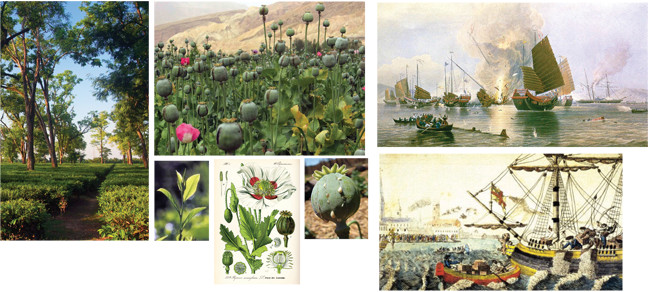
Clockwise from far left: A tea plantation interspersed with eucalyptus trees; a poppy field in Afghanistan; illustrations depicting opium war and the Boston tea party; a photo and illustration of poppy plants; close-up of a tea bush
Parsi enterprise’s global reach
The first bulk exports were made by the Dutch who transshipped Chinese tea from Java to Holland starting in 1606. But it remained little known in the rest of Europe or in the United Kingdom (which today has the highest per-capita consumption) until Catherine of Braganza, a Portuguese princess arrived to marry Charles II of England in 1662. She was the same princess whose dowry, ceding Bombay to the British, propelled the Parsis from being hardscrabble farmers or petty traders in Gujarat into entrepreneurs, international businessmen and merchant princes.
Bombay, acquired by the British in 1665, comprised seven small rocky islands occupying less than 10 percent of its current area — the rest being malarial swamps wet at high tides (think Pydhunie, which means "wet feet;” it remains a question whether the Mumbadevi temple even existed at that time). Within 50 years, land was being reclaimed from the sea and Parsi enterprises had a global reach, trading from Africa to Turkey to China, often on their own ships built in Parsi shipyards.
A petty trader, Camaji Kuverji, came down from Gujarat to Bombay in 1735 and with his sons Mancherji and Edalji, established Cama and Sons, becoming one of the leading opium trading houses with China. Hirji and Maneckji Jivanji were the first Parsis recorded to have traveled to China in 1756. Jamsetji Jejeebhoy came from a humble family buying and selling used glass bottles but may have become the richest businessman in India at the time of his death in 1859 by selling opium to Chinese smugglers in return for silver which, in turn, financed the purchase of Chinese tea by the East India Company.
In 1730, Lowji Wadia, already an established shipbuilder in Surat, established a drydock in Bombay. And, as is well known, the HMS Minden, built in the Wadia drydocks, was the ship on which the American national anthem was composed (Star-Spangled Banner was a poem composed by Francis Scott Key in September 1814, while held captive by the British, on board the Minden in Baltimore harbor. The poem was later adopted as America’s national anthem. The Minden, built in Bombay in 1810, was retired to Hong Kong as a hospital ship in 1841, and sold for scrap in 1861).
Tea and a revolution
After a difficult Channel crossing to marry Charles II, stepping ashore at Portsmouth in 1662, Catherine of Braganza asked for her favorite drink. But no tea was available. The nonplussed English offered her a glass of ale instead, which did little to settle her stomach. But the court set the fashion and tea drinking spread among the English nobility. Initially, only the rich could consume it since, based on mercantilist principles, UK tariffs were punitively high, ranging at one time as high as 119 percent ad valorem although they were later reduced (to more moderate levels since tea began to be smuggled into England by privateers, to avoid paying the tariffs).
Tariffs were also needed to fund the Franco-English war that began in North America in 1754 and then spread to Europe and to India, with fighting between the British and French as far eastward as Indonesia (some Euro-centric historians label the Franco-British 1754-1763 war as the "first world war,” although the conquests of Genghis Khan, by the year 1225, covered more degrees of latitude and an incomparably greater fraction of mankind from Hungary to Korea and from Russia to Iraq). The American patriots (some call them ruffians led by Samuel Adams) who threw the cargo of British imported tea into Boston Harbor in 1773 were protesting high tariffs on the import — a trade then monopolized by the East India Company.
Resentment against high tariffs and taxes, imposed from London, were the direct causes of the American revolution. After winning independence, tea drinking, considered unpatriotic, declined in America but increased steadily in popularity in the UK where millions of middle-class English found their favorite "cuppa” to be indispensable.
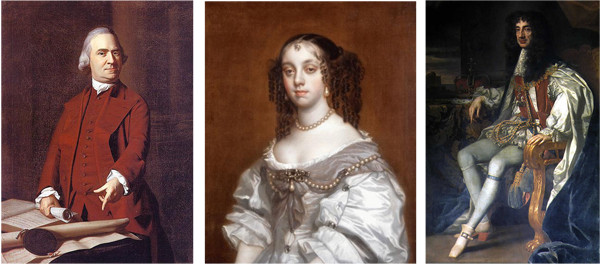
Associated with tea: (from left) US founding father Samuel Adams, Catherine of Braganza and husband Charles II
The tea and opium connection
By the late 18th century, the British faced a mercantilist dilemma. Tea cultivation existed only in China, with the Chinese refusing any foreigners access to their tea plantations. China therefore had a tight monopoly. But the supposedly "inscrutable” Chinese, as sole suppliers of tea to the world, refused to import much from the West, and insisted on being paid in silver. This meant that tea imports — by now massive since England had a large middle class with a tea-drinking habit — had to be financed in silver and bullion shipped out from England, in exchange for the Chinese monopoly product. It was a case of a British import monopsony (the British East India Company was given the right to be the sole buyer of tea) versus the Chinese monopolist producer.
The massive drain of silver out of England caused grave concern and threatened the health of the UK economy (an interesting comparison with today’s massive trade surplus enjoyed by China against the rest of the world, and huge Chinese foreign exchange reserves). Finally, the East India Company had an idea to solve the drain of bullion going to China. It invested in Indian plantations to grow opium in Bihar and financed poppy cultivation in Malwa through Parsi intermediaries. (It is said by anti-colonialists that this also dealt a blow to Indian cotton cultivation and its workers.)
This opium was not for Indian consumption, but was intended as an export to China to be exchanged for tea. Naturally, the Chinese government was horrified, and prohibited the import of a narcotic which, already by the 1830s, had turned tens of thousands of Chinese into addicts and fostered an illegal smuggling of opium into China.
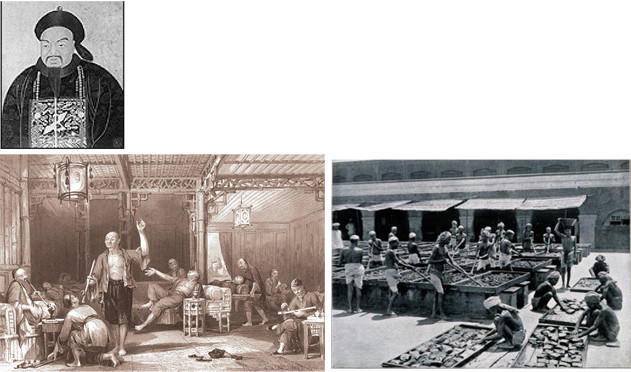
Top: Lin Zexu, Chinese commissioner in Canton; Chinese opium smokers in den; (alongside) production of opium in India
Parsis and Victorian hypocrisy
The British government was aware of the cost to Chinese society from addiction, smuggling, and the emergence of a large underworld mafia with its corrupting influence on Guangdong government officials. The government and the East India Company could never openly admit that these evils were forced on the Chinese because of the enormous appetite, on the part of their Victorian middle-class, for a mild Chinese stimulant called tea. Nor could they openly admit that the British were involved in the tea for opium trade.
Parsi entrepreneurs provided the cover. Companies like Bharda and Sons, Jamsetji Jejeebhoy and Company or P. and D. N. Cama Company would buy opium from growers in Malwa, export it to Canton or Lintin where it would be exchanged with smugglers into silver. The silver would then be given to British agents in China to buy tea. The Parsi traders would receive Bills of Exchange (promissory notes convertible for cash in London, Calcutta or Bombay) or other trade goods to take back to India. This way, the British could say that they were not officially involved in the China trade except for the legal purchase and import of tea into the UK.
Besides avoiding the taint of a narcotics trade, by using Parsis, the British also avoided the cost of fronting the capital for the opium and the risks of price swings, delays, spoilage, confiscation or arrest by the Chinese authorities, piracy, war, and having to deal with shadowy networks of Rajasthani and Bihari opium suppliers (scholar Dr Jesse Palsetia indicates several suicides by Parsis facing economic ruin).
Of course, other private British firms were also involved once the East India Company’s monopoly was cancelled. But by the late 1830s, 20 of the 42 foreign firms in China were Parsi owned, according to scholar Mahmood Farooqi. Another source mentioned by Palsetia indicates that in 1837, 11 Parsi firms in Canton compared with only four European and nine American companies. This understates the Parsi role because Parsi firms also handled consignments for the British and American companies, in addition to their own. Leveraging their wealth and ship-building expertise, the Wadias, Jejeebhoys, the Banajees, and Rustomjees had 50 to 80 ships in the trade.
The Wadia yards were not only known for the sturdiness of their ships, but for keeping up with the technology of the time which resulted in sleeker and faster vessels, culminating with the famed "clipper ships” that could travel from India to China in a record 23 days. The journey from as far away as America to India was cut to less than three months with the result that winter ice from frozen Massachusetts ponds, packed in sawdust, could be exported to Bombay ice houses.
It is likely that in the mid-1800 several hundred Parsis, some accompanied by their families, lived in China. Parsi cemeteries in Whampoa, Hong Kong, Shanghai and Macao, and Macao’s Estrada dos Parses (Parsi Road) attest to a now vanished presence.
Tea and the opium trade
Finally goaded beyond endurance by rampant smuggling, corruption and addiction, the Qing Emperor appointed a new commissioner who cracked down severely on the business in 1838. The British response was the First Opium War (1839-1842) fought between Imperial Britain and an enfeebled China, which together with the Second Opium War (1856-1860) forced open Chinese ports, handed over to the foreigners enclaves such as Hong Kong, and collected large indemnities from the Chinese — all because they dared to resist the smuggling of a narcotic. Opium and tea could now be freely imported and exported.
Millions in the middle classes of the UK and Europe got to enjoy their cups of tea, with the habit spreading worldwide and even to India by the late 1800s. But the humiliation at the hands of the British rankles to this day in the minds of many educated Chinese, and shapes their anti-Western attitudes.
Tea and terrorism
It was thought that tea could not be grown outside China. Indeed, several attempts to plant the Chinese cultivar elsewhere ended in failure. Meanwhile, Robert Bruce (a Scotsman who lies buried in the Indian town of Tezpur) discovered a variety of the tea bush in the Himalayan foothills of Assam (then populated by Tibeto-Burmese tribes such as the Bodos). This proved to be a close substitute for the Chinese cultivar. India’s tea exports supplanted those of China by the 1860s. But this came at a further large cost in human suffering.
In the heedless fashion that was common in the colonial era, the British moved tens of thousands of indentured laborers from other poorer areas in India such as Chota Nagpur, Bihar and Bengal to work the tea estates in Assam, since the indigenous Assamese population was content in its own culture and unwilling to work as plantation labor. There followed traders, railroad workers and other enterprising Indians who took over, and displaced the Tibeto-Burmese indigenes. These ethnic tensions and conflicts have culminated in separatist movements and terrorism that simmers beneath the surface in Northeast India to this day.
The highlands of Ceylon (today’s Sri Lanka) also proved salubrious to the tea bush. Not many of the proud, and relatively well-off, Singhalese population deigned to work as plantation labor. The British imported tens of thousands of Tamils from India to work in their tea and rubber companies in Ceylon — a population that never assimilated with the native Buddhist Singhalese. This induced migration directly led to the just-concluded civil war in Sri Lanka that has left nearly 100,000 dead, hundreds of thousands injured, and millions of refugees.
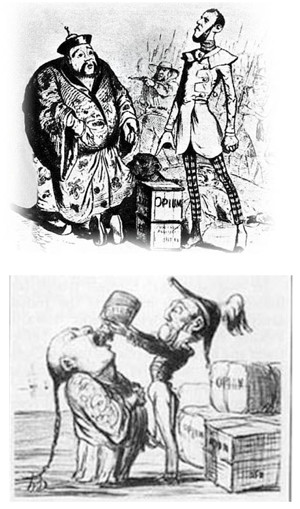
Top: Cartoon in British Press about opium war; French cartoon showing a British admiral forcing opium down the throat of a Chinaman
The issue of ethics
From Ireland, to Israel/Palestine, to Guyana, to Fiji, to China, Assam and Sri Lanka, migrations induced by British colonialism and commerce have left a legacy of ethnic tension, conflict and tears. To the Jejeebhoys and Camas or to their British colleagues in the trade like William Jardine and James Matheson, their riches were cleanly earned, and their honors and Baronetcies considered well-deserved. The Chinese opium eater, or the Santhal tea plucker were a race and class apart, and their lives considered to be outside the domain of corporate responsibility. But is it appropriate to apply today’s ethical standards to the past? We may be too harsh in our judgment of the British or the Parsi traders using the narrower and more stringent ethical lens of the 21st century.
We can rejoice that our global standards today are higher, thanks to the globalization of ideas. The same globalization that still causes angst and ethnic tensions, has also contributed to world prosperity. Trade and foreign direct investment have lifted literally billions today to a middle class status (and tea into one of their favorite beverages). When the world history of the 19th and 20th centuries is written in future millennia, all the wars, terrorist incidents and conflicts may be reduced to a passing mention, or footnotes. But one salient fact will be recorded — the emergence of billions of humankind from agrarian backwardness to productivity, from ignorance to enlightenment, and from poverty to a middle class status, as a result of globalization. Companies from nations such as China or India have emerged to rival multinationals from the West.
The natives had their revenge in the year 2000. In an acquisition redolent with symbolism for the future, the UK’s leading tea company, Tetley Tea, was taken over (in a "reverse” investment) by the Tata Group based in India.
References for further reading
Farooqi, Mahmood (2006). Opium City: The Making of Early Victorian Bombay. New Delhi, Collective; Janin, Hunt. (1999). The India-China Opium Trade in the Nineteenth Century. Jefferson, NC, Macfarland; Macfarlaine, Alan & Iris. (2004). The Empire of Tea: the Remarkable History of the Plant that Took Over the World , New York, Overlook Press; Palsetia, Jesse (2008). "Parsis of India and the Opium Trade in China.” Contemporary Drug Problems, December 22, 2008; Palsetia, Jesse (2001). The Parsis of India: Preservation of Identity in Bombay City. London, Brill; Scott, James (1965). The great tea venture, New York, Dutton.
United Kingdom Tea Council, http://www.tea.co.uk; Yan, KeJia (2008). "Parsis in the Opium Trade in China.” Working Paper, Shanghai Academy of Social Sciences http://www. asianscholarship.org/publications/papers/Kejia%20Yan%20-%20Parsis.doc
Portions of this article are drawn from the author’s earlier academic publications in ‘Yale Global’ a publication of Yale University, and ‘AIB Insights’ a newsletter of the Academy of International Business. Used with permission.

Dr Farok J. Contractor is Professor in the Management and Global Business department at Rutgers Business School. He is a graduate of the Wharton School, University of Pennsylvania, where he received his PhD (Managerial Science and Applied Economics) and MBA, and the University of Michigan, where he received an MS in Industrial Engineering. He has written over 75 scholarly papers and books and is rated by several surveys as among the top-ranked contributors of scholarly papers to the field. He was elected a permanent Fellow of the Academy of International Business in 1995.
◆ ◆ ◆
From the archive