
Politics and Policy
Federation in fetters
Federation office bearers may continue talks on the Global Working Group without committing themselves on behalf of the Indian body
It is only a meeting of Federations...to help Parsis across the diaspora. It is only networking,” reiterated Dinshaw Mehta, president of the Federation of the Parsi Zoroastrian Anjumans of India (FPZAI) and chairman of the Bombay Parsi Punchayet (BPP) to dispel the substantial "misunderstanding, misinformation, disinfor-mation” surrounding the Global Working Group (GWG). "To consider formation of GWG” was an item slated on the agenda of the FPZAI executive council meeting in Bombay on February 11 and 12, 2012 but the issue was not taken up for discussion on the first day but deferred to the next day to ensure the presence of BPP trustee Jimmy Mistry who with Mehta had represented India at the last GWG in London in October 2011.
For the orthodox lobby in India, the Coming Together Roundtable (CTR) which was the precursor to the GWG, has been viewed with suspicion for it brings together FPZAI with the Federation of Zoroastrian Associations of North America (FEZANA), the Zoroastrian Trust Funds of Europe (ZTFE) and the Iranian association. The traditionalists’ main worry is FEZANA which, they believe, under the influence of California based Zoroastrian Ali Jafarey, wrongly emphasizes only on the Zara-thushti denomination instead of linking it with the ethnic Parsi identity and ensuring that the doors of the religion are exclusively open to Zarathushtis of Parsi origin. Their sentiments were expressed in letters from the five High Priests carried on the WAPIZ (World Alliance of Parsi Irani Zarthoshtis) Page of February 3, 2012 (see "High Priests’ alarm”), the Traditional Zarathushtris Mailing List (TZML) widely circulated on the internet and other vigilantes.
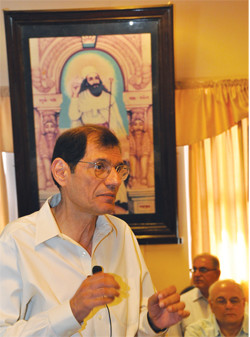
Sarosh Maneckshaw addressing delegates
Acknowledging that "40-50 percent of Parsis are abroad,” Mehta stated that even though they are "rather independent” in their functioning "it is always better to have exchange of views... you cannot throw out the baby with the bath water.” This issue that was deliberated for over an hour required considerable persuasion and diplomacy on the part of Mehta and Mistry to convince the Federation delegates that "only positivity can come out” of the informal meeting of Federation representatives at the GWG.
"Instead of politicizing every issue… there needs to be dialog between international bodies,” declared Mistry. Whilst reiterating his commitment to BPP, its institution of dakhmenashini, Mistry confirmed "all of us are athank (staunch) Parsi/Irani Zarathushtis,” but the refusal to exchange views is "passé, ancient… Nothing anyone does will change any other organization’s stance.” Instead of isolation if the Indian community had engaged in dialog with Iran we would have seen more Parsipanu there, he insisted. He cited the example of the patrilineal clause (whereby children of outmarried Zoroastrian men can be initiated into the religion but not children of outmarried Zoroastrian women) that is accepted by the FPZAI but not by all. There are some anjumans who like the high priests believe that only if both parents are Zoroastrians should children be admitted to the faith and yet they set aside their differences and come together at Federation deliberations. Mistry’s "main purpose” of continuing with GWG deliberations was the "$ 100,000 contribution committed by ZTFE and FEZANA for mobeds globally.”

(From left): Muncherji Cama, Arnavaz Mistry, Mancher Mubarakai, Khojeste Mistree, Yazdi Desai, Dinshaw Mehta, Jimmy Mistry, Tehmton Anklesaria, Darayas Master, Kerfegar Antia and Armaity Tirandaz;
"Sorry to burst your bubble of happiness,” commented Bombay resident Tannaz Parakh representing Khergam who maintained that the GWG was "setting up a structure which they may not be able to control 10 years’ hence… As leaders you are responsible for what happens 30 years’ hence.” Why was it reported in the Press that each Federation will have only one vote? she demanded. "Why are you compromising our supremacy on the world body?” She further questioned, "When you talk of community, which community are you representing? FPZAI that has Parsi/Irani Zarathushtis exclusively or FEZANA that has Zarathushtis only?”
Another round of cross-questioning came from Bombay resident Bakhtawar Karbhari representing Jabalpur, "Wasn’t this (GWG) the previously cosmopolitan world body? Will it only (serve) a social purpose?” Mistry attempted to allay her fears by reinforcing that instead of interacting with representatives of organizations like WAPIZ or PRG (Parsi Resource Group), GWG chose to dialog "with elected representatives, only office bearers of Federations... It will serve more a social purpose than a political/religious need.” Commented Karbhari "At the moment it sounds benign…”
"The GWG is merely old wine in a new bottle,” opined Hushang Vakil of Bhatha questioning the need for a world body. "Their aim is not to protect and preserve but to alter and change…Why are lessons from the past not learnt? Did we not survive until now? Why are we destroying our peace, unity and celebrated Parsipanu?” His fears of Jafarey being able to influence over 50 percent of the community youth on Facebook made Mistry remark, "Jafarey is over 90 years. What will he do over here?”
Zoroastrianism is considered "a designer religion in North America because of which many Muslims want to convert (for) political reasons,” said Federation joint honorary secretary and BPP and WAPIZ trustee Khojeste Mistree. "My recommendation is let networking happen but without an umbrella organization… In any organization, politics has to come in… I have miserably failed in politics… You can’t say we are only interested in the project… I am not popular with FEZANA. They have gone off at such a tangent. As Sarosh Manekshaw brilliantly said (see "Grim future”) the Parsi identity has been lost in North America. We will be closer to conserving our orthodoxy if we continue dialoging without the Federation structure… I have been told that in New York (where the GWG will precede the 16th North American Zoroastrian Congress in August 2012) the World Zoroastrian Organisation will come and there will be representation from the Jafarey group. If these are signals shouldn’t we be cautious?”
"Are we living in this century or in the Dark Ages?” enquired Bombay resident Jamsheed Kanga representing Satara. He felt the Federation body’s refusal to talk with FEZANA tantamounted to fear of Inquisition in Europe in the Middle Ages. "Give up your small minds,” he told the delegates reminding them that the Zoroastrians "owe so much to this country… to the Hindus who allowed us to prosper. Imagine what would have happened if the punchayet of Sanjan had said (on seeing the first boatload of Zoroastrians) ‘Let us not allow them to come. Anyone who is different has to be kept away’…We have prospered because we were most flexible…”
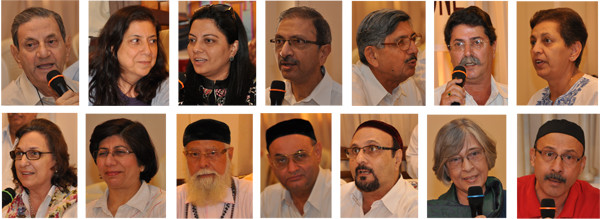
From left (top row): Jamsheed Kanga, Tannaz Parakh, Anahita Desai, Farrokh Rustomji, Baman Cama, Pervez Irani, Guloo Austin; (second row) Piloo Ginwalla, Yasmin Sanjana, Marazban Wadia, Viraf Chiniwala, Hushang Vakil, Bakhtawar Karbhari, Hanoz Mistry
The irrational fear gripping some of the delegates he felt was akin to "a virgin’s fear of rape in a crowd. Today we are behaving as if something is likely to be lost… All so-called protectors of our faith are hypocrites… Can we not have healthy open dialog?” Referring to the High Priests’ letter carried on the WAPIZ Page advising the Indian Zoroastrian community to distance themselves from GWG, Kanga reminded the house, "Our earlier High Priests have done what the current (ones) condemn.” He was convinced "Jafarey bogeys have been created to spout orthodox credential… You are not scholars, you are bigots.”
Co-opted member from West Zone A Farrokh Rustomji reminded the members that even prior to the CTR, Rohinton Rivetna would always invite a cross-section of the community over hamazori sessions "to talk, to discuss, to find solutions. I don’t think there is anything wrong… I would advise anjumans here to take interest in this group.”
Relieved to get some semblance of support, Mistry declared, "We will continue talking (with office bearers of overseas Federations) but we won’t make it official and form a world body.”
Asserted South Zone vice president Kerfegar Antia, "Let this be minuted that you won’t be joining. This topic should not come on the agenda of the next FPZAI meeting.” But the West Zone A vice president Mancher Mubarakai insisted, "It has to come on the next agenda… We would like to know… to keep track of action and reaction.”
Just when everyone thought this issue was finally laid to rest and Marazban Wadia of Davier was permitted to share his Gujarati poem describing a Parsi [each verse reiterated that a Parsi is capable of masti (fun) and wears the sudreh-kusti] Karbhari instigated, "Are you giving him (Mistry) the mandate to talk on behalf of the Federation anjumans?”
Instead of getting the response she hoped to evoke, Baman Cama of Vadodara spoke up, "We are giving him the mandate… What is this august body for?”
She once again sought an affirmation, "Giving him mandate to talk?”
Cama: "Yes.” Referring to the discussions that have been going on for 25 years on the issue of India joining a world body, Cama noted, "Now we are backtracking and saying ‘Don’t even talk?’ Why are we so scared to talk internationally?”
Supporting him was Pervez Irani of the Iranian Zoroastrian Anjuman who could not understand why "everyone gets scared” at the mention of world body and FEZANA as if "it is some monster we cannot fight… Give them a chance. Maybe they will do what you want.” He wondered how anjuman representatives must be managing their affairs if faced with encroachment. Would they hide their face and run away? He doubted how many in the room "actually perform… the tariqats,” the rituals expected of a Parsi five times a day.
When Karbhari advised him to "keep your opinion to yourself,” Irani retaliated, "I have a right to give my opinion.” He then reminded the delegates that 40-50 percent of the traditions followed by the Indian Parsis are adopted from the Hindus. "When in Rome, do as the Romans. To survive they (FEZANA members) have absorbed the American customs.” Considering that many of those who have settled abroad had their roots and training in India he felt we should analyze "what went wrong.” He then reassured the delegates that FPZAI delegates meeting with GWG representatives "are not going to sign without consulting anjumans” in India. Hanoz Mistry of The Parsee Voice stated that the Parsi community has retained its identity because "we have stayed in isolation.” He recommended that other federations "should come on our terms and conditions.”
When Bombay resident Anahita Desai representing Badnera-Amravati referred to the "practical difficulties” that may arise since there is "no definition in place” for a Zarathushti, she was not sure how parameters would be laid down for student exchange programs. Reassured Jimmy Mistry, "We will lay down rules depending on each program. Our stance is very clear. There will be no compromise on the issue.” The Indian body is only expected to recognize Parsi Zoroastrians.
"Dinshaw and I will compromise on anything except religion and ethnic identity,” declared Federation joint honorary treasurer, BPP and WAPIZ trustee Yazdi Desai. Whilst conceding that GWG talks could have religious undertones, he felt that "only for his (Mistry’s) sake let us go ahead and talk. If anything is to be decided we will come back.”
"I love Jimmy as much as you but this is not about giving one person leeway,” announced Parakh, adding, "According to me we have already compromised by putting aside the definition of Zara-thushti, by saying we will not talk about our identity.”
"Life is a compromise,” pointed out BPP trustee Armaity Tirandaz, stating, "We are not compromising principles. We are here to uphold principles. We have to take one step in dialog. We can always step backward, there is nothing stopping us.” Supported BPP trustee Muncherji Cama, "Talk but in no way should it imply that we are creating a situation that the (Indian) Federation will accept Zarathushtis without their being Parsi/Irani.” In the absence of any "defence mechanisms” he was not comfortable with joining the GWG knowing that "they need us more than we would need them.” Federation executive secretary and BPP trustee Arnavaz Mistry expressed that there should be no harm in talking on a social basis. Reasoned Mehta, "Even if we don’t talk, their views have changed so why not talk and see if we can change their views?”
When Vakil referred to a Swedish national doing a thesis on fire temples in India that allegedly could mar the sanctity of a sacred place, Jimmy Mistry allayed his fears, "We will do the same as we did in Sanjan.” When another delegate reiterated, "People like Meher Master-Moos should be stopped in the initial stage,” Mistry declared, "What Meher Master-Moos did, we gave a befitting reply and showed her her place.” But Noshir Dordi of Surat complained that his involvement in the Sanjan fracas had earned him "police cases… who has defended us?” (The Norwegian scholar has sought the assistance of Parsi/Irani individuals/researchers who can enter the fire temples to collect the data — editors.)
High Priests’ alarm
In a letter signed jointly by Dasturs (Dr) Kaikhusroo JamaspAsa, (Dr) Firoze Kotwal, Kaikushroo Dastoor Meher-jirana, (Dr) Peshotan Mirza and Cyrus Dastur opposing the GWG and published on the WAPIZ Page of February 3, 2012 the five High Priests stated, "After six years of relative quiet on the cosmopolitan world body, an attempt is once again being made on this very same front. The proposal put before you to form a GWG is nothing but the cosmopolitan world body with a new title and a slightly different form which is nevertheless every bit as dangerous to our community as the earlier proposal. We are therefore constrained to address all of you once again to provide guidance in this crucial matter…
"We sincerely hope that as community leaders you realize that although the formation of a GWG may look harmless, our millennia-old unique religious identity and religious survival cannot be safeguarded in any organization like the GWG that shies away from perpetuating the Parsi/Irani identity and is essentially cosmopolitan in nature…
"While FPZAI and the ZTFE are committed to promoting only the Parsi/Irani identity, FEZANA has abandoned the Paris/Irani identity to accommodate organizations which accept converts and in Iran, our religious traditions have already been severely altered. Our religion and its very survival are at stake with such defiance of our religious traditions and practices... Over time… we Parsis/Iranis will become a minority in our own community. Within no time the majority in the GWG will begin dictating to us, the true Zarathushtis as to how our religion should be followed…
"The GWG is being touted as bringing together our global community but an organization in which the definition of a Zoroastrian is deliberately kept ambiguous, and one which is not committed to keeping the Parsi/Irani ethnic identity intact, cannot unite the community. It will instead destroy the very fabric of our community and pose a grave risk to the practice of our religion, as there can be no Zoroastrianism without born Parsis/Iranis…”
"Grim future”
"Transformation and loss of Parsi Identity” was the subject of Sarosh J. H. Manekshaw’s talk whose objective was to trace developments and changes over time, study the major events and make a prognosis for the future of the community in India and USA.
The Zoroastrian identity as a link between religion and ethnicity goes back to Achemenian times, he stated before adding that the Parsi identity in India emerged following the narration of Kisseh-i Sanjan. In his presentation he referred to the passage of different centuries when the religion and ethnicity remained unaltered but only the culture and customs changed — from the time of the Persian Rivayats; the controversy over the accuracy of the Shahenshahi and Kadmi calendars; the setting up of the BPP reportedly in 1725 with the authority to mete out punishment in the form of ostracism; the major dispute that required the intercession of the British to ensure that the mobeds give their daughters in marriage to the behdins, just as they wed the daughters of behdins; the reconstitution of the BPP in 1787 with legal rights vested in it and the subsequent loss of moral authority when their word was questioned by those who were educated; origin of rift between the orthodox and the reformists.
The second part of his speech focused on the "second migration to North America… for economic reasons.” His profile of a North American Parsi showed him as being "very well educated… integrated and assimilated, developing liberal and reformist views, rapidly abandoning rituals and traditions; less than 20 percent wear the sudreh-kusti…In the term FEZANA, there is no mention of Parsi anywhere.”
In 1983 at the time of the Joseph Peterson navjote, "North Americans showed their independence from priesthood in India.” In 1990, the movement founded by Ali Jafarey took its inspiration from the early Parsi reformist movement and condemned the Vendidad, Yasnas, rituals and customs. He personally conducted navjotes of non-Zoroastrians and encouraged converts, and founded many chapters in Europe and South America. The North American Mobeds Council in 1990 defined Parsi as a race and Zoroastrianism as a religion. Their definition of a Zoroastrian is "a person who believes in and follows the teachings of Zarathushtra.” Thus whilst the community is "losing sight of religion, abandoning Parsipanu and has little to pass on to the next generation” by way of culture and tradition in North America, "in India attempts are made to preserve the identity against attacks by the reformists consisting of the intelligentsia.” His forecast for the community in North America was "grim… the Parsi identity will disappear in the next two generations. There is no one to blame but ourselves. The Parsi identity will be lost.”
Whilst the predominantly orthodox members of the FPZAI were happy with Manekshaw’s conclusions considering themselves superior to their American counterparts, it took a fellow North American, Guloo Austin of Canada, who was present as an invitee, to denounce Manekshaw "for really painting a grim picture.” According to her "FEZANA is an excellent organization… In Canada we follow most of the rituals… We are not doing mass conversion but only accepting the non-Parsi spouses and children.” This made Karbhari ask her, "What guarantee that the non-Parsi spouse will remain married to the Parsi? What if the non-Parsi spouse were to divorce and marry another non-Parsi? And what if that non-Parsi were to divorce and marry another juddin? Where do we end? The children would be baffled. How do we handle this situation?” Viewing this as "a hypothetical situation not found anywhere” Austin reminded her that non-Zoroastrian spouses are given a good grounding in the Zoroastrian religion.
As conceded Manekshaw, if eight-year-old Zoroastrian kids from USA were to be tested against those from Bombay, "the American kids will know more about their religion. It is not sufficient to do the navjote and forget about it.” This made Bombay resident Yasmin Sanjana representing Tavdi comment, "More than the children we need to educate the parents.” Her sentiment was echoed by Piloo Ginwalla of Bharuch who commented, "We have to walk the talk” referring to children who after a lavish navjote are seen running around in their singlets instead of their sudrehs. Bombay resident Viraf Chiniwala representing Navsari remarked, "There is a lot of liberalization in North America. There is a similar trend in Bombay.” The community members living outside baugs have limited "exposure to culture and traditions. How can we influence the youth to preserve their Parsi identity?”
The last instalment on the Federation meeting in the April 7 issue will refer to the activities of the anjumans, the progress report on the defunct anjumans subcommittee and the other programs of the Federation.
◆ ◆ ◆
From the archive