
Politics and Policy
The north star
Delhi Parsi Anjuman president Dadi Mistry outlines plans for the capital’s Parsis/Iranis
A prayer hall or satayash gah above a senior citizens’ home are among the plans contemplated by the Delhi Parsi Anjuman (DPA), states the north Indian association’s president Dadi Mistry. To be situated in the agiary-dharamshala complex on Bahadurshah Zafar Marg, the unconsecrated prayer hall will be open to members of all communities. Elderly Delhiites will reside on the ground and first floors of the new structure and the prayer hall will be on the second floor. "Fortunately donations are coming in,” says Mistry. An afargan and a portrait of Zoroaster will adorn the prayer hall and divas will be lit.
The home will be "similar to the World Zoroastrian Organisation (WZO) senior citizens home in Navsari with the person running it residing there.”
Six additional rooms are also planned for the Mengusi Parsi Dharamshala thanks to a generous donation from the Neterwalla Foundation which earlier had also donated money for increasing the number of rooms. "We still have a lot of FSI (floor space index),” notes Mistry. "The Dharamshala’s occupancy is 70 percent on an average,” he says.
The Kaikhushru Pallonji Katrak Dar-e-Meher (dadgah) is to complete 50 years in 2011 and the DPA is planning "a big function” for the occasion with "people from all over the world” being invited.
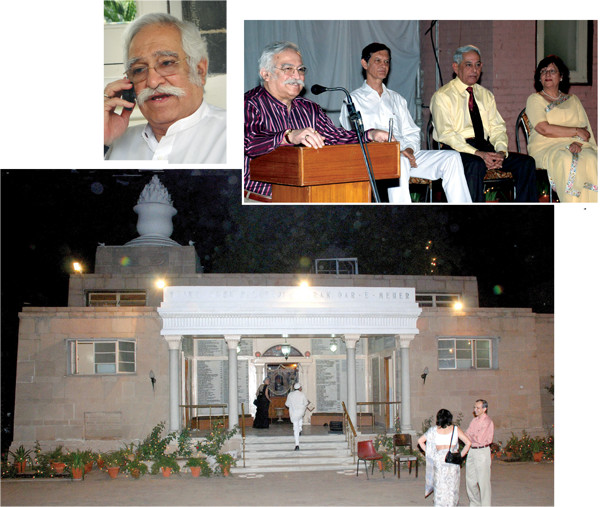
(Bottom) Kaikhushru Pallonji Katrak Dar-e-Meher. (Inset) Dadi Mistry addressing anjuman members at a function to honor Air Chief Marshal Fali Major and his wife Zarin; Dr Homi Dhalla (second from left) was also honored. (Top) Mistry: vital contacts
"We want to do up the agiary, build up a corpus. We are not generating enough money to take care of the two priests,” says the president. The DPA’s present corpus is 60 lakh rupees which Mistry hopes to "make it one crore rupees in three years’ time.”
There are plans to develop part of the burial plot next to Khan Market gifted by the late Prime Minister Rajiv Gandhi in the early 1990s to accommodate more graves. The adjacent half acre plot gifted earlier to the DPA in 1931 is now almost full, notes Mistry. For the families of those who opt for cremation, a one square foot plot is provided to bury their loved one’s ashes. There are around 42 graves in the old graveyard behind the agiary.
A special issue of the DPA’s organ Dipanjali to mark the 50th anniversary is also planned.
Tata Steel managing director B. Muthuraman has offered to donate the steel for the prayer hall, notes Mistry. But now the follow-up, paper work, etc needs to be done.
"The board of trustees need the younger generation to come forward and devote energy, experience and time,” says Mistry whose wife Nergish often has to sit up late at night typing out letters and following up on correspondence and other details. The board comprises Yezad Kapadia (vice president), Adil Nargolwala (honorary secretary), Veera Mavalwala (honorary joint secretary), Yezdi Pithawala (treasurer), Navroze Dhondy, Kavas Kapadia, Marazban Zaiwala, Ava Khullar, Mehernosh Shapoorje, Dr Niloufer Shroff and Rohinton Sidhwa. The distances in Delhi being vast and with the constraints of time and work pressures, the number of youthful volunteers are low. "If youngsters don’t come forward we will have to look at retired people.” Mistry intends to form committees to handle various projects of the Anjuman.
The Farohar Club run by volunteers has "become more and more popular,” he observes. Children are taught the prayers and learn about the community. "Recently we had an exhibition” where youngsters prepared charts and explained to the viewers what Ahura Mazda and Zoroaster represent.
Non-Parsi mothers are active in the Farohar Club, notes Mistry. This is in keeping with the DPA ethos to involve non-Parsi spouses in the affairs of the Anjuman. While they are entitled to membership of the Anjuman they are not permitted to stand for trusteeship, enter the agiary or be buried in the aramgah, he clarifies.
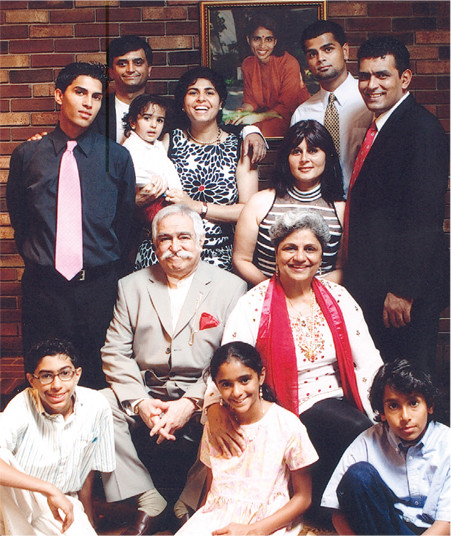
Dadi and Nergish Mistry (center) with extended family
Over 35 percent of the Delhi Parsis/Iranis must be marrying out, guesses Mistry. He foresees more and more interfaith unions in the coming years. He estimates around 700 Parsis/Iranis reside in Delhi, some of them permanent residents and others being stationed on assignments and then moving out. The population largely consists of professionals, says Mistry.
The DPA has three major annual functions: Jamshedi Navroz, Pateti and the agiary’s salgirah. Government officials are very cooperative: meetings with them are arranged when required and messages obtained for special occasions, says Mistry.
Delhi chief minister (CM) Sheila Dikshit mentioned at one public talk that other Indians should emulate the Parsis who have "no controversies.” "I don’t agree,” countered Mistry who was present at the talk (Mistry offered a tip to ghazal singer Penaz Masani who was with him prior to Parsiana’s interview saying that if she met Dikshit she should take along some dark chocolates as the CM had a weakness for them).
Controversies are not new to Mistry, an avowed liberal. When asked about the move, no doubt prompted or supported by the World Alliance of Parsi Irani Zarthoshtis (WAPIZ), to oust him from the vice presidency of the North Zone of the Federation of Parsi Zoroastrian Anjumans of India (FPZAI) by promoting the candidacy of Tehmtan Anklesaria of Ratlam, Mistry responded: "I don’t want to get into that.” He stated he was not going to canvas for the office. "Let the community decide. I came up in life on my own.”
He had a meeting the day before the Parsiana interview on February 18, 2009 with Bombay Parsi Punchayet (BPP) chairman Dinshaw Mehta and the other trustees (barring Yazdi Desai who was not present at that time) where he spoke of anjuman properties in North India. "In some areas there are no Parsis. If legal documentation (of sale or gift or lease, etc) is available we can see if we can generate money from these properties. There are aramgahs in places such as Hatharas, Aligarh, Simla, Dehra Dun, Mussoorie, Saharanpur” that may be encroached upon or usurped if there is no Parsi/Irani to look after them.
"The Ajmer dakhma is closed. Bodies are brought to Delhi for burial. The (outstation) Parsi population is dwindling at a considerable rate. We should have one paid person in each and every area to oversee (the property). We should try and preserve the property through the Federation. They all agreed.”
What did he feel about the late BPP trustee Rustom Tirandaz’s assertion, echoed by Mehta, that the BPP was the all India and world body?
"I’m the only person alive from all the people who formed the Federation. The Federation is necessary. The Punchayet trustees did not know the Ajmer dakhma had closed… suppose there is a problem in Ratlam? If the BPP intervenes the government will say ‘You’re a local body. What is your interest?’”
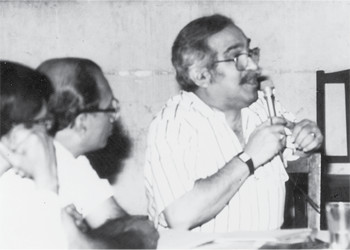
Mistry at a Federation meeting (circa 1980s): "I’m the only person alive from all the people who formed the Federation”
Around 1980 Ayatollah Khomeini and Idi Amin caused a large number of Indians to flee their two countries. "Under the guidance of the late Nani Palkhivala we formed a world body (WZO). We get a lot of help from the United Nations… can the BPP do something if trouble occurs in Karachi or Colombo? Does it have the wherewithal and the contacts?”
Mistry, who says he is out of Delhi on work 20 days in a month, notes, "Whenever I travel I put a hand in everyone’s pockets” to raise funds for charitable causes he is associated with. He spends around 25 percent of his time on DPA work. "I want to devote more but my business does not permit me.”
A former resident of Mancherji Joshi Parsi Colony, Dadar, Mistry was sent to Delhi around 1963-4 by his employers J. N. Marshall as a liaison officer. Five years later he left to join a Punjabi Group and after another four years ventured on his own as a consultant. He specializes in joint venture projects, he notes and represents foreign firms in India liaising with government officials and other corporations. This was more so in the days of excessive government control on industry. But his earlier contacts with government still help to move things along.
Mistry, 71, became a trustee of the DPA in 1968, vice president in 1991-1992 and president following the death of Lt Gen Adi Sethna in October 2006.
"I’ve always been a liberal,” he states adding what was pertinent and practical 50 years ago may not be so today. He intends to serve two three-year terms as president and then step down. "People helped me in life. I don’t have pots of money but whatever I can do with my experience and contacts to bring others up, I do.”
◆ ◆ ◆
From the archive