
Books
In the service of others
Up to 250 guests attended the launch of An Indian Portia: Selected Writings by Cornelia Sorabji 1866-1954, the latest book by historian Dr Kusoom Vadgama at the Nehru Centre in London on June 1, 2011. The program was compered by acclaimed legal journalist and BBC (British Broadcasting Corporation) commentator Joshua Rozenberg and began with Vadgama explaining the background to the book, reveals an e-mail sent to Parsiana by human rights campaigner Zerbanoo Gifford. Vadgama recounted how she had spent nearly 15 years researching and compiling this, her third book.
Gifford, who shares a Zoroastrian background with Sorabji, was the keynote speaker. Vadgama has described her as "Cornelia’s natural successor, as both had dedicated their lives to the service of others, especially the empowerment of women. They were also both consummate networ-kers and social reformers.” After her speech, Gifford garlanded a bust of Sorabji sculpted by Sachidanand Unavane which had been specially commissioned by Vadgama for the occasion, the e-mail notes.
Pauline Drayson, poet and lecturer in literature read out extracts from the book followed by a personal account of Sorabji by her nephew Prof Richard Sorabji. The book was launched by Jyoti Munsiff, the first Indian woman, and the youngest ever, solicitor in the UK, who was also the first woman advisor to Shell, reveals the e-mail. The program concluded with a speech by Dr Alice Prochaska, principal of Somerville College, Oxford, where Cornelia had been a student.
Parsi Christian
Extract on Cornelia Sorabji sent to Parsiana at our request by her nephew Prof Richard Sorabji.
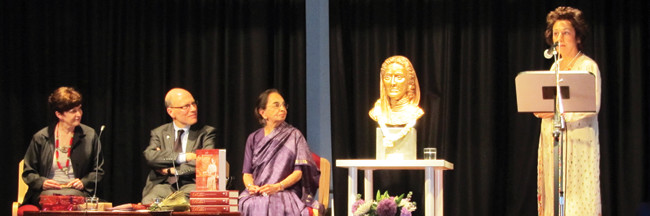
From left: Principal of Oxford University’s Somerville College Dr Alice Prochaska, legal journalist and BBC commentator Joshua Rozenberg, author Dr Kusoom Vadgama and Zerbanoo Gifford of Asha Centre with the specially commissioned bust of Cornelia Sorabji sculpted by Sachidanand Unavane Photo: Michele Cornish
Cornelia’s mother Franscina Sorabji, founded the Victoria High School in Poona in 1875, followed by a Marathi-speaking and an Urdu-speaking school and a Gujarati-speaking infant school for Parsis, the last of which fed the main school. When these schools closed on her retirement, Cornelia’s sister Susie, raised funds to re-found four parallel schools in Poona. The Parsi infant school of 1905 was located in her home. The big school, St Helena’s, celebrated its centenary in 2008.
Cornelia’s father, Sorabji Kharshedji, had grown up a Zoroastrian in Bombay, with Gujarati as his native language, but as a relative of the high priest, had learnt Zend and Pahlavi as well as Persian. His family was mortified when, aged 16 in 1840, he became the fourth boy in the notorious series of conversions to Christianity of that period. The conversion was not deliberately engineered and was not accompanied by denigration of his earlier religion. Despite having risked his life by changing his religion, he had very much hoped to retain his ethnic identity as a descendent of the arrivals from Persia. He wore Persian dress and hat, and it was a point of pride with him and, by descent through the father’s line, with his son and daughters and with the present writer, to think of themselves as ethnically Parsi. He collaborated with the high priest after moving to Poona in textual work on the Vendidad. Eventually he was reconciled even with his family, some of whom came to stay in Poona.
Cornelia knew not only Marathi, Urdu and Bengali, but also Gujarati, Persian and even the ancient Persian script, Shikasta. Though a devout Christian, she wrote with warmth and pride not only about her Parsi ancestry — she spoke of Parsi women as "our women” — but also about Zoroastrianism and its customs in her father’s time, and of its generous traditions. She devoted to the subject four pages of the first seven of her autobiography in 1934, India Calling. "We were told tales of our ancestors in Persia,” she wrote, "and of our forbears and immediate family in the Parsi community in India.” Tales of the immediate family would interest also the present writer. She insisted on all her sisters wearing saris and wearing them in the Parsi style, although it was the fashion then to combine these with an Edwardian English blouse. The costume that she best liked her brother, my father, to wear, was Persian dress, which he kept for the grandest occasions.
◆ ◆ ◆
From the archive