
Sports
Shahriarian’s super strokes
The first Zoroastrian on the US women’s cricket team, Delkash Shahriarian plays as opening batsman and wicket keeper
We were sledged on the field,” candidly admits Delkash Shahriarian, opening batsman and wicket keeper for the two-year-old US women’s cricket team when playing against experienced teams from Sri Lanka and South Africa. "Do you think you are playing baseball?” the players of the US women’s cricket team were asked at the International Cricket Council (ICC) 2011 World Cup Qualifier tournament in Bangladesh in mid-November, Shahriarian recalls the jibes.
"US didn’t make it this year. We hope to next year,” says the optimist. Of the 10 teams that played in the tournament, West Indies, Pakistan, South Africa and Sri Lanka qualified. These teams will play against India, England, Australia and New Zealand that had already earned their seats in the World Cup.
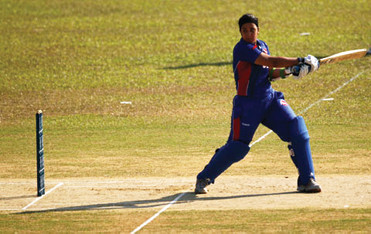
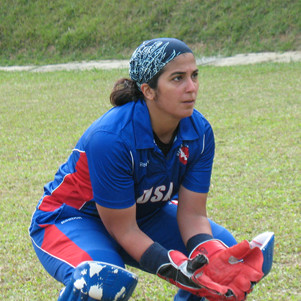
Above: Delkash Shahriarian displays her batting and fielding abilities
Facing seasoned international players and watching them play "is the only way we can improve,” realizes Shahria-rian. In the absence of ODI (one day international) status the US women’s team is unable to visit other countries and with their exposure being limited their only option is to play local games or occasionally play against men’s teams, she states. There are other factors too that serve as impediments for the nascent team. Their climate being such, they are only able to play cricket for half the year. Additionally, since they practice on matting, their pitch is different and not conducive to spin bowling. For the Bangladesh games they came from a clime of 20 degrees to 40 degrees. "It went against us somehow.”
She had an opportunity to play as a wicket keeper for two games. In one game she served as wicket keeper for some overs and in the match against Zimbabwe, the only one they played in a stadium, where they won by one run, she was wicket keeper for the entire game of 50 overs. Since then she has been retained as the national wicket keeper. But as it is difficult to be an opening batsman immediately after tending a wicket for the full game, there are times when her order as batsman is shuffled depending on the strategy of the game. Officially the coach of their team is Madras based Robin Singh who was with them in Bangladesh. However for their regular weekend training sessions his assistants, Asif Mujtaba, a former Pakistani player who has settled in the US, or Dashrath Sankhe who travels between US and Bombay, monitor the progress of the team.
Shahriarian had secured a berth on the national team in July last year after she scored 58 runs at the national tournament. Their New York based Team Phoenix of which she is vice captain, came second amongst the five participating teams. Eighteen players who were then shortlisted were trained at two camps after which the final 14 on the playing squad were announced in October in Florida.
Whilst the average age of their team is between 25 and 30 years, there are some in the team who are even over 40. "They are passing on their knowledge to us. It is a learning experience for the youngsters,” appreciates 29-year-old Shahriarian. Most of the members on the US team are of Asian origin, with some others being from the Caribbean area and a few locals. "Another thing that goes against us is that everyone on the team is either studying or working. Even when we were in Bangladesh everyone was studying or preparing for submissions or exams.” Whilst USACA (USA Cricket Association) pays the players a stipend when they are on tour, they cannot afford to be full-time cricketers.
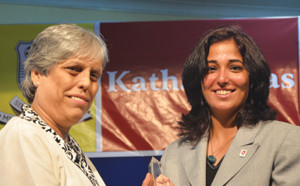
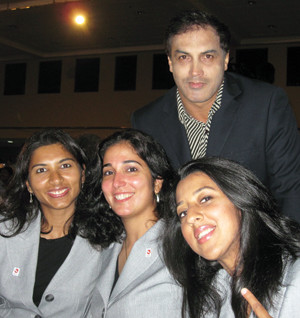
Above: Delkash Shahriarian (right) with Diana Eduljee Photo: Zal Cassinath and (alongside center) with teammates and coach Robin Singh
Working for a private architectural firm, being a LEED (Leadership in Energy and Environmental Design) certified architect and designer in Manhattan New York, Shahriarian is a designer for high end retail stores in the global market requiring her to travel. Since she cannot practice cricket if she is constantly on the move, she has to request her employers to excuse her from overseas assignments. They try to accommodate her as much as possible realizing she is on the national team. Even for the current tour she was granted five weeks’ leave, mentions Shahriarian.
Opportunity to practice together as a team comes only on weekends in the US. Her tryst with cricket started as the captain of the Sir Ness Wadia Club, Rustom Baug women’s cricket team when she led her players to victory for two successive years at the 2004-05 All Parsis Women’s Tournament, she had related (see "Batting brava,” Parsiana, January 7, 2011). After her graduation in architecture from Rachna Sansad’s Academy of Architecture she did her masters from the Pratt Institute in New York.
"Seeing opportunities in New York and the ability to live your dream,” Shahriarian chose to migrate, referring to "a lot of sacrifices I had to make, in my personal life and family.” Whilst appreciating that her life overseas has made her more independent, she is now looking for a Zoroastrian marriage partner and is willing to settle down either in India or overseas. "If we marry within our community, it will make us stronger and keep our identity intact,” she believes although she thinks "it is not fair” that out-married women and men are not treated on par. "That has to be made equal,” she states.
Hoping to see the community infighting settle down in Bombay, the youngster notes, "As a community we need to come together, utilize the resources we have at our disposal and move forward.” With so many eminent Zoroastrians in the community "we need to tap their knowledge and guidance.”
Her success in life she largely attributes to her parents Hormoz and Banu. "They used to literally hold my hand and take me everywhere,” acknowledges Delkash who had studied at Christ Church School and St Xavier’s College in Bombay played the piano, and was active in Girl Guides and art during her student days. An automobile engineer by training, Hormoz with his son Arash runs the Pejas restaurant in Bombay’s Grant Road area. He used to be a bodybuilder and in fact had won the "Junior Mr Bombay” title. Banu who worked as secretary to the Malhotras before becoming a full-time home maker, used to play table tennis at Rustom Baug. Arash enjoys playing cricket and football for Rustom Baug and even serves as compere for the Colony’s programs when he has the time.
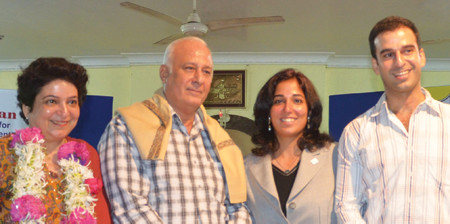
From left: Banu, Hormoz, Delkash and Arash Shahriarian
Photo: Zal Cassinath
Shahriarian also values the support she has received over the years from Cyrus and Vera Bagwadia of Rustom Baug as also Homi and Kashmira Cooper of New York. Her role model, announces Shahriarian, has been Diana Eduljee, former wicket keeper on the Indian women’s cricket team, whose presence at the felicitation organized for Shah-riarian at Rustom Baug last December made the occasion particularly memorable for her. Advising the youngster to put in her best effort and stick with the game, Eduljee cautioned her that "it’s going to be a very difficult journey.”
Overwhelmed by the felicitation at Rustom Baug, having grown up in that Colony, Shahriarian wants "to give my community the love and affection I have received.” She feels the need to turn mentor to aspiring Zoroastrian sportsmen. When friends look up to her as an individual "that makes me proud,” she confesses. The sportsperson’s goal is to be "captain cum wicket keeper like M. S. Dhoni,” the captain of the Indian team. On the professional front she looks forward to starting her own architectural company.
Recently when the family was in Udvada, her mother recalls the priest at the Pundole Adarian pointing to the Jam-e-Jamshed copy on his table that featured Shahriarian as an achiever and commenting, "Aapré jaa bhi hoié aapri kaum ni chhokreeo shine out (wherever we are our community girls shine out).” The proud mother happily told the priest that the lady standing before him was the same one staring out of the newspaper. Just as the sports star has learnt to accept praise, she is also learning how to face critics who belittle her accomplishments saying "Éma su mottu, bat né ball ramvanu (what is so great about playing bat and ball)!”
◆ ◆ ◆
From the archive