
Tribute
Spirit of steel
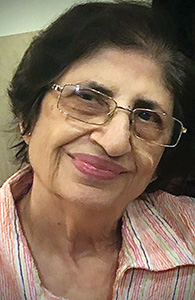
Khorshed Javeri was the first woman selected for the prestigious Tata Administrative Service
She was not expected to live. Born to Rustom and Freny Andhyarujina in 1934, the fourth child in less than five years, Khorshed had congenital rickets, a condition characterized by soft and weak bones caused by maternal Vitamin D deficiency. She was the third daughter; there were already two girls, Gool and Neena, followed by a boy, Tehmtan. With four children under the age of five, the Andhyarujinas were struggling. Rustom was working part time as a school teacher to provide an income while trying to establish a legal practice.
 Money was short but her mother Freny was undeterred. She would take baby Khorshed by bus or tram from the family home in Mahim to KEM Hospital in Parel for ultraviolet light therapy, leaving the other children in the care of Rustom’s younger sister Aimai who chided her for wasting time, effort and the bus fare on what seemed to be a lost cause. "Ai chhokri kaanda nai kaapsé, Freny, rhavaa dé (this girl will not make it, Freny, let it be)” she would say, but Freny was adamant that her child must have the best chance possible. And so, against all odds Khorshed did not just survive but thrived. The treatment was successful and Khorshed’s physical and mental development continued normally.
A bright student, her power of retention was excellent. "Khorshed ékaj vakhat vaaché (Khorshed needs to read anything just once),” Freny was to recall years later. Khorshed would read her text books and course work just once to know it. Revision was not for her; she sailed through school, passing her exams with flying colors. Rustom was unusual for men of his time; his best friend Homi (Hormusji) Seervai, also a lawyer, was of the firm belief that all children must be educated. Their gender did not matter in the least and therefore Rustom’s four daughters went from school to university as a matter of course. Khorshed joined Elphinstone College in Bombay which had the reputed Royal Institute of Science (now the Institute of Science within the Homi Bhabha University) to study the biological sciences so she could apply to read medicine. She wanted to be a doctor. However, the long hours and the lab work did not suit her; she discovered she was squeamish about blood and decided that she would change career course.
Money was short but her mother Freny was undeterred. She would take baby Khorshed by bus or tram from the family home in Mahim to KEM Hospital in Parel for ultraviolet light therapy, leaving the other children in the care of Rustom’s younger sister Aimai who chided her for wasting time, effort and the bus fare on what seemed to be a lost cause. "Ai chhokri kaanda nai kaapsé, Freny, rhavaa dé (this girl will not make it, Freny, let it be)” she would say, but Freny was adamant that her child must have the best chance possible. And so, against all odds Khorshed did not just survive but thrived. The treatment was successful and Khorshed’s physical and mental development continued normally. A bright student, her power of retention was excellent. "Khorshed ékaj vakhat vaaché (Khorshed needs to read anything just once),” Freny was to recall years later. Khorshed would read her text books and course work just once to know it. Revision was not for her; she sailed through school, passing her exams with flying colors. Rustom was unusual for men of his time; his best friend Homi (Hormusji) Seervai, also a lawyer, was of the firm belief that all children must be educated. Their gender did not matter in the least and therefore Rustom’s four daughters went from school to university as a matter of course. Khorshed joined Elphinstone College in Bombay which had the reputed Royal Institute of Science (now the Institute of Science within the Homi Bhabha University) to study the biological sciences so she could apply to read medicine. She wanted to be a doctor. However, the long hours and the lab work did not suit her; she discovered she was squeamish about blood and decided that she would change career course.
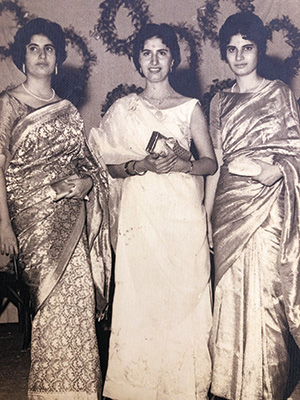
Khorshed Javeri (top and above, ext l) with sisters
Gool and Pervize at Gool’s wedding
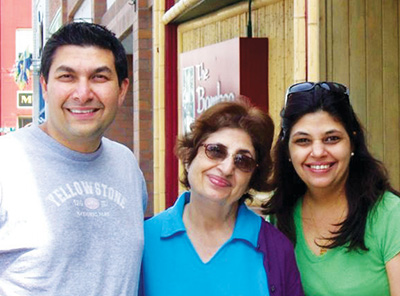
Khorshed (center) with son Neville and daughter Rashna Bilimoria
It was no coincidence that she chose law. Her father was a lawyer and so were her older siblings Gool and Tehmtan. Academically she shone, getting the silver medal in law from the University of Bombay. However, unlike her siblings, she did not enter legal practice.
No one expected her to get chosen for the Tata Administrative Service (TAS). In those days TAS was one of the most prestigious jobs within the Tata group, India’s largest industrial empire. Created by J. R. D. Tata in 1956, it was the flagship leadership program for young talent, mentoring them for leadership roles within the Tata companies. J. R. D.’s aim was to create effective captains of industry who would steer their companies effectively and innovatively and enable the continued progress of the organization. A TAS recruit is on a fast track program to the top echelons of management. Since its inception, no woman had ever been selected. It was hard enough for the male applicants. Khorshed applied, writing a covering letter explaining the reasons for her application. J. R. D. was impressed with her curriculum vitae and qualifications and thought she deserved an interview although he expressed reservations about whether she would actually be selected. Nevertheless, as he had said himself, it was essential to be completely impartial and she was an applicant of the highest caliber.
At the interview, Khorshed did well. Yet, she was not offered a job immediately. The interview committee was still hesitant about letting a woman through. How would she conduct herself at meetings? Could she hold her own with international clients? She might be intimidated being the lone woman at executive meetings. After some deliberation, the board of directors decided to have a second interview; this time over dinner. They intended to see if this 24-year-old newly minted graduate lived up to the high standards she projected. Khorshed had shone during her initial interview. At dinner, she dazzled. There was poise and composure, intellect and wit, manners and courtesy, intelligent conversations and quick repartees. The board offered her the job. And thus in 1958, a glass ceiling was shattered within the Tata group.
In 1965, Khorshed married Rustom (Russi) Javeri, a chartered accountant. He had been senior to her in the Government Law College which he was attending part time while doing his articles for chartered accountancy. They went on to have two children, Neville and Rashna (Bilimoria) who survive their mother and her eldest granddaughter Natalia who follows in her grandmother’s footsteps has chosen law as a career and is about to start work at Freshfields, Bruckhaus Deringer in London.
Khorshed went on to become company secretary and chief in-house legal counsel for Tata Steel which was then TISCO (Tata Iron and Steel Company). She wrote several books, the first of these being A Company Secretary’s Handbook with the foreword written by J. R. D. It was sold out and reprinted a second time. She went on to write Capital Issues — the Law and Methodology and also Law and Tax for the Layman, which was reprinted five times.
After leaving TISCO in 1981, Khorshed became self-employed as a corporate law consultant and a director on the board of several companies including Jyoti Structures and Citibank India. Khorshed loved writing; she had a regular column in The Economic Times for 20 years and she then decided to make a foray into fiction. The Mother and Other Short Stories published in 2005 was followed by Through the Corridors of Justice, another collection of short stories. The proceeds from the sales of these books funded the education of girls in India, a mission that she remained passionate about till the end of her life. Khorshed maintained that her humble roots were what fired her ambition to serve the underprivileged and the less fortunate. On principle, she rooted for the underdog over the established. She was a gentle but firm personality, not beaten by the brash and uncouth. She wrote several other stories and articles in publications like Parsiana and the Jam-e-Jamshed.
Khorshed believed education was the ultimate gift one could give one’s children or the greatest investment one could make in oneself. Travelling the world and experiencing different cultures was the best way to open the windows of the mind.
It was not just writing that she enjoyed. Khorshed loved reading books and poetry, keeping a file of her favorite poems.
She was so much more than a lawyer, corporate executive, author and company director. She was a beloved wife, mother, sister and aunt. I am proud to be related to her, my mother’s younger sister. Of all my mother’s siblings she was the one who maintained links with the extended family. Ties of blood were always important. It was over this that she and I clashed fiercely. I railed and ranted at some of the extended family who would only make contact when they wanted a favor, but she would urge me to forgive, acknowledging that with time and age she could no longer find it in her heart to feel resentment even towards those of her own cousins who were time servers. She had been deeply hurt when none of them made contact after her beloved husband passed on but would approach her later to ask for help which was never denied. I felt that her attitude denoted weakness. It is only now that I realize how much strength and nobility she displayed.
She was never expected to die so suddenly. At the beginning of life, her survival was unexpected, and at the end of life, her sudden departure on May 13, 2021 unforeseen. And in between her entrance and exit she had a full existence. Her academic and professional achievements were surpassed only by her goodness, grace, decency, humility and generosity. To use a quote from one of her favorite poems she was one of those "millions who humble and nameless, the straight hard pathway plod. Some call it consecration and others call it God.”
◆ ◆ ◆
From the archive