
Books
Cornelia’s crusades
An Indian Portia. Selected Writings of Cornelia Sorabji 1866 to 1954. Edited by Kusoom Vadgama. Published in 2011 by Zubaan, an imprint of Kali for Women, 128 B, Shapur Jat, New Delhi 110049. Pp: 702. Price: Rs 1,200.
What made Cornelia Sorabji decide to become a lawyer at the callow age of eight? It was the anguish of a Gujarati Hindu widow, swindled out of a substantial inheritance by her trustee. Illiterate and unable to deal with the world outside the purdah, the widow was typical of many purdahnishins (women compelled by orthodoxy to wear the purdah throughout their lives), who had lost all their property and suffered untold grievances and illnesses without any help. But, alas! The legal profession was not then open to women — it took a remarkable woman to fight to improve the education and rights of Indian women.
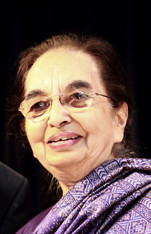
Dr Kusoom Vadgama: enthralled by Sorabji Photo: Mala Vadgama, MKV Photography
Sorabji was that woman. The first woman, Indian or British, to sit for the examination of the degree of Bachelor of Civil Law at Somer-ville College, Oxford, way back in 1892. It took another 31 years before she could be called to the English bar.
The years were not wasted — not for a woman of Sorabji’s distinction and determination. She worked tirelessly for the rights of purdahnishins and orphans. In 1904, she was recognized by the government as the lady legal advisor to the court of wards. She supported traditional Indian life and culture, but campaigned to reform the outdated laws of child marriage and the position of widows.
Judging from her professional work and services to the community at large, Sorabji’s private life and public life were never separate. Most of the brilliant collection of her letters and papers were left to her friend and confidante, Lady Elena Richmond. In 1973, Elena’s nephew William Rathbone X presented the collection to the then India Office Library, now the Asia, Pacific and Africa collection at the British Library in London. Another collection is held by Sorabji’s nephew Prof Richard Sorabji, in Oxford. Cornelia was an indefatigable letter writer and had something to say even if written on consecutive days or twice in the same day! These letters are priceless gems of the turbulent history of two nations, India and Britain, divided by culture and colonial rule. As her book’s editor, Kusoom Vadgama, highly qualified and much respected, puts it: "She had a deep desire to communicate with others through letters and to put her private thoughts in her diaries. Writing for her became a labour of love as well as a recreational activity: she would unwind after a day’s hard work by recounting it all again on paper.”
A stroke of luck led Vadgama to learn about Sorabji. A writer herself, Vadgama’s first book India in Britain had forewords by Indira Gandhi and Prince Charles. In the course of her research in the British Library, Vadgama accidentally came upon the 233 volumes of Sorabji’s private papers. Vadgama was enthralled particularly by Sorabji’s fight for justice. An Indian Portia was the result after years of research.
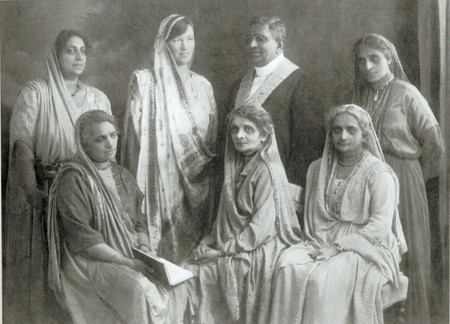
The Sorabji family: (left, l to r, standing): Alice, Mary (sister-in-law), Richard and Cornelia; (sitting) Lena, Mary and Pheroze; (below) parents Sorabji and Franscina
Raja Ram Mohan Roy — regarded as the first great modern Indian, a social reformer and linguist who spoke five languages and was an enthusiastic votary of English education and a modern educational curriculum which included mathematics and science — understood that conquest, war and civil strife had blighted India’s intellectual growth. Writing to Lord William Amherst, the Governor-General in 1823, he thanked the Supreme Disposer of the Universe for having unexpectedly delivered his country from the long, continued tyranny of its former rulers and placed it under the government of the British — a nation who not only is blessed with the enjoyment of civil and political liberties, but also interests itself in promoting liberty and social happiness as well as free inquiry into literary and religious subjects among those nations to which its influence spreads. Sorabji was in full agreement. Roy also prophesied that after a hundred years when an Indian middle class had emerged, the British would be asked to leave. Among many others there was of course Sorabji working alone who favored the India Act of 1919 and 1935 for Dominion Status for India — with eventual full independence.
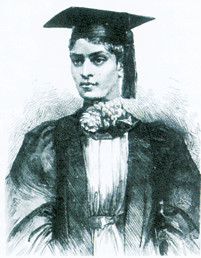
Sorabji was the first woman graduate of Western India
Striking a personal note, Sorabji once said: "There is one circumstance in my life of which I may boast, unashamed — and that is my inheritance; the fact that I am a child of my parents. For there are no two people in all the world whom I would have chosen as my parents, if a choice had been given me, save just my very own father and mother.” She goes on to add: "We were ‘brought up in English’ — that is, on English nursery tales with English discipline; on the English language, used with our father and mother, in a home furnished like an English home.”
So concerned was Sorabji about the plight of purdahnishins, that she wrote a letter for publication to the prestigious London Times, suggesting a scheme of devoting trained female agencies to the service of the very large number of purdahnishins who in their communication with the outside world are exposed to manifold difficulties, dangers, misunderstandings, and often brazen swindling. The Times not only published the letter but editorially commented that "this honorable Indian lady whose talents, education and practical training, equal to that of the most advanced European ladies, entitles her to a respectful hearing from all those who sympathize to further social progress in the Indian empire.” The Times pointed out that there was in existence an organization for this purpose which bears the honored name of its founder Lady Hariot Dufferin, but which may be augmented with the development of various branches of female education.
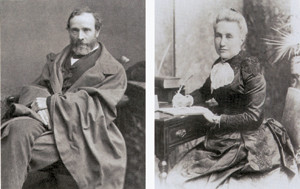
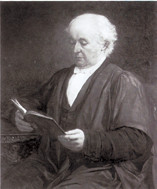
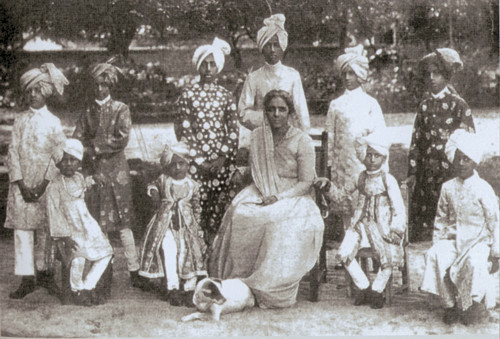
Above (from left): Lord and Lady Hobhouse who encouraged Sorabji to come to Oxford and raised funds to enable her to study at Somerville Hall and Benjamin Jowett, master of Balliol College and a trusted friend Alongside: Susie Sorabji (in sari) with some of her resident pupils at St Helena’s, Poona
Sorabji not only sought justice for the veiled women, she saw to it that justice was done. After a period of training in a solicitor’s office in London, she practised for seven years in India, devoting herself chiefly to chamber counselling for purdah women and sometimes even appeared in court, under special sanads or permission to plead. With her exceptional qualifications, she drew up a businesslike scheme, supported by the letters of several eminent judicial authorities, all of them past or present judges of the Indian High Courts. The Times editorial concluded by suggesting as a last resort that Sorabji’s scheme be brought to the attention of Lady Mary Curzon who was renowned for her sympathy for the women of India.
Space constraints compel this reviewer to pass over the short stories Sorabji wrote and the books she published. However, reference to the interview Sorabji had with Mahatma Gandhi, published in Atlanta magazine, cannot be avoided. By mutual agreement, the two spoke to each other as professionals — barristers who spoke their minds without offense being given or taken. It turned out to be a confrontation between two antagonists, each of whom spoke his or her views. There was no exchange of ideas, no questions were asked, no answers given, almost as if each spoke to the audience rather than to each other. It was a confrontation rather than an interview — and a rigid, even frigid one at that.
Awarded the Kaiser-i-Hind Gold Medal in 1909 for her services in India, Sorabji practised in the Calcutta High Court from 1924 to 1929 when she moved to London. That same year she visited the United States and lectured at the Institute of Politics in Williamstown on the British rule in India. An American lady was provoked to declare that Cornelia Sorabji had the idealism of India, the training and administrative skills of Great Britain and the energy of America and that therefore she belonged to all three. Sorabji stood tall, dignified, even stately and strikingly attractive in the saris she wore in the orthodox Parsi style. A fine writer and an extraordinary woman, a doer and a winner.
BURJOR K. KARANJIA
◆ ◆ ◆
From the archive