
Institutions
A charitable tradition
The Bhikha Behram Well has been maintained by the Panday family and others for 287 years
What am I doing in life? Just making money? Going to my office at Fountain? I did some introspection. Why not take up a project?” recalls 53-year-old Aspi Deboo who made it his mission to refurbish the Bhikha Behram Well (BBW) precincts last December.
A jashan was performed by Ervad Yezdi Aibara, panthaky of the Seth Nusserwanji Hirji Karani Agiary at Cusrow Baug and others on December 26, Amardad mah, Avan roz to mark the completion of the nearly two-month long restoration. Deboo was presented with a shawl by the BBW Trust’s chairman Ervad Burjor Antia, a noted solicitor and former trustee of the Bombay Parsi Punchayet (BPP).
"We were looking for somebody who would volunteer” to repair and restore the Well precincts, Antia told Parsiana on December 9. Deboo’s appearance on the scene was akin to that of an "angel,” said Antia.
"We don’t say ‘give us the money, we will do it,’” says BBW trustee Dr Viraf Kapadia. "We leave it to them (the donors).” The Trust has a small corpus of a few lakhs, note Antia and Kapadia. The other two trustees are Meher Dhun-bhoora and Sooni Taraporevala.
A jashan was performed by Ervad Yezdi Aibara, panthaky of the Seth Nusserwanji Hirji Karani Agiary at Cusrow Baug and others on December 26, Amardad mah, Avan roz to mark the completion of the nearly two-month long restoration. Deboo was presented with a shawl by the BBW Trust’s chairman Ervad Burjor Antia, a noted solicitor and former trustee of the Bombay Parsi Punchayet (BPP).
"We were looking for somebody who would volunteer” to repair and restore the Well precincts, Antia told Parsiana on December 9. Deboo’s appearance on the scene was akin to that of an "angel,” said Antia.
"We don’t say ‘give us the money, we will do it,’” says BBW trustee Dr Viraf Kapadia. "We leave it to them (the donors).” The Trust has a small corpus of a few lakhs, note Antia and Kapadia. The other two trustees are Meher Dhun-bhoora and Sooni Taraporevala.
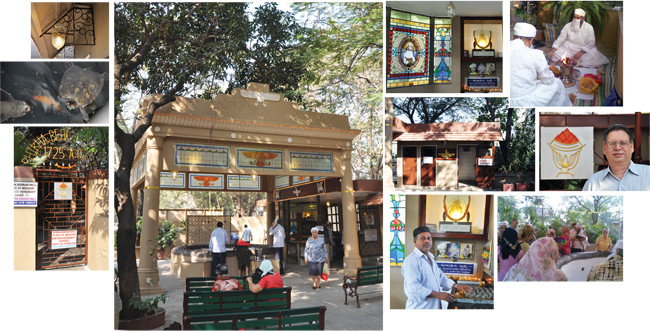
Clockwise from top left: Ornamental grill and lamp; overview of Well; Stained glass panes after its recent restoration, Avan roz jashan in progress, benefactor Aspi Deboo; worshippers at the Well; caretaker Nadir Tangri and facade of prayer rooms; entrance; tortoise and fish swim in the Well
"I feel truly blessed this project came my way,” states Deboo. "It is a defining moment in my life. By doing this I have developed as a person. I feel humbled. My calling in life has changed,” said the finance and real estate advisor to developers.
Deboo says he personally supervised the repairs and restoration, cutting out any architect and contractor. "I have not visited my office for two months. I sourced all the material from wholesalers and hired labor on a casual basis.” At first he thought only plastering, painting and woodwork was required to be done. "But the final product is other than what I had visualized. New ideas kept evolving. They came naturally without any difficulty.” He added a small, mangalore tiled roof over the prayer and washrooms, increased the height of the gate to improve security and added inbuilt seating for around 25 people along a part of the inside of the perimeter wall. The added seating capacity will be useful when humbandagis are held at the site.
"Additional garden beds on either side of the gate” have been added, he pointed out to Parsiana on January 4, 2012. But what he is especially keen to point out is the lighting facilities that brighten the small complex at nightfall. A row of tiny LED (light emitting diodes) rope lights run across the perimeter of the canopy constructed above the Well by Shapoorji Pallonji. "There was piped wiring which I felt was not in keeping with the ambience. We concealed it.” Energy saving CFL (compact fluorescent lamp) bulbs were fitted into the inverted glass containers hanging from the ceiling of the diva section and elsewhere.
"The surface of the Well walls was given a sandstone finish” along with an application of weather seal coating. Deboo says he is "committed to maintain” the Well precincts on a year to year basis; after each monsoon he will examine what is required to be done. "It is the sacred duty of the community to maintain heritage places of worship.” His wife, Manek and children, Khorshed, Rustom and Anahita, have been "most supportive” of his efforts "egging” him on to start and complete the project.
Kekoo Nicholson of Selvel Advertising had donated the metal bulls that grace the precincts and some saplings for the garden, noted Deboo.
"Coincidentally on December 8, 120 hawkers (adjacent to the Well) were removed. The entire place was taken possession of by the Collector of Mumbai,” remarks Deboo. Thanks to the OVAL Trust spearheaded by activist and lawyer Shirin Bharucha and Nayana Kathpalia the Cross Maidan precincts that were encroached upon by various parties and occasionally rented out for circuses and sales is now converted into manicured gardens. The place has an eye-catching steel Charkha designed by sculptor Nuru Karim and sponsored by the Jasubhai Foundation and Tata Steel. The only eyesore on the property is a disputed structure belonging to the Siporex tile company. A case has been filed in the courts for its removal; for some reason the provisions of the Public Premises Eviction Act which are used to evict poor and middle class tenants from government owned property have not been invoked in this case. Parsiana’s earlier attempts to talk to the tenant were rebuffed (see "Another garden for Bombay,” September 7, 2010).
The BBW has no employees but Nadir Tangri and his son Vistasp manage the place from morning to evening, earning revenue from the divas that are lit by devotees. Two assistants help with the cleaning of the premises.
"Roji roti chaalyaa karéch (we meet daily expenses),” says Tangri who also works as a chasniwala at the Fasli Atash Kadeh at Marine Lines where he and his son reside. On an average day, 100 to 250 devotees come to pray at the Well though on Avan and Behram rozs and other auspicious days the number can increase to over 500. The divas come in three sizes, half glass for Rs 5, full glass Rs 10 and for a large glass Rs 70. At night the premises are locked till the next morning at 7 a.m. Tangri contributes Rs 10,000 per annum to the Trust.
The premises have been spared any harm all these years save once when the stained glass panels were smashed by vandals. At that time scaffolding had been rigged up for painting the pavilion and taking advantage of the temporary structure the miscreants were able to reach the panels and smash them. Both Antia and Kapadia said that the Trust does not have enough funds to employ a night watchman.
Over the years the number of devotees visiting the well has diminished. Kapadia approximates that the drop has been in the vicinity of "70 percent.” He attributed the decline to the decrease in the Parsi population and that fewer Parsis hold jobs in the Fort area. "Vasti pèhlé Fort ma hati (there was a Parsi population in the Fort area). Now lawyers and retired people come. Earlier it was a meeting point.” He recalls in the earlier days Shah Nameh recitals used to take place at the Well and the reputed Vithal bhelpuriwala started his career there. The late lawyer and BPP trustee Homi Banaji once related a story of how a listener to the Shah Nameh stories seated on the perimeter wall of the Well was so moved by the narration that in his excitement he fell into the Well and was pulled out!
"The water in the Well is supposed to have curative powers,” recalls Antia. Cars would line up and drivers would collect the water for their owners. Whether the water is potable or not is left to the individuals to decide for themselves, say Antia and Kapadia. "I drink it,” says Kapadia. "Every year we clean the Well. We drain out the water in May when the level is down. The fish and the turtles are transferred to a big tub” and then reinstated in the Well.
In a hand written note to Parsiana Kapadia mentions that for the last 287 years, the community has been "maintaining the edifice.” Shapoorji Pallonji constructed the canopy above the well. Sohrabji Godrej renovated the premises in 1995 "providing it with the beautiful garden.” Shapoorji’s son Pallon Mistry "once again restored the premises in March 2000.” In 2004 Sharukh Davar did up the place, while in 2005 Xerxes Master of the Master Group restored the damaged stained glass panels.
Metal boards on the two gates to the entrance of the Well state entry is restricted to Parsi Zoroastrians. When questioned as to why it was so as the precinct is not a consecrated site, Antia claimed that as the Well is part of the community’s heritage "all said and done it is (akin to) a consecrated area.” He likened it to a dar-e-meher/dadgah and noted that divas were lit.
In his Global Directory of Zoroastrian Fire Temples author Marzban J. Giara cites the history of the BBW from the Parsi Prakash Volume I: "It was built in 1725 AC by a Parsi merchant Bhikhaji Behramji Panday who was known as ‘Bhikha Behram’ amongst the merchants of his time. He was an akabar (trustee) of the then Bombay Parsi Punchayet. He was the grandfather of Seth Meherwanji Faramji Panday who built the Panday Sanatorium at Colaba and Panday Dharamshala at Thakurdwar. His grandfather, Seth Khurshedji Ponchaji Panday, came to Bombay from Bharuch in 1665 AC. He was arrested on suspicion that he was a spy and imprisoned at ‘Panderagadh’ fort near Valsad. Thus, the surname ‘Panday’ was derived from the Panday fort where their ancestor was imprisoned.”
In Parsi Lustre on Indian Soil, Volume II by H. D. Darukhanawalla a write-up on Seth Limjee Dinshaw Furdoonjee Panday mentions "in those olden days when Bombay was a fishing village water for drinking was scarce and sinking of wells was consider(ed) a highly esteemed form of charity. For over 200 years this well has given water to members of all communities and even cart loads of water from the Well daily go down to suburbs of Bombay for people who know of its beneficial and tonic properties. Since the death of Seth Bhikha Behram on August 23, 1783 the Well and the water trough have been held in trust by the founder’s descendents for the benefit of the public of Bombay as well as for the religiously inclined Parsis and Limjee who was during his lifetime the trustee of the Well rendered to it appreciable services as well as in managing its upkeep and repairs as in defending its title vehemently against certain controversies. Limjee — the legal descendent of Seth Bhikha Behram — relegated the performance of these sacred and charitable duties to his son Dadabhoy who like his father has been taking keen interest in this family charity for over quarter of a century. Since 1940 all expenses in connection with the Well are being defrayed by the late Limjee’s family as was done by Limjee’s ancestors.”
Fortunately the Panday family legacy has been taken up by other philanthropic minded community members.
◆ ◆ ◆
From the archive