
Cover Story
Centenary in Calcutta
The Zoroastrians of the eastern metropolis came clad in traditional finery to participate in the ceremony to commemorate the 100th year of their place of worship
"A centenary is a convenient perch from which (to) look backwards and forward,” said Noshir F. Tankariwala, senior trustee of The Late Ervad Dhunjeebhoy Byramjee Mehta’s Zoroastrian Anjuman Atash Adaran in Calcutta. He was speaking at the inaugural function of the centenary celebrations of the fire temple on October 4, 2011, welcoming chief guest Ervad (Dr) Ramiyar Karanjia and about 250 members of the community who were present dressed to the nines in garas and kor-ni-saris for the ladies and daglis and pugrees for the men. Information about the celebrations was sent to Parsiana by Ketty R. Kapadia, manager of the Atash Adaran.
Karanjia was received with a traditional aachhu michhu by Tina Mehta, chairperson of the Religious Functions Committee, and welcome songs by the ladies. He participated in the jashan that followed, after which the action moved to the lower hall of the Atash Adaran where Tankariwala, on behalf of himself and co-trustees Yezdezard J. Dastoor and Jemi S. Bilimoria, thanked Karanjia for coming to Calcutta for this very special occasion. Paying tribute to the founders and benefactors of the fire temple, the Mehta family, he stated, "I am proud to say that our benefactors would have been more than satisfied that their wishes have come true, perhaps well beyond their expectations. Thanks to the dedicated commitment of generations of trustees who have steered this legacy through some very difficult times… today the community is fortunate to reap the rewards of their endeavors.”
Acknowledging the "dedication and devotion” of our priests who have kept the sacred fire burning for a 100 years, Tankariwala made special mention of three: Ervad Burjorji Jamshedji Dastoor Meherjirana who served the Atash Adaran from 1911 to 1947, had an imposing personality and was highly respected by the community. Invited in 1908 by the Mehtas to be their family priest at their dar-e-meher at 55 Canning Street, he was later appointed the first panthaky of the Atash Adaran. After he retired Ervad Bapuji Hormusji Desai took over the reins, which he held until 1999. Desai, who had come to Calcutta in 1930, was recalled as a "kind, modest and… wonderful person who literally spent his life for our community and became a living legend.” The current panthaky, Ervad Shorab R. Kotwal, who has been in Calcutta since 1958, "has in his own quiet and humble way taken us through half a century without any turmoil,” Tankariwala noted.
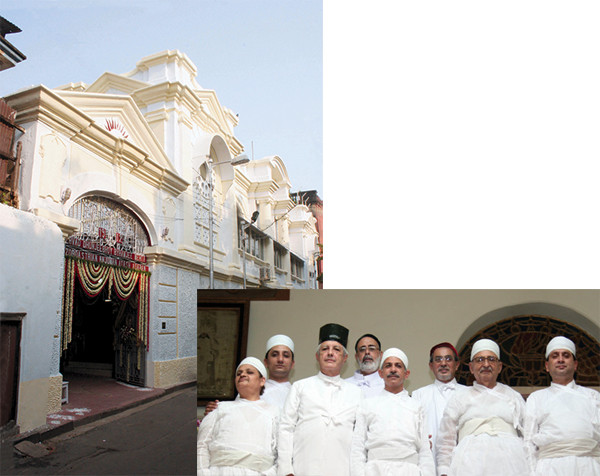
The Late Ervad D. B. Mehta Atash Adaran; (below, from l) Ervads Behram Bhadha and Jimmy Taraporwalla, Noshir Tankariwala, Yezdezard Dastoor, Ervad (Dr) Ramiyar Karanjia, Jemi Bilimoria, Ervads Shorab Kotwal and Mehernosh Dastur
Referring to the future, Tankariwala expressed the hope that with the help of Ahura Mazda "wisdom and common sense will prevail and this little community of ours which has been blessed, will not fall prey to the divisive elements prevalent elsewhere in the country, but shall live happily and united ever after.” On the occasion, the trustees felicitated the two senior most members of the community, Hilla S. Bilimoria who at 102 is two years older than the Atash Adaran and Perrin M. Dastoor, who is as old as the fire temple. Along with these centenarians, Karanjia and Kotwal were also felicitated by the trustees.
Karanjia’s address to the gathering impressed the audience and earned him a standing ovation, the write-up mentions. "Religion has to be a part of daily life. Just knowing and understanding religion is not enough, one has to live it,” Karanjia said. Zoroastrianism can best be defined by two concepts: increasing goodness and decreasing evil, as reflected in our basic prayers, he elaborated. The religion is generally explained in three words — humata, hukhta and hvarashta — which do not do justice to the depth of Zoroastrian teachings, said Karanjia while conceding that the concept is "quite profound” and "not as simplistic as one thinks, since the ‘good’ refers to intrinsic goodness and not sporadic goodness.”
Dwelling on the benefits of faith, Karanjia bemoaned that in modern times faith is often "looked down upon” as we are proud of our intellectual attainments. But in religion faith is as important as knowledge. We, however, have to learn "to differentiate between faith and blind faith. Faith is to be placed on well established teachings, powers and forces, attested by prophets and men of spiritual repute. Hollow claims by mortals to mislead men, and teachings which may have a long-term harmful effect can be classified as blind faith,” he cautioned.
The function closed with a vote of thanks from trustee Dastoor after which the congregation moved to the upper hall for a maachi. The inaugural program concluded with a sumptuous lunch catered by Dinyar Tampal of Tampal Caterers who, being originally from Calcutta, volunteered to come from Bombay for the occasion, the write-up mentions. The celebrations will continue, with a number of events being in the pipeline for the year ahead.
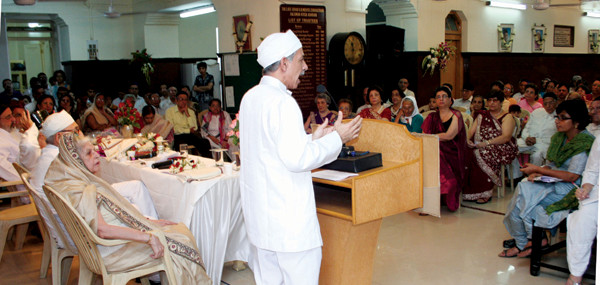
Ervad (Dr) Ramiyar Karanjia addresses Zoroastrians of Calcutta
In a letter addressed to Mehta, Dastur Kaikhushro Navroz Dastoor Meherjirana congratulated Calcutta’s Zoroastrians on the year long centenary celebrations of their Atash Adaran and wished that "the love and devotion for the padshah ever remain enlightened in your heart.” Referring to his father, who had served as the first panthaky of the Atash Adaran, the high priest wrote: "I assure you, he is sending his blessings to you on this auspicious occasion and I, as his son, am joining him.”
In the run-up to the centenary the Atash Adaran was renovated and refurbished, mentioned Calcutta Gavashni, January-March 2011 issue, being reopened to worshippers on Jamshedi Navroz, March 21. The first phase of the renovation saw the completion of major repairs such as total change of electrical wiring on the first floor, waterproofing on the terrace/roof, installing of new efficient exhaust system with exhaust fans, ducting and cowling, with modifications being made wherever required. New stained glass windows and arches were installed, the furniture polished, energy efficient lights fitted in the hall and a larger environment friendly generator set provided. The walls were painted and marble/granite areas polished. The trustees of the Atash Adaran have recorded their appreciation of the role played by Eruch J. Bamji, Malcolm B. Contractor, Katayun R. Saklath and Asbana J. Taraporwalla, without whose involvement and dedication the work would not have been completed, Gavashni mentioned.
Reporting on 100 years of Calcutta’s fire temple at 91 Metcalfe Street or Bandook Gali, The Telegraph of October 5, 2011 mentioned that the city’s Parsi population which has shrunk to about 600, many of them senior citizens, was present in "full force” for the ceremony at the newly painted and now fully restored fire temple which had been beautifully decorated with flowers. Harking back to their history, the newspaper notes that the Parsis of Calcutta will celebrate the 250th anniversary of their advent in that city in another five years. The first to arrive was Dadabhai Behramji Banaji of Surat. His relative Rustomji Cowasjee Banaji, who came in the early 19th century, was a prominent citizen who founded an agiary on Ezra Street in 1839, "which is now decrepit and encroached on.”
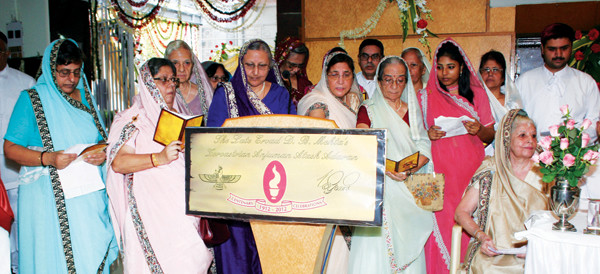
Ladies sing traditional songs on the Atash Adaran’s centenary
Reminiscing about her youth in Calcutta, journalist Bachi Karkaria wrote in The Times of India of October 22, 2011, that the closure of the now defunct agiary "was an even more visceral loss for our family. Our equally old house shared a wall with the Banaji agiary, its gongs marked out our routine, and the fragrance of its sandalwood mingling with that of frying onions in our kitchen created the abiding scent of my growing up years. It was our private font of faith.” Unfortunately, it could not be salvaged by the community because it was entangled in a family trust. In contrast, the Mehta agiary, which was the communal one, "had a cosmic grandeur. Simply ascending its radiant marble stairs seems to take us closer to Ahura Mazda,” she recalls. Nevertheless she maintains, "The aura of my childhood agiary may seem as transient as the smoke that wafted through it, but it is as lingering as its sandalwood fragrance.”
Dhunjeebhoy Byramjee Mehta, after whom the Atash Adaran has been named, arrived in Calcutta in 1846 and engaged in trade with China. He founded the Empress of India Cotton Mills in Serampore and, after a dispute with Banaji, "decided to set up a place of worship in his own house, for which the sacred fire was brought from Navsari.” After his demise his wife Khorshedbai and son Rustomjee took it on themselves to fulfill his wish and, with handsome donations from the family and members of the community the current Atash Adaran which bears his name was established with the fire brought from Navsari being installed in it. The Telegraph notes that "it was consecrated on October 28, 1912, with great pomp and splendor.”
◆ ◆ ◆
From the archive