
Felicitations
Meherjirana’s portrait unveiled
The portrait of the recently deceased Dastur Meherji Kekobad Meherjirana adorns the walls of the Navsari Atash Behram
The hall of the Bhagarsath Anjumanna Atash Behram at Navsari, was filled with devotees wearing sack dresses and gathered frocks, the men in everyday shirt and trousers donning topis on Adar roz, Asfandarmad mah — July 22, 2011. Ten mobeds chanted prayers presided over by the current Dastur Kaikhushro Dastoor Meherjirana XVIIth at the Atash Behram.
A hand painted portrait of the XVIth Meherjirana (Dastur Meherji Kekobad) who passed away in January 2010 was unveiled. "The artist from Ahmedabad has depicted the dastur in happiness and in a pensive mood,” stated Meherjirana. "Death is certain but when it comes is totally uncertain,” he added, stating "this was also the case with the sad demise of my predecessor.” Two bouquets were placed at the pedestal of the portrait, one from the anjuman and the other from the orphanage in Navsari.
The presiding priest then specifically talked of the XVIth Meherjirana who he proclaimed "was an ordinary man with extraordinary qualities who had no nafrat (disdain) for anyone, he was an Ilm-e-Kshnoom exponent. This man who stammered and was not a high achiever, compiled a dictionary of 1,100 Zoroastrian terms over 20 years’ labor. No western scholar has achieved anything of this magnitude. He took us one step closer to enlightenment. He knew mysticism.” Meherjirana credited his ancestor for asking daring questions: "What is good? Who decides this? These are technical questions in mysticism. Every subject has technical terms specific to its expertise. Even mysticism has this but the intellect cannot fathom all the nuances,” he opined.
The first Meherjirana (the title has since been bestowed on the presiding head priest of Navsari), in the court of the spiritually inclined grand mogul Akbar, was renowned for his piety, vast knowledge and spiritual powers. In fact an image of him is visible in the grain of the marble wall opposite the kebla. One of several mystical tales attributed to the first high priest of Navsari, by the current Meherjirana revealed the jealousy of the Nawab of Sachin who resented the closeness of the first Dastur Meherjirana to Akbar. Sachin decided to have this savant captured and incarcerated. The next day Sachin went to the cell in person to belittle the priest. The nawab’s astonishment knew no bounds when he and his men realized that the cell though locked was empty and the ‘prisoner’ had fled and was reportedly already at the court of the great Mogul in Delhi. All this because Dastur Meherjirana was known for his scholarship, religiosity and mysticism, and the savant seemed to have built a special rapport with the secular and spiritually inclined emperor.
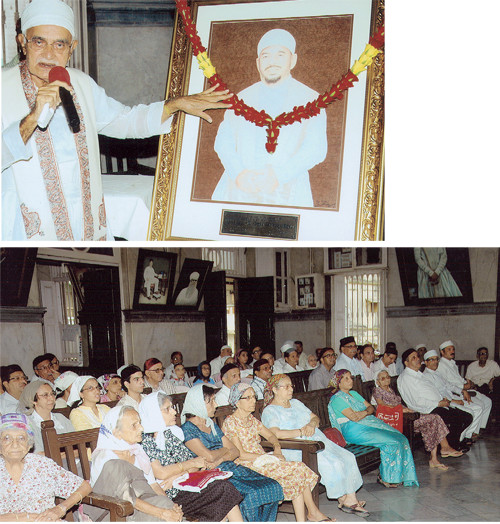
Top: Current high priest Dastur Kaikhushro Dastoor Meherjirana with the portriat of his predecessor. Below: Section of the audience
The current Meherjirana also quoted the words of the Mogul musician Tansen to praise the founder’s spiritual powers in the song Raag Sarang: "Lambi lambi dahadee Shah Mehreyari tere mooch pi barshat noor (Shah Mehreyari, your beard is long, your face is radiant with fame).” The speaker paid several accolades to the founder of this great tradition.
"Evil floats up in every one of us and it is for us to manage that. The ‘I’ factor is taking over today. No one could have envisaged the state of our community today 40 to 50 years ago, that we would be so embroiled in infighting. Evil forces in our community are overriding… God gave us a tongue to speak the truth and recite prayers not just to talk and taste — palao dar khava jeebh apuné aapi nathi (we have not been bestowed a tongue only to eat delicacies). If you come with kachra (filth) in your in your mind even a maacchi of Rs 10,000 will not be effective… it is not the path to Him. A child sees God in his mother and then life takes over and the child chalks out his own fate”. This was some of the counsel received from the Vada Dastur.
Ten women of Navsari, Dinoo Lacca, Dinoo Panthakey, Zarine Minocherhomji, Mehroo Patel, Banoo Patel, Tehmi Jokhi, Banoo Desai, Roda Kumana, Dolly Kanga and Hilla Antia were felicitated for weaving kustis for over 50 years. Meherjirana mentioned that "formerly all women wove kustis, it was as common as cooking and sewing. These ten ladies have been practicing this skill for more than 50 years — in fact from about the age of 10.” They spin (katé) and weave (vané) the kustis from wool. Today, however, there are very few women who take to this art, he proclaimed as it is a laborious process and it does not pay as well as office jobs. The weavers were honored with a certificate, an award of Rs 10,000 each and a rose. Meherjirana added that these were not the only women performing this labor of love; there were several others, but these 10 were some who could be recognized. He hoped that in the future others too would be felicitated.
Seven of the 10 awards were sponsored by the Parsee Vegetarian and Temperance Society (PVTS), Tehmina Peer spearheading this initiative. She had been collecting entries for two to three years and said "ai mohoko mali gayo tau mané bau khushali lagéch (I am happy to see it fructify specially on this occasion).” Peer mentioned that the PVTS regularly sponsors other religious initiatives and encourages participation. The Society also holds competitions in rangoli with a religious theme, recitation of passages from the Shahnameh in Gujarati and Persian and Parsi songs (monajats) among others. Three of the remaining awards were sponsored by the Parsi Resource Group founded and headed by Bombay Parsi Punchayet trustee and property developer Jimmy Mistry.
Thanks were paid to several organizers with special mention of Yazdi Cassad, Bamji and Soli Vazifdar. The evening concluded with the recitation of two Ashem Vohus and one Yatha, having begun with two Yathas and one Ashem Vohu. A line of devotees then queued up before the just unveiled portrait to pay their respects to a scholar who has upheld a tradition of centuries.
◆ ◆ ◆
From the archive