
In Memoriam
The disciplined dastur
Died: Dastur Meherji Kekobad Meherjirana, 75, High Priest of Navsari who was the permanent president of the Atash Bahram Trust, ex officio president of the Navsari Anjuman and 16th heir of the First Dastur Meherjirana, on January 23, 2010 in Navsari following a brief ailment.
"He was a quiet, kind and jovial fellow being. We all looked up to him and late Dastur Khurshed Dabu in matters religious and worked in unison. His sad passing away is a matter of grave concern to the community,” stated Dastur (Dr) Kaikhusroo JamaspAsa of the Anjuman Atash Behram when Parsiana sought his views on his contemporary.
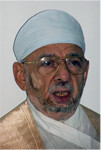
Dastur Meherji Meherjirana: "tenacity to preserve”
Commending his "interest in all religious matters,” Dastur (Dr) Firoze Kotwal referred to the "special and happy association” he shared with Meherjirana. As the High Priest he was the ex officio president of several trust funds in Navsari, including the Parsi infirmary, a duty he diligently discharged such that he helped lay "a strong foundation for the trusts,” Kotwal told Parsiana. In fact even the Navsari Atash Behram Trust fund had risen to over a crore of rupees thanks to his prudence, Kotwal gave Meherjirana credit whilst appreciating the hermit’s life that he led because of his religious obligations.
"It is because of his deep inner spiritual strength that he maintained all the traditions of our faith, particularly the spiritual tradition of serenity,” stated Parzor director Dr Shernaz Cama recalling, "The first time I saw Dasturji he had just hitched a ride on a passing cycle to come and meet the Parzor team at the Meherjirana library, yet one could sense a calm presence, unconcerned with outward appearance. It was this serenity which has pervaded the great Atash Behram and made it the most beautiful and serene place for prayer in India.”
For the Parzor team he had recited the Nirang of the Vanant Yasht, convinced in its potency to defeat evil. "He had realized, as have many of our priests, that if we do not record our inner, complicated ceremonies, they will be lost to posterity…” she reported.
He was keen to preserve Dastur Vad (locality) and maintain the sanctity of the Atash Behram, regretting that he and his wife Meherbanu (the couple had no issue) were the last Parsis in the area. Although not wont to flaunt his scholarship or his ceremonial abilities, the 16th descendant took pride in his family ancestry, and would happily recount oral stories concerning the First Dastur Meherjirana who was revered by the Mughal ruler Akbar, notes Cama. "It was this passion for preserving the knowledge of his ancestors that made him our ally in preserving the manuscripts at the Meherjirana Library… Dasturji had helped scholars and researchers from Germany, Japan, Italy, Spain and the US to understand the great collection started by his family,” mentions Cama. Having retrieved many heirlooms from the kabadiwallas (scrap dealers) "he tried all his life to make the community value its spiritual treasures,” writes Cama mentioning how he would wistfully tell her "If only people would donate their books instead of selling them as raddi…”
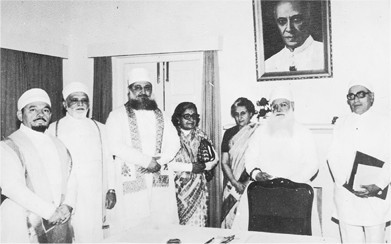
16th Dastur Meherjirana (far left) and 17th Dastur Meherjirana (far right) with then Prime Minister Indira Gandhi
He inherited the dastur’s title from his maternal uncle Dastur Kekobad Meherjirana who had no children and had thus adopted his sister Dhunmai and brother-in-law Pestonji Dastoor’s son at a young age. According to a write-up by columnist Berjis Desai in The Bombay Samachar of January 31, 2010, "Dastur Kekobad was a sensitive soul who loved Indian classical music and was often heard humming a ghazal at some Parsi wedding… He enjoyed engaging in a dialog with visiting holy men, including sadhus and fakirs… As compared to his colorful uncle, Dastur Meherji was plain, uncontroversial and simple.”
Along with the other High Priests he was "always in the forefront… in defending the tenets, customs and practices of the religion… He had an abiding love for studying the religion, was deeply interested in the mystical science of Ilm-e-Khshnoom, and voraciously read all its literature,” observed Ervad (Dr) Ramiyar Karanjia in the Jam-e-Jamshed of January 24, 2010, continuing, "He had authored in Gujarati a primary dictionary of technical words of the Ilm-e-Khshnoom entitled Farhang-e-Meher which was published in 2003.”
Meherji Meherjirana is known to have spent 15 years on this project for not only did he explain the meaning and import of the words which would vary depending on the context, he gave references to all the different writings and books of Khshnoom where the words could be found. "This was a massive exercise and required not only good indexing abilities but also a disciplined approach and vast amounts of memory and patience,” according to his life profile penned by Ervad Marzban Hathiram and featured on the blog Frashogard. "This book is an invaluable tool and compulsory accessory for every serious student of our religion and its mystic angle,” maintained Hathiram.
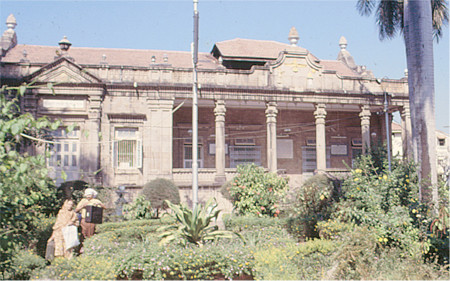
Serenity at the Navsari Atash Behram
Perhaps the most orthodox among his dastur peers, even when five of his colleagues consented to the navjote of octogenarian Neville Wadia in September 1994, Meherjirana dissented (see "A Zoroastrian again,” Parsiana, October 1994) on the rationale that "good thoughts, words and deeds are not the only essential ingredients of our religion. This moral and ethical aspect is inseparably interwoven with certain spiritual disciplines and institutions. Navjote, sudreh kushti, manthra prayers, holy fires, dakhma, rituals and ceremonies and boonak-pasbani constitute the equally crucial and indispensable part of our religion. It was more to save, preserve and protect these disciplines and institutions than mere moral principles that our forefathers left the land where we had ruled for centuries. Here in India we have survived in the midst of all the storms and upheavals because of our tenacity to preserve and live by these divine exercises and exertions. In particular, we the dasturs and mobeds were and are ever anxious to see that the tenets and practices are protected in their pristine traditional form without any dilution or compromise.”
Trained at the Dadar Athornan Madressa, Meherji had impressed his seniors with his memory, speed and pronunciation of prayers. His navar and maratab initiation was at Navsari and at a young age he had even performed a nirangdin ceremony there. He completed his BA in Avesta and Pahlavi from St Xavier’s College in Bombay and when only 24 years old was required to take on the Dastur’s mantle following the demise of Dastur Kekobad in 1960. He would have completed 50 years as a dastur in July this year.
"From a very young age, Dasturji was greatly drawn towards Ustad Saheb Behramshah Shroff’s unique life and teachings… and had piles of exercise books filled with notes from lectures or from his readings,” Hathiram provides insights into his life. One of Ustad Saheb’s closest disciples was Jehangirji Chiniwalla who published a weekly Parsi Avaz which the Dastur keenly studied. In fact he had all the issues of this periodical and over the years started making and collecting index cards based on the topics covered. After the paper closed down in 1974, Meherjirana collated his index cards and created one comprehensive index running into 100 foolscap sheets.
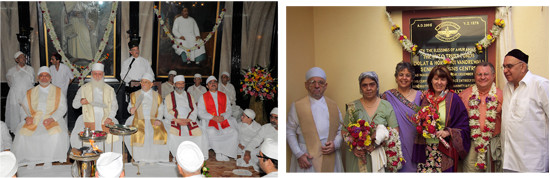
Dastur Meherji Meherjirana (above, seated front row center) at the 225th birth anniversary of Sir Jamsetjee Jejeebhoy; (right) with Meherbanu at the inauguration of the Vandrewala Senior Citizens Centre in Navsari
Thereafter he created a separate index of the writings of Jehangirji’s brother Framroze Chiniwalla, other published books and writings "which are of great help to students like me today,” states Hathiram. He also facilitated the publication of Framroze’s writings by undertaking, with the assistance of Dosabhai Desai, "the very tedious and laborious work” of typing out the manuscripts, sending them to the printer for formatting, checking and correcting the proofs, viewing the final layouts and overseeing the printing. "On my last visit to Navsari he proudly showed me his new computer which replaced his trusty old typewriter and we discussed the various methods of putting Gujarati into Microsoft Word and Excel,” recalls Hathiram grateful that the High Priest would always present him one or more books from his personal collection.
Mindful of his deteriorating health, "Dasturji… was anxious to ensure that all (post-death) prayers were done not only in the traditional manner but also the more intense and deep manner done in light of the teachings of Ustad Saheb,” states Hathiram referring to the schedule that Meherjirana had predetermined according to which prayers were to be recited in Navsari as also at the Ustad Saheb Behramshah N. Shroff Daremeher in Jogeshwari.
As per the practice, after the uthamna prayers for the 16th Dastur Meherjirana in Navsari, 83-year-old Ervad Kaikhushroo N. Dastoor who is a descendant of the Meherjirana family was named the 17th Dastur Meherjirana. The new Dastur too is a Khshnoomist, known to the community as editor of the quarterly Parsi Avaz. Declared Hathiram, "There are few who can fill in and take on the tremendous spiritual responsibility of this august post…(which) is not just ceremonial or administrative.”
The dedicated dastur is survived by his wife Meherbanu.
◆ ◆ ◆
From the archive