
Seminar
Enigmatic epic - III
hree scholars discuss how some of the well-known sub-plots in the Shahnameh have evolved pre and post Ferdowsi
The Shahnameh’s many facets as examined by international scholars at the seminar hosted by the K. R. Cama Oriental Institute, January 8 and 9, 2011 are being presented by Parsiana in six installments. A review of the many celebrations of the epic a thousand years after it was composed (August 7, 2011), synopsis of the papers dealing with the Parthian influence on the Persian national epic and the poet’s concept of evil were presented earlier (August 21, 2011). This issue deals with papers discussing some of the sub-plots in the poem that spans human memory from prehistory to the fall of the Sasanians. The conflicting perceptions of Alexander, the art and illustrations that the epic spawned and the treatment of some of its themes from different perspectives, different cultures and why an epic is an epic will be addressed in subsequent issues.
Prof (Dr) Anna Krasnowolska, head of the department of Iranian Studies at Jagiellonian University in Krakow, Poland, spoke about "Ferdowsi’s dastan as an autonomous narrative unit.” Defining the dastan she notes, "Apart from sections of the text which contribute to its main plot, the poem includes a number of side stories (dastans) which do not belong to the mainstream narrative… (but) had originally functioned as separate narrative entities coming from independent (possibly oral) sources and secondarily incorporated into the body of epic tradition… Singled out from the flow of the main plot… (the dastan) is characterized through its compact composition… which develops from a beginning, through a culmination, (to a) conclusion.” Using the story of Bizan and Manize, she sought to show how such tales maintain their autonomy within the main narrative of the Shahnameh (SN).
Believed to be one of the few preserved continuations of Parthian court literature, it recounts the love affair between a young Iranian knight and a Turanian princess as sung by a woman during a wine session in a garden, ostensibly taken from a Pahlavi book. The conclusion of the tale provokes an extended reflection on the instability and perversity of fate followed by the announcement of the next story, noted Krasnowolska.
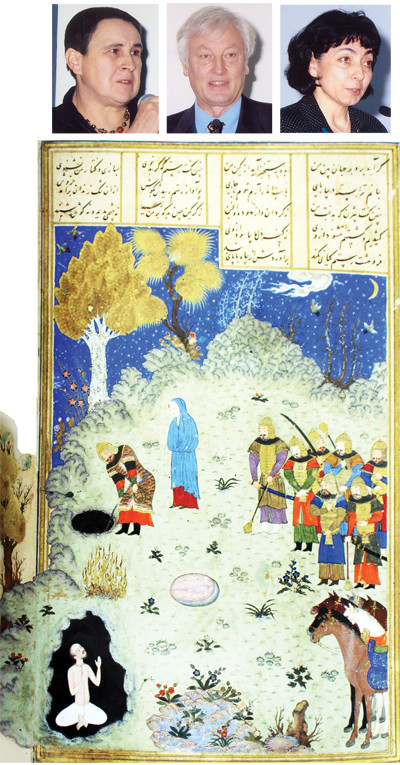
Top from left: Drs Anna Krasnowolska, Charles Melville and Firuza Abdullaeva
Below: Bizan imprisoned in a pit (Courtesy, Epic of the Persian Kings, K. R. Cama Oriental Institute)
Set within the context of the Iranians’ great war with Siyavush the Turanian king Afrasiyab (Siyavush, falling out with his father Key Kavus of Iran, had sought refuge in Turan where he was well accepted and married to Afrasiyab’s daughter Farangis but later accused of conspiracy and murdered on Afrasiyab’s orders. Siyavush’s son Key Khosrou however grows up to inherit the Iranian throne and seeks to avenge his father’s murder) Bizan, of aristocratic lineage in Key Khosrou’s court, accepts an assignment to rid the land between the two kingdoms of the boars that had overrun it, succeeds in the venture, chances on Afrasiyab’s daughter Manize picnicking in the adjacent woods, falls in love with her and finds his passion reciprocated. When it’s time to return to the palace, she smuggles him in but their euphoria is short lived as rumors of a man in the princess’ apartment reach her father’s ear. Bizan is picked up and held captive in a pit covered by a huge stone (as the king’s counselor advises him against a repetition of Siyavush’s murder which unleashed the long war) and Manize is turned out of the palace to beg for her living. It is only when Key Khosrou consults his miraculous goblet on New Year’s day that Bizan’s fate becomes known to the Iranians who then seek Rustom’s help to release Bizan and the young man and his bride are free to return to Iran.
Krasnawolska analyses the literary finesse with which this story is inserted — preceded by a chain of war episodes like the story of Forud, also a dastan, tales of heroic encounters between the Iranians on the one hand and the Turanians and Chinese on the other and another dastan featuring Rustam’s adventure with Akvan-div. The Bizan-Manize encounter is followed by another tale of war.
Though disparate events, the tales are woven together by the common topography of the mainstream narrative — the Iranian and Turanian capitals being the opposite poles of this universe — and Rustam’s stronghold of Zabol. Also, the timeframe is circumscribed by the Irano-Turan war.
"The dastan of Bizan and Manize shares the motif of an expedition in search of a lost/concealed person with the stories of Faridoon, Kay Qobad and Key Khosrou in exile. (Thus) an autonomous side-story, apparently outside the mainstream plot of the epic narrative, becomes integrated into its texture, and contributes to its general structuring.”
Blame for the tragedy
Providing a synopsis of the story of Forud, Prof Charles Melville discussed the apportionment of blame for the tragedy in the SN and in texts before and after.
Shortly after being brought to Iran and crowned Shah, Key Khosrou mounts an expedition to Turan to avenge his father Siyavush’s death there. He appoints Tus to lead the army even though Tus was disappointed in his own bid for the throne and possibly held a grudge. Khosrou instructs Tus to avoid marching through the territory of his half-brother Forud (another son of Siyavush by Piran’s daughter Jarireh). But Tus does just that, Forud fears the army is coming for him and responds accordingly even though Tus’ son-in-law is sent to assure him of the force’s peaceful intention towards him. Skirmishes escalate, Forud and his mother are killed and their castle razed. The Iranian force then proceeds towards its original assignment to Turan but meets with defeat.
"One of the most interesting elements of the story is the way the causes of the tragedy and shifts of blame play out through the narrative... It is clear for much of the narrative that it is Tus who is blamed for what happens. Nevertheless, the poet makes it clear that Key Khosrou was unwise to appoint Tus to command the army. Although Khosrou is depicted uniformly as a positive force, ultimately the blame for the disaster can be attributed to him; lack of wisdom is a cardinal fault in Ferdowsi’s scheme of things,” notes Melville.
As the story unfolds, the blame shifts on to Forud and his advisor Tokhvar. "It is also the case that Fate has already determined the outcome,” notes Melville quoting from a translation of the text: "The fortune of the young man was clouded with dust; when the firmament turns crookedly from its zenith, neither love nor rage are any use.” But the agency by which the result is achieved is the clash of wills and senseless belligerence of those on both sides, whose warrior code makes them more like each other than distinct.
Melville compares and contrasts the treatment of the story by Ferdowsi and others, noting how Ferdowsi’s "nuances of the shifting motivations are lost” in subsequent texts. Though some of the later narratives of these events echo Ferdowsi, Melville finds they are often "devoid of the psychological penetration of the SN and Ferdowsi’s concern to draw morals from the narrative.” In the SN, "Forud’s aggression and inexperience also influence the outcome.”
Femmes fatales
Speaking about "Femmes fatales in Persian literature and beyond,” Dr Firuza Abdullaeva Melville, associate professor at the University of St Petersburg before she joined the Cambridge Shahnameh Project, noted, "From the very beginning the literature in the New Persian language bears witness to a special sub-genre of popular fiction/folklore, both in prose and poetry, where the dominant role was given to stories about cunning, lustful and malicious women, whose only aim was to torture , seduce and destroy the poor male population.” In that context she spoke of the story of Yusuf and Zulaykha which may have originated in pre-Biblical Mesopotamia, a legal case of a mature noble woman trying to seduce a young slave/step-son who happened to be in her household. She approached the young man, was rejected and to protect herself, accused him of raping her. There has been some controversy if Ferdowsi was one of the authors who expanded on it.
Abdullaeva, however, concentrated on the story of Siyavush and Sudaba, very much a part of the SN. Siyavush, the son of Key Kavus by an inordinately beautiful woman of perhaps noble birth, was raised by Rustom who poured all his unrealized paternal love on the boy after having lost his own son Sohrab, teaching him the chivalric code and aristocratic skills. "Sudaba is one of very few characters in Ferdowsi’s epic who is depicted with more colors than just one. The features of her character are so contradictory that one may think that Ferdowsi used two different sources to construct her image. Originally an Arab princess, she dedicated herself to her husband, the Persian king who invaded her country and forced her father to give him not only all their wealth but herself… When Sudaba arrives in Iran she gets the status of head queen in the harem, although this status can be changed any time and Ferdowsi mentions at least once that she was dismissed and replaced by Siyavush’s mother. To keep her status the queen had to have enough influence on the king and be able to manipulate his mind, the skill in which Sudaba excelled.”
Despite using all the seductive means at her command, Sudaba fails to overcome Siyavush’s reluctance, perhaps out of fear or loyalty to his father. "This is the moment when a divinely beautiful and seductive woman turns into a witch (supported in faking her abortion by a real witch) whose only aim is now blind revenge.” According to Ferdowsi she began the trail of events which eventually led to the death of Siyavush. When the news reached Rustom’s ears, the angry pehlwan (strong man) invaded the harem and decapitated her.
"What made Sudaba change her personality? What enflamed her immediate passionate love towards her step-son, putting in danger her reputation? It should be Siyavush’s irresistible beauty… Ferdowsi gives a very elaborate description of Sudaba and her court… but says nothing of Siyavush’s appearance except that he had an angelic face. One will have to assume that this should be enough,” notes Abdullaeva.
To be continued
◆ ◆ ◆
From the archive