
Comment
“I can remove the darkness”
People need to be taught about other religions in school to remove hatred, discrimination and create an atmosphere of mutual respect
Four outstanding intellectuals from different communities speaking on the problems and solutions latent in "Interfaith Hindu-Muslim Dialog” emphasized the similarity between the religions and their long history of togetherness in India undermined by a common villain in recent times — the British heritage of "divide and rule.”
Jointly held by the Wisdom Foundation and the Foundation for Unity of Religions and Enlightened Citizenship (FUREC) at Bombay’s Homi Taleyarkhan Memorial Hall on June 10, 2011 at the meet Dr Narendra Desai, a member of The International Society for Krishna Consciousness, recalled Mahatma Gandhi’s sterling advice: "You must not lose faith in humanity. Humanity is an ocean. If a few drops are dirty, it does not mean that the ocean is dirty.” He set "egotism and massive greed… superstition and false beliefs” as the root causes of the dissension between the communities, citing the example of smallpox which was considered the "curse of devi mata” but which has been nearly eradicated today with scientific knowledge, though unfortunately, "the mental pox” remains with us. Citing Gandhi Desai said, "Nothing wastes the body as does worry. It shows we do not have faith in God” and complicates issues and problems. We need to cooperate with others in a humble spirit, he advised, "because the stiff grass gets cut first.”
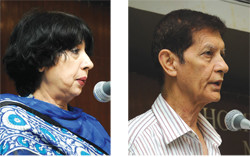
Dr Zeenat Shaukat Ali and Dr Homi Dhalla.
Informing the audience that FUREC was started by former president of India Dr A. P. J. Abdul Kalam in 2005 by inviting religious leaders from different parts of India people working in areas such as ecology, human rights, etc its president Dr Homi Dhalla recalled that the world’s first known interfaith dialog was between the Zoroastrians and the Jews in the 5th century BC. Pope John Paul, who initiated interfaith dialog in our times in 1986 by calling for a day of peace in Assissi, had described the 20th century as "a century of tears” when 110 million people were estimated to have been killed in wars. Initially it was the Jewish-Christian dialog that began in the aftermath of World War II. Later, Christian-Muslim talks began with meetings between King Abdullah of Saudi Arabia and the Vatican. Turkey, Tunisia, Qatar, the Philippines followed.
"Understanding our neighbor is imperative,” and begins with communication. It also demands common activities and a sympathetic mindset, Dhalla noted. According to him there are five types of dialogs, beginning with the "dialog of life” denoting meets at grassroots levels by members of different communities. Then there is the "dialog of action” as two (or more) communities come together to solve problems. The "dialog of religious experience” tries to understand differing viewpoints through prayer, yoga exercises, meditation, etc. Dhalla cites the example of Japanese Buddhists who went to the Christian monastery to understand their rituals. Then there is the "dialog of theological experience” entailing an understanding between the priests of the different faiths and the "dialog of scholars,” both of which are crucial in bringing about religious understanding at the community level.
For Dr Asghar Ali Engineer, director of the Centre for Society and Secularism, communalism is "basically a political phenomenon. It has nothing to do with religion. If we truly follow our respective religions, there can never be any conflict.” Citing the example of the Sufi poet Rumi, loved by everyone as an embodiment of peace and harmony, Engineer recalled that when he died, "Jews, Zoroastrians, Christians and Muslims joined the funeral procession, citing their respective scriptures.” Maintaining that Sufis have played a great role in building bridges between communities, Engineer said "differences are less religious and more cultural;” rituals depend on culture and way of life.
"There is conflict because we are ignorant of each others’ values. There is great similarity between the Gayatri Mantra and the first chapter of the Koran. Dara Sikoh had said, ‘If Hindu scriptures are translated into Arabic and the Koran translated into Sanskrit, you would not be able to differentiate between them.’” Eliminating the linguistic prejudices had led to a syncretic culture in Northern India where almost everyone spoke Persian and/or Urdu, said Engineer, noting that the Koran was first printed in India by a Hindu and three editions of the Gita were sold out. "Our ignorance leads to prejudice… True religions never clash. Our interests clash; we invoke religion to give them legitimacy.”
"The clash of civilizations is the most counterproductive, negative theory in the history of the world,” declared Prof Ram Puniyani, a former faculty member of IIT (Indian Institute of Technology), Bombay who is now a leader in the movement for communal harmony. Noting that superpowers wanting to hold control over middle eastern oil had created the clashes, Puniyani was critical of the media’s role in the coining of such phrases as "Islamic terrorism” which he castigated as one of the worst concepts. Describing Gandhi as the embodiment of the finest multicultural Indian mores, he said historiography as we now know it began with the British. They are the ones who had taught that the Mughals invaded India. "Babur was invited to India by Rana Sanga,” maintained Puniyani. Of the nine jewels at Akbar’s court many were Hindus. Thirty-three percent of Aurangzeb’s court officials were Hindus, he noted. "Was Ram Dev Baba Peer a Hindu or a Muslim?” he queried, adding, "The morality of religions unites people. It is the superficial aspects that have unleashed wars. Religious identity has been abused for political goals leading to false propaganda against other communities.”
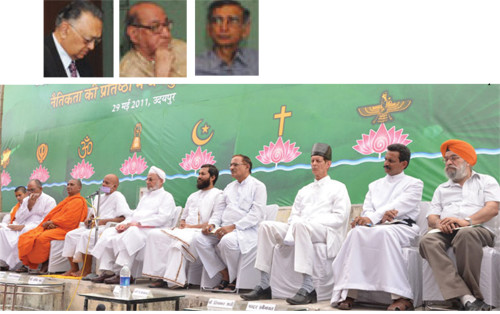
(from left) Dr Narendra Desai, Dr Asghar Ali Engineer and Prof Ram Puniyani. Alongside: Dhalla (3rd from right) at the interfaith meet in Udaipur
Likening her Wisdom Foundation to the little lamp which said to the sun who wanted a holiday, "I can remove the darkness,” founder Dr Zeenat Shaukat Ali rued the "misconceptions about Islam, the Islamo-phobia introduced by the West.” Referring to Prophet Mohammed as "the gentlest of souls,” she noted his kindness to animals, that they be not overburdened. "The Koran speaks of animal and human worlds as being similar... A Muslim is not a Muslim if he eats while his neighbor is hungry.”
Stating that the view of Muslims as a monolithic violent bloc was a misnomer, Shaukat Ali noted that the community felt rejected, sidelined, discriminated against. Nothing has been done in pursuit of the Sachar Committee report which had highlighted the community’s slackening grip on development in India. "Hindus feel that Muslims demanded the Partition of India. It was the Muslim League (a political party) which had demanded it, not the Immams. (Mohammad Ali) Jinnah has damaged Islam, the community and the country,” declared the scholar who teaches Islamic studies at Bombay’s St Xavier’s College.
All the speakers were in favor of multi-religious courses in schools, peace education to teach young people to live together in mutual respect; for amity cannot come if there is hatred, discrimination…
Promoting moral values
On May 28, 2011, Dhalla was invited by the Jain spiritual leader Acharya Mahashraman to Udaipur for an interfaith conference where the representatives of various religions, were invited to speak on "The role of religious leaders in the promotion of moral values.”
Religious leaders should be more vocal and in the forefront of solving several problems facing society, said Dhalla, quoting the example of Baba Ramdev who had taken up the issues of corruption and black money. Swami Agnivesh has been carrying on his crusade against child labor and land grabbing which affect tribals.
Buddhist monks in countries such as Burma, Thailand and Tibet have been leading protests against dictatorship and unfair government practices. Religious leaders need to go beyond their places of worship and take the lead in solving social ills, he noted.
◆ ◆ ◆
From the archive