
Seminar
Enigmatic epic - II
We are still in the process of learning about the Parthians and their role in Zoroastrian Persia, argues Prof Albert de Jong
The Shahnameh’s (SN) many facets as examined by international scholars at the seminar hosted by the K. R. Cama Oriental Institute on January 8 and 9, 2011 are being presented by Parsiana in six installments. The first installment was a review of the many celebrations of the epic a thousand years after it was composed (August 7, 2011). Synopsis of the papers dealing with the Parthian influence on the Persian national epic and the poet’s concept of evil are presented in this issue. Some of the sub-plots in the poem that spans human memory from prehistory to the fall of the Sasanians, the conflicting perceptions of Alexander, the art and illustrations that the epic spawned and the treatment of some of its themes from different perspectives, different cultures and why an epic is an epic will be addressed in subsequent issues.
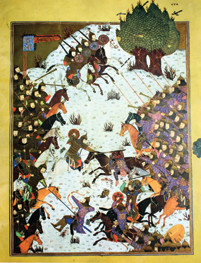
Eternal battle: Iran v Turan, good v evil (Iran: Persian Miniatures Courtesy: K. R. Cama Oriental Institue)
Dr Albert de Jong, professor of comparative religion in the University of Leiden, is currently working on Parthian Zoroastrianism — the fourth volume in Mary Boyce’s A History of Zoroastrianism, based on some of her research — as well as on The Religious History of the Sassanian Empire. Speaking on "Parthian Heritage — Persian Culture: How the Shahnameh became the Persian ‘national’ epic,” de Jong noted, "One of the most difficult subjects in the study of pre-Islamic Iranian culture is that of regional pride.” He was referring to the three great cultural areas of Iran: Media, Parthia and Persia. According to him, "one-lordship” over all Iranians was a cornerstone of the Sasanian quest for legitimacy and to establish imperial and cultural unity they deliberately projected an image of the Parthian empire, which they had subjugated, as a failure. Although Parthian continued briefly as the nation’s official language, one of the earliest rock inscriptions of the Sasanians equates the defeated Parthian King Ardaban with Ahriman and Ardeshir, the founder of the Sasanian dynasty, is represented as the restorer of lordship and the Good Religion.
"Zoroastrian Middle Persian sources — most of them from Islamic times — identify Zoroastrianism with Iranianness.” Those who converted to Islam became "non-Iranian. Also, Iranians spoke Iranian languages and professed Zoroastrianism; non-Iranians failed on both counts.” However there were areas not securely administered by the Sasanians: the realm of Kushans, Sogdiana and other parts of Central Asia. "Here we find not only persistence of local languages and scripts but also a wealth of cultural, artistic and religious data that make it clear that the world of these Iranian lands was structurally different from the lands administered by the Sasanians: different languages, different scripts for these languages, different religious institutions (temples dedicated to named deities), different gods, etc,” noted the scholar.
De Jong refers to the three great ancient fires: the Parthian Adur Burzen-Mihr which played an active part in Zarathushtra’s conversion of King Vishtaspa, the Median Adur Gushnasp which was involved in the liberation of Iran from the tyranny of Afrasiab and Adur Farnbag of Pars or Persia, "the youngest of the three fires … its role in human and cosmic history more limited.” Nonetheless Adur Farnbag, which precedes the others in the Zand to the Atash Niyayishn, was associated with the priestly class in texts of the Sasanian and early Islamic periods. De Jong admits that these regional associations were at times tenuous.
The professor’s main concern is to rethink the very large Parthian contribution to the SN and to understand how and why it gained its reputation as the Persian national epic. To do that, he delves into the history of the Parthians and of their religion. When the Parthian language was recovered by a series of discoveries, it was demonstrated that the Parthians spoke a western Iranian language and that they were Zoroastrians, he noted. It has also been accepted that the Iranian epic tradition included in the SN has a north-east Iranian (Parthian and Saka) background. "The quest for Parthian Zoroastrianism thus became a question whether the Zoroastrianism of the Parthians was distinct from that of the Sasanian Persians…The fact that the Parthians were Zoroastrians is no longer seriously in doubt…Wherever the Parthians ruled, evidence for Iranian legends and epic conventions pops up…In Armenia, ruled by a junior branch of the Arsacid family, Parthian culture was the dominant foreign influence.” The evidence from Armenia shows that Parthian Zoroastrianism was very distinct from the religion as practised by the Sasanians, notes the professor.
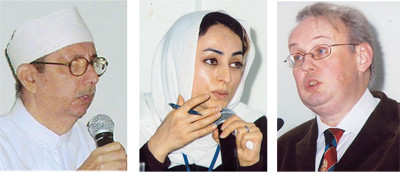
Session chair Ervad (Dr) Rooyintan Peer with Kolsoum Ghazanfari and Dr Albert de Jong. Below: Fight of the pehelvans — a recurring theme (Tableaux from the Shahnameh, Courtesy: K. R. Cama Oriental Institute)
De Jong notes that the Parsis migrated to India before the publication of the SN. However, "from the 17th century onwards, they increasingly began to rely on it as the main source for stories about the early heroes of their religion. In the 19th century especially, they began to use the SN almost as a religious work and it is still hugely popular among Parsis,” he noted, citing the serialization in Parsiana of Ervad (Dr) Ramiyar Karanjia’s rendition, to say nothing of the community’s plethora of first names and family names derived from the epic.
For most specialists on classical Persian literature, the SN is the beginning of a long Persian literary tradition and has occupied the position of ‘national epic’ of the Iranians for more than a millennium. But for those whose interest lies in the history of Zoroastrianism, the SN is the end of a long tradition, says de Jong, adding, "The pre-Islamic Iranians believed their culture and their lands to be better than all others, and celebrated them extensively in song and art. It was not possible to dissociate these superior qualities from the fact that their religion was also decidedly superior to the religions of other peoples. Their historical narrative, in other words was a religious narrative, and its main theme — apart from the fact that it pivoted on the appearance of Zoroaster — was one in which the Iranians fought alongside the forces of good against those of evil. The latter theme was one which the Muslims in north-eastern Iran, facing the threat of the Turks, could easily identify (with), but they had become, in the meantime, followers of another — and a foreign — religion. So if the traditions of the ancient Iranians were to be preserved, this could only be done by turning them into a ‘national’ history; but that is not how they were intended.”
Addressing the concept of evil — "Ahriman and the Divs in the Shahnameh” — Kolsoum Ghazanfari, a PhD student at the Institute Iranistik, Georg-August University in Goettingen, Germany, noted that from the beginning Ahriman is differentiated from the divs who are his subordinates and is often referred to as Eblis, the Islamic term for Satan.
"One of Ahriman’s subordinate divs in this work is Az (greed), who in the Zoroastrian tradition is Ahriman’s commander-in-chief,” notes Ghazanfari. "A notable and important point regarding Ahriman in the SN is that he is not the origin of all evil, in spite of many bad deeds attributed to him. All evil and goodness together are frequently attributed to God; this seems to be based on the ideology of Ferdowsi himself, which was wholly Islamic.”
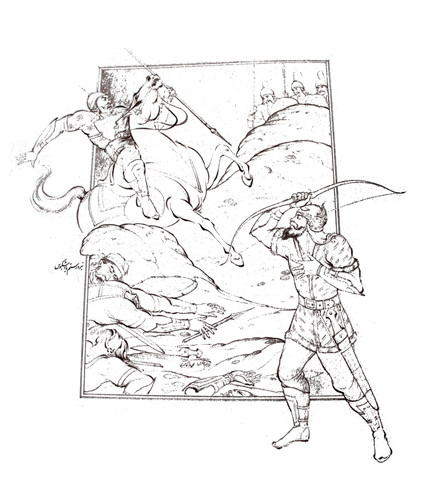
Ferdowsi portrays two types of divs, human and supernatural, notes Ghazanfari. The first are wicked human beings who do evil and are not grateful to god. The second type is a wicked supernatural being who is completely independent of and different from humans. "Despite this attitude towards divs, they are known as civilized creatures from whom the first kings learned civilization and culture. For instance, by Jamshyd’s order they constructed some buildings such as baths, high palaces and large halls. They taught Tahmuret how to read and write. Kaykavus used their art and power to build a great palace in the Albourz Mountain.”
The divs of Mazandaran on the other hand were the ancient residents of the area who persisted with their ancient religion and refused to convert to Zoroastrianism. In some areas SN reflects Zoroastrian beliefs about divs while in others the term conjures the attitude of Sasanian kings towards their enemies, she notes. Their main attributes seem to be to mislead people and violate morality, rebelling against God and bringing disorder into the world. On the other hand wisdom and good temperament are shown to be the means to fight them: "Ahriman cannot do harm to wise and happy people…These divs are mostly realized in men. They are against the good temperament of humans and are always seen as evil. Whenever their names are mentioned in the SN, people are also advised to fight against them and not to let them dominate their being. Similarly this can be found in the sixth book of the Denkard where it is emphasized that fighting against the dominance of divs over the world is not a fight against real and physical beings but against a part of one’s inner self.” To be continued
◆ ◆ ◆
From the archive