
Events & Personalities
Overcoming odds
The 50th anniversary of The Temple of Understanding was celebrated in New York on October 19, 2010 and echoed in Bombay’s Homi J. H. Taleyarkhan Hall at an interfaith meeting organized by Homai Modi, convener of its Bombay chapter. Three well-known social activists spoke on topics of overriding contemporary importance. Modi, who is honorary secretary of the Indian Red Cross Society Maharashtra State Branch, related her personal connection with Gadchiroli, the Naxal affected area of the state where the Red Cross runs a mobile health unit in 29 villages. The NGO’s (nongovernmental organization) presence was established in response to the International Committee of the Red Cross’ interest for working in this area. The redoubtable Debi Goenka, currently executive trustee of the Conservation Action Trust, who had been instrumental in the drafting of the CRZ (Coastal Regulation Zone) notification, spoke about climate change and Bombay. Dr Homi Dhalla, founder president of the World Zarathushti Cultural Foundation and Zoroastrian representative on international fora, referred to the various dimensions of peace.
Though people today want to assert all kinds of rights, it is only those guaranteed by the Indian constitution and international agreements that can be enforced, began Modi. It is when even these rights are denied to them that they tend to form subversive groups and indulge in terrorism, she noted. Emphasizing the Red Cross’ principles of respect for human rights and strict neutrality between warring factions, she sought the help of an individual known in the area to guide her small group to a representative Naxal village. Even while the party enjoyed the flavor of the forest, they were conscious of being watched and followed throughout. "Once assured of our intentions, they cooked lunch for us and invited us to a feast,” she noted appreciatively. Nothing can be done without the permission of the villagers/Naxals and no politics is entertained. However, it was understood that when skirmishes took place, those hurt from either side would be treated according to the Red Cross mandate.
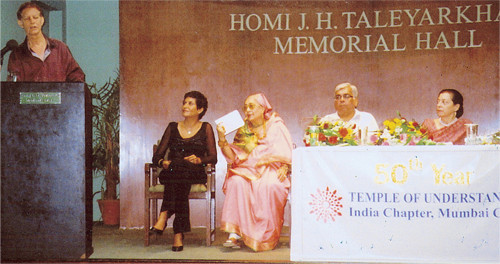
(From left): Dr Homi Dhalla, Gulzar Dastur, Meher Master-Moos, Debi Goenka and Homai Modi
In an area bereft of mobile connectivity or toilet facilities, where temperatures hover at 48°C, the economy mainly comprises of hunting and beedi making. Vegetable cultivation and fish farming are livelihood projects the Red Cross is now embarking upon. The Red Cross is now slowly building bridges by treating an average of 800 patients per month. "The villagers are afraid of losing their land in the name of development…when you destroy the green belt you displace not only humans but destroy other forms of life, which ultimately leads to global warming problems. Gadchiroli is one example of why and how terrorism survives and when terrorism survives, no one is safe,” concluded Modi, whose talk was aptly titled: "Today, my security depends upon your security.”
"When the CRZ notification was first drafted, the Government of India had indicated that climate change would be taken into account,” noted Goenka, adding that the menace of corruption has led to the interests of people and the environment being "shunted out as of no consequence.” Climate change is affecting all species of life, but it is the humans who are responsible for the crisis, he maintained, and it is up to us to begin by reducing our consumption of electricity and everything else as for example paper or the number of miles we travel. Referring to the 2005 deluge in Bombay whose economic cost he estimated at $ 3 billion, he predicted that such problems will increase in intensity and frequency in the coming years.
Dhalla referred to a power point presentation on violence and peace compiled by Dr A. P. J. Abdul Kalam, former President of India, to motivate people to work for peace and the Mohalla Committees instituted by police officers Julio Ribeiro and Satish Sahney after the demolition of the Babri Masjid which helped restore peace to riot torn Bombay by starting a dialog between the confrontationist communities. At the international level there is the Sarvodaya Movement which seeks to cultivate the art of forgiveness in Sri Lanka. Bhutan, with its economy and civilization built on non-materialist Buddhist values, computes its Gross National Happiness instead of Gross National Product. The western countries are sending representatives to study it, he maintained. Brazil is likely to introduce it in its economy, Dhalla noted. In Tibet it is the duty of every monk and lay person to work for the betterment of the people and war torn Bosnia is healing its scars through a gardening project: soldiers from both sides of the ethnic divide have been given seeds, fertilizers and knowhow to grow flowers and vegetables and in the process have forgotten that they were sworn enemies, said Dhalla.
The evening’s master of ceremony Gulzar Dastur informed the audience that 50 interfaith visionaries were scheduled to be honored with the presentation of the Juliet Holister Awards in New York, including Meher Master-Moos.
Arnavaz S. Mama
◆ ◆ ◆
From the archive