
Law
Entitled to enter?
A three-member bench in the Gujarat High Court will decide whether Goolrookh Gupta has the right to pray at the Valsad fire temple
The Special Marriage Act of 1872 required the parties to forsake their religion but the subsequent act of 1954 had no such requirement. Hence to rely on the earlier act to bar entry to fire temples to Parsi women married to non-Parsis is "not an interpretation that can be placed” on the fire temple trust deed, said counsel Percy Kavina referring to the justification proffered by the Valsad Parsi Anjuman (VPA). Kavina who represents petitioner Goolrookh Gupta was presenting his argument before a three-member bench of the Gujarat High Court comprising Justices Jayant M. Patel, Akil Kureshi and R. M. Chhaya in Ahmedabad on August 4, 2011.
In 2005 the VPA had reportedly passed a resolution barring entry to the Seth Mota Shapur Daremeher in Valsad to Parsi women married to non-Parsis even if the marriage was under the provisions of the Special Marriage Act of 1954. Gupta, a former Valsad resident now residing in Bombay, challenged the ban in the High Court fearing she would be barred from attending the funerary rites of her aged parents Adi and Dinaz Contractor.
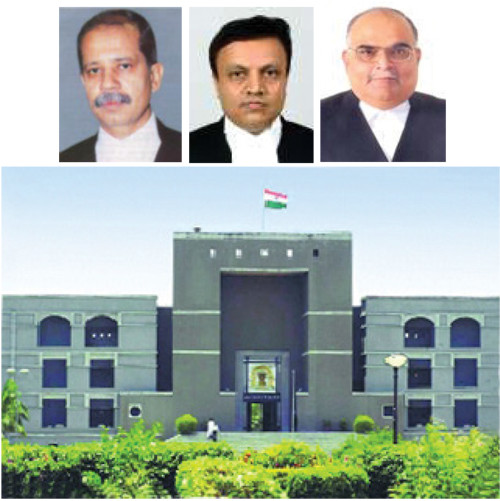
Gujarat High Court (alongside) and the three judges (from left) Akil Kureshi, Jayant Patel and R. M. Chhaya
Kavina pointed out the VPA trustees are "entrusted to manage the trust properties as per the trust deed.” But do they have the powers to exclude anyone claiming "we are in charge; we can decide” who can enter or not? He referred to the recent judgment by the division bench of the Bombay High Court in the so-called "renegade” priests case where the two judges ruled that the Bombay Parsi Punchayet (BPP) trustees did not have the powers under the trust deed to exclude the two priests from performing religious ceremonies at Doongerwadi and two other fire temples controlled by the BPP.
Justice Patel inquired if the Supreme Court had stayed the judgment to which Kavina replied they had not. The matter was referred to a mediator.
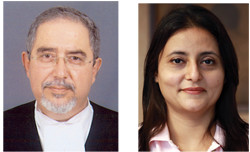
Counsel Percy Kavina (left) representing Goolrookh Gupta
"My client is a Parsi professing the Zoroastrian religion…no action of hers is inconsistent with” the practicing of the faith, Kavina averred adding "there is no reason to exclude her” from entering a fire temple. "In deciding to exclude the ladies” had the VPA trustees kept in mind "the contemplations of the settlors of the trust when the deeds were formulated?” Referring to the historic judgment of Petit vs Jeejeebhoy, Kavina noted the two Bombay High Court Justices — Dinshaw Davar and Frank Beaman — observed that "Zoroastrianism not only permits but enjoins conversion.”
"In a revealed religion (such as Zoroastrianism) you cannot have a bar to conversion,” pointed out Kavina. The plaintiffs in Petit vs Jeejeebhoy had contended that the great Mogul emperor Akbar converted to Zoroastrianism. Parsis welcomed into the faith those who would be "excellent allies” and who would "do no harm to their religion.” But both justices, however, observed that since coming to India there was no proven instance of a total alien being converted to Zoroastrianism. Davar believed the settlors of the trust would not have envisioned members of the lower castes entering their sacred houses of worship and Beaman noted that the issue was not a religious one but one of caste. "The defendants, expressing as we now know the orthodox Parsi view, are prepared to overlook immorality, bastardy — anything by alienage.”
They thus ruled that to enter a fire temple or to avail of any trust benefits meant for the community, a dual qualification – racial and religious — had to be fulfilled. A person had to be born of a Parsi father and had to profess the Zoroastrian faith. "There was a conflict between rationalism and traditionalism in the judges’ minds,” opined Kavina.
"In 1908 everyone was a racist,” he stated adding that at that time racism was not considered "wrong… The Charter of Human Rights was not there.”
Patel: "The Indian constitution was not there also.” (The judge also commented that at the time of the Petit vs Jeejeebhoy case the judges must have had a lot of time to write such a long judgment that Kavina termed "rambling.”)
How does one determine a person’s origins? queried Kavina. "I don’t (always) have a family tree. What is the ‘same stock?’”
He argued that "the absence of custom does not mean the basic belief of the religion is undermined… there cannot be a custom of not doing something.”
Patel: "So many customs become part of law.”
Kavina countered this was so only as long as the custom had the force of law. "Is there any material to say ‘if you do this you will be out?’ Is the petitioner to be barred from entering the agiary?...There is no authoritative law, no Shruti, no Shariat law or learned treatise — only a custom that comes from belief.” Of the theological scriptures only "fragments…part of a prayer book” remain. There are "no rules.”
In her PhD dissertation legal scholar and associate professor of legal history at the University of Wisconsin in Madison Mitra Sharafi noted that Petit and the others did not challenge the Bombay High Court division bench order before the Privy Council. She was of the belief that the Privy Council may have viewed the contentions of the plaintiffs more favorably. In less than 20 years after the Petit versus Jeejeebhoy case, the Privy Council in London when deciding in Saklat vs Bella ruled that while Bella, the child of a Parsi mother and Goan father, did not have a right to enter the fire temple in Rangoon, the trustees could still admit her.
"But when the subject matter of such a trust or charity is the rendering of some convenience or service of such a nature that it will not hurt the lawful recipients if others share with them, their lordships are aware of no case in which it has been held that the trustees are bound to exclude persons who have no legal title to share. They may do so; they may treat all such persons as trespassers. But if they choose to admit to the benefit of some park or garden established for a particular district some persons from over the border or to admit to a public library destined for a particular municipality persons from outside, or what is perhaps a nearer analogy, admit to the hearing of a lecture by a university professor persons not members of the university, this of itself furnishes no ground for complaint. If the numbers admitted are too large or the persons are disorderly or unpleasant in their habits or in any way substantially interfere with the convenience or benefit of those for whom the endowment was created, the trustees may be required to exclude them. But the mere claim of A that B shall not share in such a benefit because B is not within the terms of the foundation is not one that courts would encourage.”
Kavina pointed out that "unfortunately on any given day four to five” worshippers must be entering the portals of the Valsad fire temple. "In Valsad they are lucky if they get one person per hour” so the question of overcrowding does not arise. On festival days of course the fire temple is filled with worshippers.
The priest in Rangoon refrained from performing Bella’s navjote because it would be "unpopular” with Parsis. He did not demonstrate "much courage but great wisdom,” quipped Kavina. But in citing the Saklat vs Bella judgment, Kavina said he was "pointing out the progress” in judicial pronouncements... In 25 years we see how the law has been transformed… I request the court to go where it has not gone before,” he said referring to the trend of judicial opinion.
When closing the hearing on August 4 the judges requested Kavina to inform them of the practices followed in other cities regarding entry to the fire temples for women married to non-Parsi Zoroastrians. "I don’t know if it is relevant or not,” commented Patel.
Transformation of trustees’ role
Within a week, by August 11, Gupta had been able to procure support from 10 anjumans in India and five associations overseas that confirmed that men and women married out of the community are both given admission to their institutions. An affidavit for these documents was filed in the court on August 11 and sought to be served to the respondents a day earlier which they had refused on the rationale that with the proceedings in progress they could not accept any further documents. Kavina reminded the court that the affidavit had been filed in response to the judges’ request making Patel remark, "We’ll consider it later.” As Kavina subsequently noted, "There is change in the view of the community all over the world but Valsad Anjuman would like to remain rooted 150 years ago.”
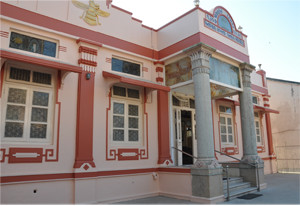
Valsad Daremeher
To convince the judges that the issues before the Bombay High Court in the matter of the renegade priests case and the present case concerning Gupta’s exclusion from the agiary were "congruous matters that were arraigned,” Kavina cited at length the facts of the case. He stressed how the role of the Parsi Punchayet trustees has "undergone a transformation” and instead of concerning themselves with religious issues they are now expected to assume "a secular character.”
Quoting from the judgment Kavina asserted that "trustees cannot abrogate powers on themselves not conferred in the trust deed;” let there not be "grave abuse” of authority. He appealed to the court not "to encourage religious obscurantism.” When he mentioned that the renegade priests case is presently under mediation under instructions from the Supreme Court, Patel observed, "There is scope for mediation here too… but the parties are ready to spend on litigation.” While Kavina is fighting the case pro bono it is believed that Ahmedabad business magnate Areez Khambatta funds the legal fees of Rs 1.25 lakhs for every appearance charged by senior counsel Sharad Vakil engaged for the Valsad Anjuman.
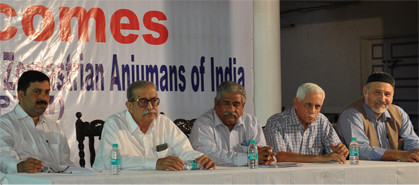
Part of the opposition to Goolrookh Gupta (from left): Sam Chothia, Areez Khambatta, Dinshaw Mehta, Marazban Dhanbhoora and Khojeste Mistree
Since the priests were faulted for performing religious rites for those who had opted for cremation, Kavina stated, "Cohesiveness of a faith is maintained by reason. Its perspective is based on contemporary need.” Referring to the absence of vultures due to which solar panels are installed to assist in the disintegration of the body, Kavina pointed out that it is "only bodily fluids that evaporate.” When Patel wondered why "solar panels are not anathema” to a community not favoring cremation, he jested, is it "to make it comfortable for the vultures?” Responded Kavina in a lighter vein, "carrion eaters don’t eat flesh that is cooked.” Solar panels are "a backdoor entry” to the principle of heat that is used in a crematorium, he observed making advocate Aspi Kapadia clarify that solar panels ensure that the body does not catch fire.
Kavina also referred to the inconsistent practice of permitting alternate forms of disposal like burial or cremation in cities or towns where no option is available but "condemning to damnation” a soul who opts for alternate methods when dakhmenashini is available.
The judgment in the Petit vs Jeejeebhoy case must "be understood in the context of the social milieu” in the early 20th century when society was "predominantly male dominated. We are applying for equality of gender.” The judgment in the Bella case too talks of the religion permitting conversion. Why does every court take cognizance of the conversion issue? It is "like a prism” through which the socioreligious issue before the court can be understood, said Kavina making Patel comment, "No religion would discourage conversion. The basic purpose of religion is to espouse the faith.”
Referring to the discrimination meted out to Dilbar a Valvi who was not permitted to attend her mother’s funeral rites in Valsad in 2008 because she had married out of the community, Kavina mentioned that in Bombay not only were outmarried ladies permitted to attend the prayers they were also permitted to be consigned to the dakhma. But it appears that "to get into a religious building you have to die first,” he added tongue in cheek.
With the respondents objecting to Gupta’s non Parsi name after marriage which Kavina viewed as "convoluted logic” Patel sought to ascertain how many Parsi surnames continue to be of original Persian usage. Even the frequent reference to absence of ashirwad ceremony for Gupta’s nuptials made the judge enquire whether there is no Persian word for ashirwad.
With the respondents relying on a statement by the high priests that on her marriage to a non-Parsi, the Parsi lady loses her Zoroastrian identity and automatically leaves her religion, Kavi-na countered, "These are the views of individual priests… patriarchal and sexist views. The sooner we abandon it the better. There should be a gender neutral view. In our religion there is no tradition of turning to the high priests for ecclesiastical decisions that will be followed all over the world.” With the respondents citing the verdict of Dastur (Dr) Peshotan Mirza, high priest of Udvada, in their favor, Kavina mentioned that the second high priest of Udvada was "clearly in favor” of granting equal rights to both the sexes.
While conceding that no one has the right "to reform religion out of its existence,” Kavina argued, "If a petitioner goes inside does the religion change? Will we stop wearing topis, sudreh-kusti or praying before the fire?”
The respondents further contend that "the petition is premature because the parents have not died.” Kavina explained that the reason for the petitioner continuing with the case is because when her parents die they will say ‘you sit outside.’ Commented Kureshi, "The Parsi community is known for its longevity and tenacity to fight.” Kavina cited Sharafi’s findings that at one time 50 percent of the cases in the High Court were being fought by Parsis.
Kavina sought to impress on the judges that the writ petition be accepted because while certain articles under the constitution can only be enforced by state actors there are others that can be enforced by non-state actors. He then went into the details of Minocher Dastur’s case against the Valsad Anjuman. In that case the Anjuman had passed a new rule that the last rites cannot be performed at the deceased’s residence and the body be then brought to the dakhma. Challenging this decision Dastur had approached the charity commissioner who ruled that this is a religious issue and the matter should be resolved by a court. When the subject was raised as a writ petition, the court ruled that the trustees have no business to dictate anything against the objectives of the trust. This made Patel question, "Suppose we accept that women have the right to attend, how will it be enforced? Is this right directly enforceable?” Mentioned Kavina, "We are first requesting the court to decide whether she has the right. The consequences of this decision can be enforced in any way. Parsis are a litigious but law abiding community.”
◆ ◆ ◆
From the archive