
Religion
“What distinguishes us…”
A sparkling speech, a receptive and questioning audience marked the first public lecture jointly organized by two liberal organizations
"A very kind Parsi gentleman has allotted us a plot of 15,000 square feet for construction of a universal agiary,” declared Kerssie Wadia, founder trustee of the Association for Revival of Zoroastrianism (ARZ) to the brimful of Zoroastrians at the Bombay Red Cross Society’s Homi J. H. Taleyarkhan Hall on February 10, 2007. "I am confident we’ll be able to declare the agiary open in two years. But we will need to dig deep into our pockets!” he added.
The largely middle-aged, knowledgeable audience had responded to personal invitations as well as an announcement in the Jam-e-Jamshed Weekly. For the first time a public lecture had been arranged to present the liberal viewpoint directly: Zoroastrianism is a universal religion. The ARZ, in conjunction with the Association of Inter-Married Zoroastrians (AIMZ), presented retired attorney Dina McIntyre of Pittsburgh to argue the case. The audience was not disappointed; they didn’t nod off to sleep; the interest was reflected in a spontaneous question-answer session at the end of her talk (see "A tradition of acceptance,” page 32).
But a bemused Justice Sri Krishna, retired judge of the Supreme Court of India and the evening’s president, pondered, "I am not a Parsi, I am not married to a Parsi, none of my daughters are married to a Parsi! I spent the night wondering why I was invited to preside!”

Dina McIntyre: golden strands of Gathic thought
"We are here to learn something more about the Zoroastrian religion. We are not just a group of people who worship the same God,” commented Darayas Malegam of ARZ. Describing religions as "various armed forces,” he contended that the Zoroastrians were "one such army of God. Prayers and manthras are our weapon; the sudreh-kusti is our uniform. We pledge allegiance to Ahura Mazda. The enemy we fight is the enemy within. Unless this enemy is vanquished, there is no true peace.”
Malegam paid tribute to the two mobeds who have supported the liberal cause: Ervads Khushroo Madon and Framroze Mirza, calling them "two dedicated lieutenants of Ahura Mazda who have dared to bear opposition and insult in a rare blend of activism and restraint, daring and dedication. They try to ensure the spiritual needs of man are serviced even when he transits this life, irrespective of how he chose to be disposed of.” Madon and Mirza were presented with flowers and a shawl by Sri Krishna and McIntyre respectively.
Introducing the speaker, Meher Amersey, president of AIMZ, noted how McIntyre had been turned off Zoroastrianism in early life because of the community’s animosity to her non-Zoroastrian spouse. "But the Gathas provided a way of life that made for satisfaction — emotional, intellectual and spiritual,” she noted, referring to McIntyre’s essay series "Introduction to the Gathas” (see "The key to survival,” page 30). McIntyre is now a much sought after speaker at Gatha conferences.
Homework diligently completed, McIntyre cited chapter and verse to prove that Zoroastrianism was meant for mankind at large. She had marshaled the words of Zarathushtra as expressed in the Gathas. But here was no ‘Gathas only’ scholar. There were references to the Yasnas, Yashts, Niyaeshes and various texts spanning a time frame of 1,000 years after Zarathushtra. And for further reinforcement there were opinions from the Rivayats — the written questions the Zoroastrians of India addressed to their coreligionists in Iran and the answers they received — as well as more recent correspondence between the Zoroastrians of North America and the Mobed Council of Iran. Nor did she stop there. Traditions and customs were also invoked to buttress the points she made. McIntyre’s soft, friendly and gentle tone heightened the impact of the evidence she presented.
AIMZ committee member and social activist Meher Rafaat, the evening’s emcee, introduced the judge, a "household name in Bombay” because of his meticulous but thankless work in compiling a report on the communal riots of 1992-93. Describing Sri Krishna, currently chairman of India’s Sixth Pay Commission, as a man of "courage and integrity and deep concern for justice,” Rafaat spoke of his felicity with seven languages, knowledge of music and philosophy.
"Religion is the outward index of an inner yearning for spirituality…a yearning to unite with the Almighty by whatever name,” noted Sri Krishna adding, "What is said in any religion is what is said in any other religion. Our instincts of food, fear and procreation are common to humans and animals. What distinguishes us is dharma, the search for universal order, social order…Education is that which liberates us from bestial behavior, promotes an equanimous state of mind…If a religion teaches a human being to hate another, ostracize another for what is not sinful, there is something wrong. It is abhorrent to our sense of natural justice, of equity. That’s why I am happy to be here with AIMZ, with ARZ.”
"The test of true spirituality is the internalization of religion as seen in social behavior. I have seen Parsis in college, at the bar, as judges. Parsis have internalized the true meaning of religion. They are always above board…
"It is essential to appreciate the good values of other religions, emphasize points of convergence. As the Rig Veda says, ‘Let good thoughts come from all directions.’ Let us subsume the world into a nest where birds of all hues live peacefully…May ARZ and AIMZ propagate value based religion,” concluded the judge.
In the discussion which followed, Kersee Kabraji of Poona asked, "Is there rebirth in the Gathas?” "There is no specific mention, none in the later texts that I’m aware of,” responded McIntyre adding, "But in my view — and it’s a minority view — reincarnation is strongly implied in the Gathas: Zarathushtra teaches that life is a progression towards Huvaratat (completion, perfection). Is his teaching false because no one is perfect in one lifetime?”
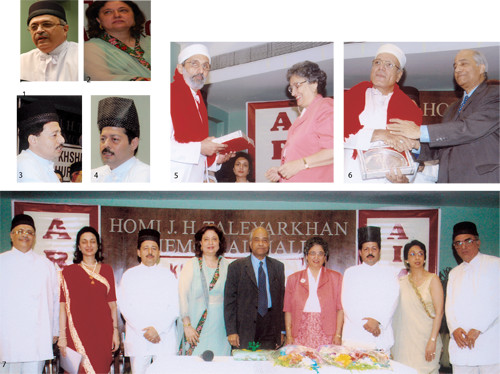
1: Darayas Malegam; 2: Meher Amersey; 3: Kerssie Wadia; 4: Vispy Wadia; 5: Framroze Mirza and Dina McIntyre; 6: Khushroo Madon and Sri Krishna; 7: (L to R) Malegam, Meher Rafaat, K. Wadia, Amersey, Krishna, McIntyre, V. Wadia, Khusheed Narang and Aspi Billimoria
Former Bombay Parsi Punchayet (BPP) trustee and retired Indian Administrative Service officer Jamsheed Kanga, who has authored several articles on the universality of the religion in the community Press, wondered why the belief that conversion is not permitted is so ingrained among Parsis. He said, "The high priests will not produce any documentation, but they will not accept (that the religion is meant for all mankind).” Rationalized McIntyre: "The practice may have originated out of fear (that) we’d melt away as a community.”
Dr Mahrukh Joshi referred to forcible conversions under the Sasanians and questioned the relevance of the Vendidad, the fatwas and punishments it imposed. Noting that French scholar, Prof James Darmesteter has shown that there are references to Manichaeism — a religion propounded in Sasanian times — in the Vendidad, McIntyre agreed that the tone of the Vendidad differs radically from that of the Gathas: "Zarathushtra said we must think for ourselves; the Vendidad controls through fear…It prescribes lashes as punishment but they could be converted into cash fines. It gave the priests power!”
Someone from the audience wanted to know if we had promised Jadi Rana, when he gave our forefathers asylum, that we would not convert his people to our religion. Replied ARZ co-founder Vispy Wadia: "There is no record that we gave such a promise. Even if we did, it applied to the region of Sanjan. Now the constitution of India allows us to practice and propagate our faith.”
Is it the effect of the caste system on the Zoroastrians? wondered Parsiana editor Jehangir Patel. Responded Sri Krishna, "At one time it was totally rigid. Now no more so. The constitution and the law does not recognize it. Jadi Rana was the sovereign of his own territory. In law that means that a promise, if given, (is applicable) as long as the status quo remains unchanged.”
A measure of humor entered the discussion when Mirza asked, "What is Chinwat Pool?” He elaborated that "one of our big scholars took me to Doongerwadi and said, ‘Tumooné Chinwat Pool pur jawab aapvo parsé (You will be answerable on the Bridge of the Separator).’ But what about the high priests and scholars? Will they be questioned or will I be questioned?”
Noting that her concept of the Chinwat Pool is a metaphor: as described in the Mainyo-i-khard it is a bridge whose one end is in the temporal world, the other in the spiritual, McIntyre spoke of the three entities who tend it as Meher — the angel of friendship, love, good faith; Srosh — obedience to God’s teachings; Rashna — justice. "If you have practiced such attributes, they facilitate the transition. Anger, extreme passions, greed, various vices, retard spiritual progress. Zarathushtra says we have the freedom to choose…the man who makes the right choices is ‘beneficent.’ I’d say you have a darned good shot at Chinwat Pool!”
When someone noted that ‘conversion’ is a word badly misinterpreted, McIntyre said that the "whole idea of navjote is unique…everyone is born a non-Zoroastrian. The child — in the old days it was a young adult — studies the religion, reflects on it and chooses it for himself.”
Former BPP trustee Rustom Tirandaz attempted to introduce a red herring. "At what point of time in history did Zarathushtra come into the world and when did calligraphy begin?” When McIntyre replied that there were conjectures but no hard evidence, he continued: "The words of the Gathas could have changed over the ages because there was no calligraphy at the time. We can only accept your speech in terms of wishful thinking.” Writing didn’t exist but the Gathas are poetry. "It is much more difficult to corrupt poetry, because of its meter, than prose,” she assured him.
Former BPP executive Pervez Aibara questioned her about the dakhmas. The concept was brought in by the Magian priests, she said. "In the Vendidad it is written that the dakhma is most polluted by devils; that if it is pulled down, your sins will be forgiven. But (the Vendidad’s philosophy) flies in the face of the Gathas. Moreover, the kind of dakhmenashini we are practicing today is quite different from the Vendidad’s prescription.”
Bringing the evening to a close Malegam referred to the orthodox view of intermarriage, noting, "There are those who talk of contamination when two beautiful children of God join together,” adding, "What should never be contaminated is the divine flame within each one of us. Let us sustain it by good thoughts, words and deeds and a life of simplicity. For to live in simplicity is to live in virtue and virtue is nothing more than to live in the likeness of God.”
◆ ◆ ◆
From the archive