
Events & Personalities
Understanding religions
"Religion is deeply embedded in the human psyche…The communists ruled the Soviet Union for 70 years with an atheist dogma, brainwashing three generations of its people. Yet, in 1989 the whole nation exploded with joy to celebrate the 1,000th anniversary of Christianity in Russia.”
Member of the Rajya Sabha, Dr Karan Singh, Padma Bhushan laureate, poet, scholar and connoisseur of the arts, chancellor of Delhi’s Jawaharlal Nehru University, former ambassador of India to the US was introduced by K. R. Cama Oriental Institute (KRCOI) trustee Ervad (Dr) Rooyintan Peer. Singh is the national chairperson of the Temple of Understanding, the interfaith body founded in the US in 1960, that shuns debate and criticism and instead seeks to promote the study and inculcate the finest in all religions. Under the common umbrella of religion Singh sought a coalition for the education and welfare of women and children, wished it would gather momentum for the common good.
Noting that it is a mistake to consider religion as "unfashionable,” he urged that it be interpreted in a rational fashion to inculcate an interest in the young. "To ignore religion is to leave it in the hands of revanchists,” he stated. Accepting that there are many theological differences between the religions of the world, "in actual practice a great deal is in common. The emerging global society should be based on certain values. Get onto these methodologies, expound the positive aspects…the Lord resides in the heart of all human beings. Fan that spark of the divine (for that) is the goal of human existence.” He compared yoga to Plato’s eternal truth and St Francis of Assisi’s love for all creation. "The world as a family is a Hindu concept. We are only now beginning to realize its possibility. Strive to develop ‘the world as a family.’ It is a different concept from that of ‘the world as a market.’
"Truth is one, though the wise call it by many names. There is no monopoly in the field of religion, no sole selling agents for the divine…That there are many religions means that there are many paths to the divine. Recognize and respect each path…Life is a unique opportunity for spiritual growth,” said Singh who, as a lad of 18, had been called upon to shoulder the burden of regency of Jammu and Kashmir when his father Maharaja Hari Singh abdicated the throne after assigning the state to India.
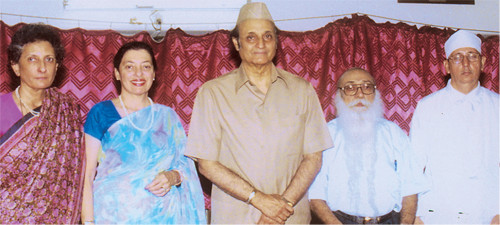
From left: Nawaz Mody, Homai Modi, Karan Singh, S. A. Upadhyaya and Rooyintan Peer Photo: Hoshi Patel
A nationalist and former minister in the cabinet of Indira Gandhi, Singh spoke of his delight to return to Bombay for any reason whatsoever. Born in Cannes, France, by a quirk of fate, Singh said his first contact with India was when he, then all of six months, landed with his mother at Ballard Pier in Bombay. He initially schooled at the Cathedral and John Connon — before going to Dehra Doon where he met Adi Sethna, the retired Lt Gen with whom he has remained in close touch — was married here and his first two children were born at the Breach Candy Hospital. His father, who had retired and lived in this city had a lot of Parsi friends, especially the eye specialist Lord Duggan and his Lady, all of whom Singh was happy to recall.
This was Singh’s first visit to the KRCOI and he was visibly impressed by the library and the preservation work proceeding there under contract with INTACH. Escorted around by trustee secretary of the KRCOI Homai Modi who is also convenor of the Temple of Understanding after the passing of Homi Taleyarkhan, Singh distributed prizes for the essay competition organized by the Temple on the subject of disaster management. Having been presented with a copy of the four-volume Enduring Legacy by its editor Nawaz Mody of the Bombay University’s department of civics and politics who is also joint honorary secretary of the KRCOI, Singh quipped, "I am literally weighed down with your gifts!” and presented three of his own publications to the library.
A lively question and answer session followed when someone asked why tenets of different religions were not being taught in schools. Singh responded that one cannot teach religion under the constitution though the fundamental duties inscribed in the constitution should be taught. "The answer lies in history,” he noted. The Hindu-Muslim conflict that dogged the Independence of India, "the havoc of communalism led constitution writers to bend over backwards” to ensure secularism as the state policy. Singh differentiated between secularism as understood in the West where the conflict between church and state had painted it as an anti-religious policy. In India, on the contrary, the emphasis was that the state had no official religion and that all religions practiced in the country had equal rights. "Thus equal respect and cultural pluralism are built into our constitution together with safeguards for religious minorities…That’s why India has remained a flourishing democracy for 60 years.”
When a member of the audience suggested that the government of India should teach democratic leaders to behave and rule the country properly, adding we cannot progress without discipline, Singh noted, "Raj dharma is enshrined in our constitution.” Acknowledging that money and mafia were obvious at election time, he said, "The ethics committee of the Rajya Sabha (has formulated) a code of conduct but what does one do if no one follows it? There must be a self-correcting mechanism to take care of political distortion. Public activists must ensure that a minimal standard is followed.”
Someone asked for Singh’s comment on the book Clash of Civilizations. He admitted that the work is "brilliant, makes a compelling case. But on principle I cannot accept the inevitability of a clash because we (Temple of Understanding) work on (the theory of) a confluence of civilizations. Huntington’s thesis is becoming a self-fulfilling prophecy. We have to be active and alert. We can’t brush it aside; we have to work through it.”
Someone complained that the Indian government did not do enough to contain the vandalism of the Taliban in Afghanistan, the destruction of the Bunyaad statues, etc. Another wanted his response to Nobel laureate Amartya Sen’s book, Argumentative Indian and suggested that the government publish a cheap edition. Singh agreed that the work is brilliant but that it lay too much emphasis on Eastern civilizations:
"the truth lies half way.”
When a member of the audience asked, "Will you give us an assurance that the next time you come to Bombay you will come as President of India?” Singh rejoined lightheartedly, "I give you no such assurance, but I share your hope!”
Arnavaz S. Mama
◆ ◆ ◆
From the archive