
Religion
Mevawala’s milestone
The holy fire at the recently renovated Seth Bomanji Merwanji Mevawala Dar-e-Meher in Byculla has been tended by members of the Bajan family since its consecration 160 years ago
The Seth Bomanji Merwanji Mevawala Dar-e-Meher in Byculla, with its distinctly old Persian architectural façade featuring bull motif topped pillars, has been restored and refurbished. The Dar-e-Meher has been enhanced with traditional ethnic Zoroastrian motifs alongside modern décor. The Asho Farohar, rising sun, brass and iron grills and the ancient frames inside have been touched up tastefully while there is sumptuous artwork on the outer wall crafted by Khushru Hoshang Sukhadia, reveals Sarosh Daruwalla. The donor Percy Lakadia provided munificent funds for the purpose in memory of his parents, late Naju and Faramroze Jivanji Lakadia, and his father-in-law, late Edul Jehangirji Punegar.
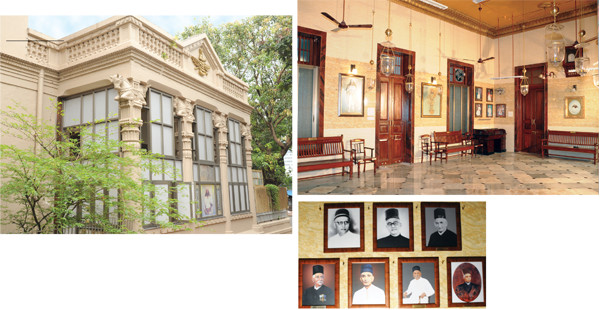
Architectural facade (left) and hall (right) of the renovated Mevawala Dar-e-Meher; (below) frames of former trustees
Originally located in the Bhendi Bazar area which was densely populated with Parsis during the time of the East India Company, the Dar-e-Meher was built by a dry fruit merchant, Bomanji Merwanji Mevadalal, in memory of his only son Sorabji who succumbed to a fatal illness at the relatively young age of 40 and consecrated on January 11, 1851 (mah Tir, roz Srosh 1220 AY), notes the historic background of the fire temple provided by its present panthaky Ervad Parvez Bajan. On February 13, 1874 when Hindu-Muslim riots broke out in the locality, the holy fire was desecrated. Rioters, in the name of religion, entered the premises brandishing swords and threatening to kill all who came in their way.
Religious riots used to break out with alarming frequency in the second half of the 19th century with clashes between Hindus, Muslims, Christians and Parsis, as detailed in the book The Bombay Rioters of 1874. On that fateful day in February 1874, realizing the gravity of the situation, the first panthaky of the Dar-e-Meher, Ervad Noshirwan Hiraji Bajan along with his brothers removed the holy fire from the sanctum sanctorum and hid it on the upper floor in a place unknown to others. Finding neither the sacred fire nor any priests the rioters ransacked the place and left, as recorded in the book. This barbarous act of vandalism greatly shocked its aged founder Bomanji who passed away on September 26 of that year at the age of 92. Before he died Bomanji had created an official trust deed for the Dar-e-Meher, bequeathing all his personal property and belongings to the trust after the demise of himself and his wife. Once again, on June 4, 1875 the fire was re-consecrated and enthroned in the Dar-e-Meher.
The prevailing tension caused by communal riots in and around the Bhendi Bazar area caused the Parsi population to gradually move out northward into various colonies and baugs built by philanthropists of the community. Since the fire temple’s structure was deteriorating permission was sought from a court of law to shift it to a safer location and on December 27, 1914 it was moved to its present location in Byculla, a stone’s throw from the Victoria Gardens Zoo (now known as Veermata Jijabai Udyan). Architects for the newly constructed Dar-e-Meher were M/s Mistry and Bhedwar, assisted by contractor M/s Jivanji Jamaji Mistry, according to Parvez Bajan.
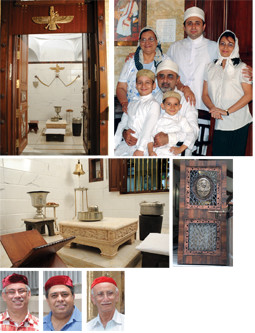
Ornate entrance to the sanctum sanctorum (above); Bajan family (top, from left) Bepsy, Xerxes, Parvez, Jehan, Darayus and Havovi; (below, from left) Khushru Sukhadia, Percy Lakadia and Hoshang Sukhadia
Since the initial enthronement of the holy fire in 1851 members of the athornan Bajan family of Navsari have served as panthakis in an unbroken line of succession for 160 years with Ervad Noshirwan Bajan being the first to grace the post. Noshirwan remained panthaky for 35 years from 1851 to 1886. He was followed by Ervad Pallonji Sheriarji Bajan (1886 to 1917) who was presented with a shawl by the trustees when the holy fire was shifted to Byculla in 1914 and he performed the first boi there. His son Ervad Ardeshir took over the reins after his father’s death and served the Dar-e-Meher for 31 years. On his demise in 1947 Ervad Ardeshir’s eldest son Ervad Jalejar, along with his younger brother Ervad Minocher, were jointly appointed panthakis, the former serving for 32 years and the latter for a record 56 years. Ervad Minocher was also appointed panthaky of the Seth N. H. Karani Dar-e-Meher in 1935, when the Karani Agiary fire was shifted from Bhendi Bazar to its current location in Cusrow Baug. Ervad Minocher passed away in 2003 aged 92 and was succeeded by his son Parvez, who remains panthaky to this day, continuing a remarkable family saga of service to the Mevawala Dar-e-Meher.
Donor Lakadia had thanked the managing trustee of the Dar-e-Meher Burjor Mehta for permitting him to undertake the renovation, as also Soli Billimoria, Maneck Engineer, Dr Aspi Mehta, Burzin Wadia and Khushru Patel for their cooperation.
The "magnificent renaissance” of the Mevawala Dar-e-Meher has impressed many. Rustom Jasoomoney, president of Sir Ness Wadia Club at the nearby Rustom Baug was quoted in the Jam-e-Jamshed of August 22, 2010: "The agiary is very impressively done. What one finds distinctively different from before is that the photo frames of the elders are uniformly framed and aesthetically displayed.”
Actor and theater personality Dinyar Contractor exclaimed: "It is a wonderful transformation. Congratulations to the trustees, the donor and the executor... All three have managed to bring down heaven on earth... I hope the other agiaries will also follow suit.” In agreement was Rustom Sethna, president of the Rustom Baug Association: "The agiary is very tastefully done without being over-the-top! I hope we are able to maintain it for another 10 to 15 years. Normally, work of this magnitude requires several donors and many helpers so I was surprised that there is only one donor who took up the entire project. I believe that Ervad Parvez Bajan has also toiled for this beloved agiary and congratulations to both of them on a job very well done.”
◆ ◆ ◆
From the archive