
Religion
Fire temples: an overview
The history and functioning of fire temples is explained
Fire temples play a very important role in the daily lives of the Parsi Zarathushti community. Besides being a place of worship to offer prayers and perform religious ceremonies they even serve as a community center where Parsis can meet, communicate ideas and information, gain religious knowledge through lectures, books, audio cassettes, CDs, etc.
Fire temples in India and Pakistan are consecrated places of worship where the sacred fire is ceremoniously enthroned and kept burning 24 hours a day, seven days a week, 365 days a year. Only an ordained priest can enter the sanctum sanctorum or kebla room. Admission to a fire temple is restricted to Parsi Zarathushtis only. Devotees should enter a fire temple after performing the kusti padyab.
The boi ceremony is performed on change of gah (time period) five times a day by an ordained priest in atash behrams and adarans. Dadgah fires can be tended by a behdin caretaker.
An agiary (Sanskrit word agni alay = house of fire) may be an adaran or a dadgah. Each sacred fire has its own spiritual entity.
In the past every Parsi house had a dadgah fire kept glowing round the clock. With increasing urbanization and living in flats as against spacious houses, the strict laws of purity could not be observed at home, hence the need for consecrated fire temples. The 19th and 20th centuries saw devout philanthropic Parsis establishing fire temples.
Most agiaries are being renovated, time to time, through generous donations from philanthropic Parsis amounting to lakhs of rupees. Simple structures have now marble, granite, new tiles and a new coat of paint. But the human capital, the priests are neglected. Organizations such as the Athornan Mandal or the Bombay Parsi Punchayet (BPP) have failed to create a central fund which could provide social security benefits to mobeds such as mediclaim, life insurance, provident fund, gratuity, pension, accident insurance.
There was a time when we had golden priests and wooden chalises. Now we have some wooden priests and golden chalises. Devotion, dedication and discipline have been on the decline. Instead of mobeds willing to do mobedi or priesthood, the crème de la crème or intelligent sons of mobeds turn to other professions. Those who do not study or cannot find a better occupation, turn to priesthood as a last resort. In short, instead of marajyat or willing mobeds who do mobedi by choice we have farajyat part-time mobeds who do mobedi for a living.
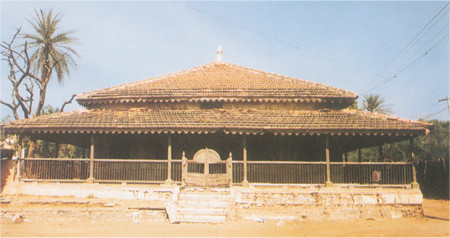
The Olpad Parsi Jarthosti Anju-man (Dadgah)
There is an acute shortage of full-time priests, as also Parsi chasniwallas. In some places, volunteers help to clean the agiary as also at muktad time. Young priests from athornan families turn to professions or business or go abroad for better prospects. In many places in the villages, there is only one mobed who offers boi in more than one agiary. There is no provision for leave or sickness.
Agiaries in Dadar, Andheri, Tardeo, Colaba which are located in Parsi colonies are well patronized. Some agiaries are languishing. The trustees of different agiaries being independent, there is no pooling of financial or human resources.
Some agiaries in Bombay have a panthaky system e.g. Mevawalla, Karani, Vatchha Gandhi, Banaji Limji, Patel Agiary at Mazagaon and Andheri, Tata Agiary and Jeejeebhoy Dadabhoy. Panthakies look after boi and ceremonies. Agiaries like Rustomframna, Narielwala have a manager.
Each agiary has trustees. The trust looks after maintenance and major repairs of the building. In some agiaries, a percentage of the bill for ceremonies is collected from the devotees and contributed to the trust for maintenance and repairs.
Kathi is obtained by most agiaries from H. Sidhwa & Sons at Nana Chowk. Ervad Farroakh Govadia has for many years been stressing on the need to grow baval trees on vacant lands so that kathi firewood could be made available to all our fire temples. The price of kathi keeps increasing but neither the BPP nor the Federation of Parsi Zoroastrian Anjumans of India have given any thought to this issue. (Both organizations have discussed this issue at several meetings — editors).
Income is generated from ceremonies performed at each agiary. In agiaries that are well patronized there is adequate income to distribute to the mobeds, chasniwallas. Those agiaries that have no baug or Parsi colonies in close proximity are less frequented. They depend mostly on donations and interest income from fixed deposits. Parsis donate on auspicious occasions and in response to fund-raising initiatives, appeals put on notice boards or in the Press.
The main items of expenditure are kathi, salaries of staff, electricity, repairs and maintenance.
The number of devotees visiting the agiaries has increased in the last 10 years. With more problems they turn to prayers, religion and Ahura Mazda for solace and comfort. Some agiaries organize mass prayers or humbandagi once a week. Some arrange jashans and religious lectures on Behram roz. It is desirable that every agiary should have a notice board where announcements, news of interest to the Parsi community are displayed. Thus fire temples can serve as information centers or powerhouses for social, cultural and economic uplift of the Parsi community besides being places of worship.
To reduce fire hazards, priests could wear a long sleeved jamo upto knee length and not a long flowing jamo upto ankle length. A fire extinguisher needs to be kept in every agiary. Lighting of divas should be discouraged in a fire temple. According to Dastur Kaikhushru Mahiyar Kutar, there is no need to light a diva where a consecrated sacred fire is glowing. Lighting these divas in an agiary burns up precious edible oil, creates more carbon dioxide. With acute shortage of Parsi workers, diva glasses are washed by bidi smoking non-Parsi workers in some places. Lighting several divas adds to pollution, fire hazard and is crass commercial exploitation.
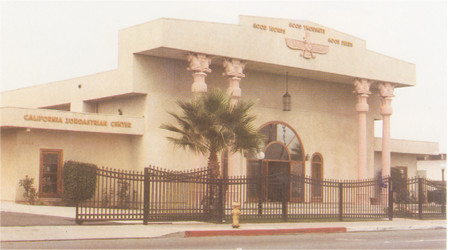
The Rustam Guiv Darbe Mehr in Los Angeles
There is need for security to check entry to our fire temples. There must be a board outside every agiary that admission is for Parsi Zarathushtis only. Employing watchmen adds to the cost of maintenance of the agiary.
With acute shortage of full-time priests and increasing costs of maintenance, agiaries which are less frequented are finding it very difficult to make both ends meet. Economic compulsions will in the near future force a situation where more than one sacred fire would have to be housed under one roof with a view to better utilize available resources. In order to maintain eight atash behrams and 150 agiaries in India the community needs to voluntarily contribute regularly and generously towards maintenance of places of worship as also for the economic welfare of the priests. Devotees need to realize that merely paying lip service is not enough. Pooling of manpower and financial resources is an absolute necessity.
Other communities such as the Jews and Christians are very well organized. Our institutions such as the BPP, Athornan Mandal, the Federation have failed to give the lead.
Agiary listing
There are three grades of fire temples: atash behram (cathedral grade), atash adaran or adarian (church grade) and atash dadgah (chapel grade).
The first atash behram in India was consecrated at Sanjan in 721 AC and called Iranshah. After nearly 700 years in Sanjan, the sacred fire was taken to the hills of Bahrot for 12 years, the forests of Vansda for 14 years, Navsari for 313 years, Surat for three years, Valsad for one year and brought to Udvada in 1742 AC where it continues to glow.
The Navsari Anjuman Atash Behram was consecrated on December 2, 1765 at Navsari. Dadysett Atash Behram in Bombay was consecrated on September 29, 1783 and was the first Kadmi Atash Behram. The Dadabhai Noshirwan Modi Shahen-shahi Atash Behram was consecrated in Surat on November 19, 1823. The Pestonji Kalabhai Vakil Kadmi Atash Behram was consecrated in Surat on December 5, 1823. The Hormusji Bomanji Wadia Atash Behram in Bombay was consecrated on November 17, 1830. The Cowasji Behramji Banaji Atash Behram (Kadmi) was consecrated on December 13, 1845. The Zarthosti Anjuman Atash Behram in Bombay was consecrated on October 17, 1897.
The oldest known agiary in India is the Vadi Daremeher at Navsari, a dadgah fire since 1182 AC over 800 years ago.
The oldest surviving adaran in Bombay is the Banaji Limji Agiary, 1709 AC in Fort, followed by Maneckji Sett Agiary in 1733 AC and Dadysett Agiary in 1803 AC.
There are as many as 50 fire temples in Bombay and its suburbs, some of them housing adarans and others, dadgahs. In Colaba, there are three — Jeejeebhoy Dadabhoy Agiary (1836), Panday Sanatorium Dadgah (1875) and Karani Agiary at Cusrow Baug (since 1935).
In the Fort area there are six — Banaji Agiary (1709), Maneckji Sett (1733), Dadysett (1803), Pirojbai D. Vatchha (1881), Godavara (1826), Langrana (1848), not to forget N. M. Petit Fasli Atash Kadeh (1940) at Churchgate.
At Dhobitalao are Indawalla (1843), Sodawaterwalla (1884), H. B. Wadia Adaran (1805) in Wadiaji Atash Behram, Bhiwandiwalla (1925) in Anjuman Atash Behram.
At Charni Road, Cowasji Banaji Adaran (1844) in Banaji Atash Behram and Albless Baug Dadgah (1868). At Walkeshwar is Thoothi Agiary (1859), Shapurji Jokhi Agiary (1999) at Godrej Baug, Saher Agiary at Breach Candy (1846), Vatchha Gandhi Agiary (1858) at Hughes Road and Doongerwadi Dadgah (1873).
At Gowalia Tank is Soonaiji Hirji Agiary (1842). At Tardeo are Sethna (1895), Boyce Dhanapatel (1834), Batliwalla (1865), Kappawalla and Mithaiwalla (1915) all located west of Grant Road station. To the east of Grant Road station are five agiaries: Aslaji (1865), Mehla Patel (1808), Cama Baug (1869), Ranji (1867) and Ashburner (1832). Byculla has the Mevawalla Agiary (1851), Mazagaon has two — F. N. Patel (1845) and Anjuman Agiary (1907). Lalbaug has Wadia Agiary (1834). Dadar has two agiaries — Narielwalla (since 1901) and Rustomframna (1929). Mahim has Soonawalla Agiary (1913). Bandra has Tata Agiary (1884) and Panthaki Agiary (1930), Andheri has Patel Agiary (1908), Salsette has Patel Dadgah (2000), Jogeshwari has Motlibai Wadia Adaran at Malcolm Baug (since 1964) and Ustad Saheb Shroff Daremeher at Behram Baug (2001), Vasai has Sachinwala Dadgah (1999), Thana has Rustamji Cowasji Patel Agiary (1829), Kalyan has Bhiwandiwalla Adaran (1880) and Uran has Umrigar Dadgah (1904).
Outside Bombay, in Maharashtra, are agiaries at Tarapore (1820), Dahanu (1940), Zai Bordi (1916), Lonavla (1899), four agiaries in Poona [Sardar Patel (1843), Sir J. J. (1844), Kadmi Shahenshahi Anjuman (1899) and Dadgah at J. N. Petit School (1889)] and at Ahmednagar (1847), Akola (1869), Badnera (1889), Igatpuri (1887), Deolali (1916), Sholapur (1845), Satara (1911) Panchgani (1931) and Nagpur (1895).
Parsis having settled on the west coast of India there are many agiaries in Gujarat: Davier (1855), Sanjan (1990), Saronda (1880), Nargol (1946), Daman (1838), Udvada — Petit Dadgah (1891) and Pundole Adaran (1976), Chikhli (1874), Pardi (1881), Khergam (1882), two at Valsad — Mota Parsi Wad Adaran (1850) and Nana Parsi Wad Dadgah (1849), Billimora (1899), Gandevi (1834), Navsari — Vadi Daremeher (1182), Minocherhomji Adaran (1686), Mody Daremeher (1936), Malesar Behdin Anjuman Dadgah (1943), Avan Baug Dadgah (1981), Sir J. J. Adaran (1853), Dosibai Kotwal Orphanage Dadgah, Doongerwadi Dadgah, dadgahs at Mahuva (1910), Bardoli (1885), Vyara (1895), Mandvi (1873) and Ankleshwar (1899).
Bharuch with a Parsi population of 150 has as many as five agiaries — Shapurji Bharucha (1924), Doongaji (1903), Hamavala (1760) and Narielwalla (1896). A new dadgah has started in Jamshed Baug (2003).
Surat has 13 agiaries — two in Sayedpura, Mistri Adaran (1897) and Navsarina Adarian (1888), one in Machhlipith — Baug-e-Parsa Adaran (1896), Goti Adaran (1843). There are four in Nanpura — Bisney Adaran (1838), Unvala (1870), Zaiya Wadia (1837) and Khan (1845) daremehers; four in Rustampura — Sir J. J. Adarian (1854), Rao (1908), Petit (1838) and Batliwalla (1823) dadgahs; and one in Gopipura — Mistri Dadgah (1866).
In the neighboring suburbs of Surat are adarans at Amroli (1893), Adajan (1827), Rander (1834), Siganpor (1849), Vesu (1889) and Bhatha (1862), whereas Olpad (1895), Elav (1869), Kudiana (1850), Ichhapor (1847), Suvali (1887) and Dumas (1838) have dadgah fires.
Vadodara has two adarans — Contractor (1824) and Umrigar (1846). Ahmedabad has two adarans — Vakil (1933) and Kankaria (1925). Bhavnagar (1891) has a dadgah fire. Jamnagar and Bhuj daremehers are prayer halls. In Rajasthan, Abu Road (1921) and Rajkot (1875) have a dadgah each whereas Ajmer (1898) has an adaran. New Delhi has a dadgah fire (1961). Kanpur has an agiary (1930). Jamshedpur has an agiary (1960), Calcutta has the D. B. Mehta Atash Adaran (1912). Allahabad has a dadgah (1930). In Madhya Pradesh, Mhow has an adaran (1846), Indore (1879) and Neemuch (1898) have a dadgah each. Hyderabad has an adaran (1904) and Secunderabad has two adarans (1847 and 1920). Bangalore has a dadgah (1926). Madras has an adaran, Clubwala Dar-e-meher (1910). Calicut, Lucknow, Jabalpur, Vizag each have a prayer hall. Belgaum (1891) and Hubli (1935) each have a dadgah fire.
In Pakistan there are two adarians in Karachi — Behrana (1849) and Wadia (1869). Lahore and Quetta have a dadgah each.
With a shift in Parsi population several sacred fires had to be shifted to locations where there was a sizeable Parsi population. Some of them are: Mevawalla Agiary (1850) from Bhindi Bazar to Byculla in 1914; Karani Agiary (1847) from Null Bazar to Cusrow Baug in 1935; Kappawalla Agiary (1857) from Pydhonie to Tardeo in 1941; Mancherji B. Sethna Agiary (1796) from Pydhonie to Tardeo in 1927; Mehla Patel Agiary (1808) from Bhindi Bazar to Grant Road in 1924; Tavri (1900) to Sir J. J. Adaran, Navsari in 1964 to Godrej Baug in 1999; Motlibai Wadia Adaran (1863) at Fort to Malcolm Baug Jogeshwari in 1964; Dhana Patel Agiary (1834) from Duncan Road to Tardeo in 1940; Elahi Baug Dadgah, Bombay to Sir J. J. Agiary, Poona, in 1994; Narielwala Agiary (1822) from Mazagaon to Dadar in 1901; Cursetji M. Shroff Adarian (1790) from Bombay to Jamshedpur in 1956 (by air); Adenwala Agiary (1883) from Aden to Lonavala in 1975 (by air); Bhagwa Dadgah fire to Bhatha; Bhesan and Khajot dadgahs to Bisney Adarian, Surat; Umra Adaran (1816) from Umra to Saronda in 1906; Soona- walla Agiary (1913) at Lady Jamshedji Road to Contractor Baug, Mahim in 1971.
Iran, where the Zarathushti religion originated, has two atash behrams, one at Yazd and one at Sharifabad and several atash kadehs. In the past few decades no boi ceremonies are performed there and the ritual base has eroded. Atash kadehs exist in Tehran, Esfahan, Kerman, Shiraz, Yazd and Zainabad.
The darbe mehrs in North America and Australia, established during the past 25 years, serve as community centers. These are not consecrated places of worship. Such centers serving as prayer halls exist in Hong Kong, London, Colombo, Toronto, Vancouver, New York, Washington, Chicago, Houston, Los Angeles and San Francisco. A new atash dadgah has been established at Auckland, New Zealand in 2004.
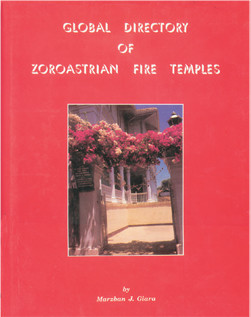
Community activist Marzban J. Giara is the author of the Global Directory of Zoroastrian Fire Temples and other publications.
◆ ◆ ◆
From the archive