
Religion
Honors for the Agiary
The Rustom Faramna Agiary’s platinum jubilee was marked by major recognition from civic authorities
"It is one of the most picturesque fire-temples. It is a corner structure with a sweeping verandah having circular columns with double bull capitals. The central arched portico forms its dominating feature. Its ornamental compound gate enhances the beauty of the structure. As a devotee climbs up the steps of this Agiary he can see a marble tablet above the main door of the kebla room inscribed: Us moi Ujareshwa Ahura (O Ahura! Make my soul more worthy).” This physical description of Dadar’s Seth R. N. Rustom Faramna Agiary in the souvenir brought out on the occasion of its platinum jubilee has a special bearing for the edifice was twice in the news in the last quarter. On March 26, 2004, the junction of Khareghat Road and Mancherji Joshi Road where the Agiary stands was named the Rustom Faramna Agiary Chowk by the Municipal Corporation of Bombay. In early April 2004 after the Agiary was renovated by Jimmy Mistry of Della Tecnica Architects and Interior Designers, it was conferred the Urban Heritage Award by the Indian Heritage Society.
Signal Chowk
"The recently renovated Agiary was looking festive, bedecked with flowers, sagan-na-chawk, and celebratory lighting adding a glow to its facade. The holy fire was burning bright, its leaping flames spreading a warm glow and strengthening the faith of all its worshippers in the inner sanctorum...Outside it was another momentous occcasion. The crossroads were fast filling up...” a write-up by Mahiar Dastoor gave the details of the March 26 function. Officials from the Bombay Police as also the Municipal Corporation, Agiary trustees, colony members and well-wishers gathered to witness the signposts being unveiled by managing trustee Rusi Jassawalla. The untiring efforts of Aspi Vasania, trustee of the Mancherji Edalji Joshi Memorial Trust, and Dadar resident Mehernosh Fitter were commended.
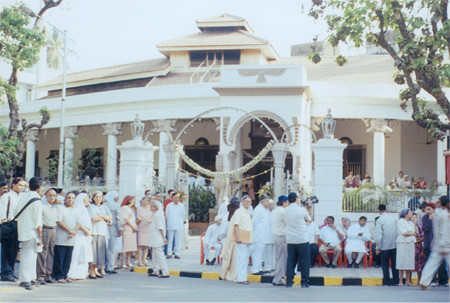
Rustom Faramna Agiary on the occasion of the naming of the Chowk
Thereafter the congregation proceeded to the main hall of the Agiary to hear the panthaky of the Agiary Ervad Faredoon Kutar trace the institution’s 75-year history. Udvada High Priest Dastur Khurshed Dastoor spoke on the power of Zoroastrian prayers and Zoroastrian Studies founder Khojeste Mistree explained the various types of bajs and fareshtas. Special felicitation was then accorded to Mistry for restoring the Agiary as a labor of love, to Kutar, his assistant Ervad Kaizad Karkaria, the mobeds and staff of the Agiary.
"The trustees of the Agiary Rusi Jassawalla, Roda Jassawalla, Jamshed Dastur, Pheroze Tarapore, Nasha Jassawalla, Dinshaw Tamboly and Mithoo Jesia need to be complimented on the smooth functioning of this very popular institution which is indeed an epitome of the very vibrant Zoroastrian community of the Mancherji E. Joshi Parsi Colony of Dadar,” stated Mahiar Dastoor.
Platinum finale
The platinum jubilee celebrations which started a year ago ended with an evening of entertainment on April 21, 2004. Thirty-eight children of the Colony’s Dharmagnyan Class, taught by the Dadar Athornan Madressa principal Ervad (Dr) Ramyar Karanjia, welcomed an audience of approximately 1,100 at the Gymkhana Grounds. "Seeing you in such large numbers makes us happy,” said one of the confident youngsters. The children sang of the community’s troubles when leaving Iran, said that when they pray they ask for "toys, games and chocolate” and hoped that happy occasions would be celebrated "dhaam dhum thi (on a big scale).”
This joyful beginning was followed by a speech by Jesia who praised the Agiary for being "one of the best in Bombay” and commended Mistry for renovating the structure while "keeping the old architecture intact.”
Chief guest Khurshed Dastoor who had interacted with the students of the Dharmagnyan Class observed that though the children said they prayed regularly, very few said they did so with their parents. Saddened by this information he cautioned, "What we do in our houses will be followed by our children.” Speaking on the significance of the navjote ceremony, Dastoor regretted that the mother of the child does not wear the sudreh on the day of the navjote itself. The correct time to perform the navjote is in the morning during the Havan gah and not in the evening when a handful of family members and friends witness the ceremony and the remaining invitees join them only later for dinner. Quoting from the Atash Nyaish, Dastoor said if the devotees knew what they were "getting back” from the fire they would not hesitate to make worthier offerings. He also clarified rumors about sandalwood from Bombay not being accepted at the Iranshah (see "If it is just a piece of wood...” pg 35).
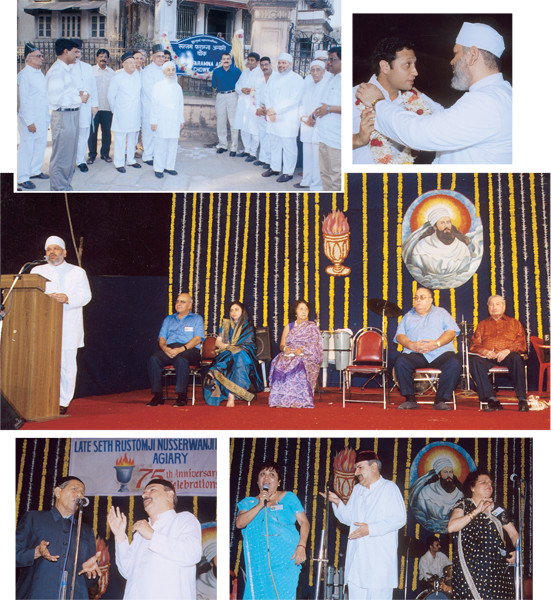
(From left) Top: Unveiling of the plaque and K. Dastoor garlanding Mistry; Center: K. Dastoor, Tamboly, Havovi Dastoor, Roda Jassawalla, Rusi Jassawalla and Jamshed Guzder; Below: J. Jesia and J. Karkaria; M. Jesia, J. Karkaria and Gandhi
In his vote of thanks Tamboly declared "it is the same fire in the agiary that kindles our hearts” and inspires the trustees "to serve the Agiary and our community.”
An entertainment program followed with Jehangir Karkaria, Jimi and Mithoo Jesia, Sharukh Divecha, Gulestan Gandhi, Jasmin Siganporia and Dara Patel taking center stage. Marzban Mehta and his live band kept the audience tapping their feet as did the special charm created by the sound and lights by Sarosh Daruwalla’s Mazda Audio Video Lab. The unexpected presence of Shiv Sena candidate Manohar Joshi and Congress candidate Eknath Gaikwad surcharged the atmosphere too. A wholesome dinner served in three sittings by caterer Minoo Bharucha brought the celebrations to a close.
Heritage landmark
"The Rustom Far-amna Agiary is our community asset. It is a heritage landmark...” states Marz-ban Giara in his brief history of the Agiary. Over the years reputed well-wishers have contributed to the growth and maintenance of this house of worship which owes its genesis to the initial donation of Rs 75,000 from Rustomji Rustom-Faramna, the proprietor of Carlton Hotel, Agra. He had built a sanatorium, Rustom Bagh, at Agra in 1919. His desire to see an agiary built in Dadar did not fructify during his lifetime for he passed away on February 14, 1927 and within nine months his widow Putlibai. The commitment of Pesikaka Jassawalla, Faramji Mistry, Maneksha Lala helped in completing the construction of the agiary building and the mobeds’ quarters. Under the leadership of Rustomji Jassawalla who appointed Ardeshir Soonawalla, Sorabji Batliwalla and Rustomji Kerawalla as trustees of the Agiary, the consecration ceremonies were undertaken on April 14, 1929 by Dasturs Faramarz Kutar, Kaikhushru Kutar and Darab Pahlan.
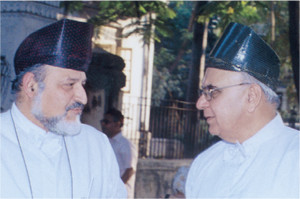
Mistree (left) and Tamboly
The professional services rendered by several Parsi architects, contractors, engineers and electrical firms have contributed to the Agiary’s smooth functioning. On the golden jubilee of the Agiary Shapurji Pallonji Mistry had a room constructed there. Prior to that Jehangir and Alamai Poonjiaji donated towards the bareshnumgah. In 1986 the Adaran Hall and the Baj Hall were donated in memory of Ratanbai, Jerbai and Pestonji Elavia by their children Homi and Gul.
In its platinum jubilee year Mistry who bore the costs of renovating the 6,500 sq ft fire-temple "didn’t want to deviate even an inch from the original design and styling,” as reported in the Afternoon Despatch and Courier of April 15, 2004. "Italian marble was used for the flooring replacing the existing one which developed cracks, whilst old cornices and moldings that had broken off from the costing were copied and refitted. Doors and windows covered with layers of oil paint were stripped and the original wood was touched upon, varnished and exposed with polyurethane coatings... Old partitions that had been haphazardly fitted... were removed and a proper ventillation system was created... a ceiling suspended diffused light fitting was designed... (and) to complete the work a stunning Zen-like landscaped garden was laid in the compound outside,” mentioned the Afternoon.
Since its inception the trustees engaged four salaried mobeds to ensure that all rituals are performed satisfactorily. The charge for reciting prayers is low so that the economically weaker class can also avail of this benefit, states Giara. Regular religious lectures help to increase the religious fervor. Present panthaky Kutar has been the manager since 1975. One page in the souvenir lists the names of the 29 mobeds "with long-standing service” to the Agiary.
The Dadar Jashan Trust has been operating from the Agiary since 1931. Its aim is to awaken religious zeal among Zarathushtis by propagating religious knowledge. Every Behram roz jashans are performed in memory of departed souls followed by religious, educative and informative lectures. Gahambars are celebrated too. During the 10 muktad days, humbandagi and religious discourses are a regular feature at the Agiary.
"If it is just a piece of wood...”
On your next pilgrimage to Udvada don’t be surprised if the priests refuse to accept the sandalwood proferred by you. The Iranshah high priest Dastur Khurshed Dastoor told the gathering at the Parsi Gymkhana Dadar on April 21, 2004 that inferior wood masquerading as sandalwood was being brought from Bombay and offered to the holy fire.
"If it is just a piece of wood, the boiwala will not accept it” but sandalwood of "presentable” quality will be. He asked the worshippers traveling in their "Sumos or in second class air-conditioned trains” if "Rs 10 sandalwood is costing you dear.”
◆ ◆ ◆
From the archive