
Politics and Policy
“Hamazori rekindled”
Regional representatives of the Global Working Group realize that the community’s growth is linked to its unity
If success is to be measured in terms of continuation of dialog, the Coming Together Roundtable (CTR), now renamed Global Working Group (GWG), set a benchmark when representatives from the global Zoroastrian diaspora met in Bombay on January 8 and 9, 2011. This bonding among representatives was a legacy of the 2009 World Zoroastrian Congress in Dubai where the responsibility of the CTR shifted from a group of ad hoc individuals to regional representatives.
"Hamazori rekindled” was the clarion call of the press release issued by Dinshaw Mehta, chairman of the Bombay Parsi Punchayet and president of the Federation of the Parsi Zoroastrian Anjumans of India following the meeting.
To realize hamazori or harmony it is necessary to develop respect, tolerance, obedience and forgiveness. "Being at peace with oneself and others is an art which needs to be inculcated,” summed up the Code of Civil Conduct (CCC), currently a work in progress that stemmed from a series of three papers on hamazor authored by Ervad (Dr) Ramiyar Karanjia, principal of the Dadar Athornan Institute. A "Hamazor Index” or a "Togetherness Index” (along the lines of the "Global Peace Index” developed in recent years by the Global Institute for Economics and Peace) would help us determine whether our strength and growth as a community is linked to our unity. The four fundamental tenets encapsulated in the Jasa me avanghe Mazda prayer are considered a fitting code of conduct to lead to a state of hamazori or unity in spiritual energy: "Fraspaayokhedhraam – unity which leads to progress; Nidhaanasnaithishem — not using force/violence; Khaetvadathaam – self dedication, serving for a cause; Ashaonim — truthfulness and sincerity.”
When it comes to safeguarding our community, our individualism must take second place and "community first” should be ingrained in our consciousness. Those of us rooted in the conventional ‘command and control’ organizations with charters and bylaws will be hard pressed to appreciate the value of a ‘chaordic organization (that appears to be chaotic but has an underlying order)’ governed and driven by the principle of hamazor.
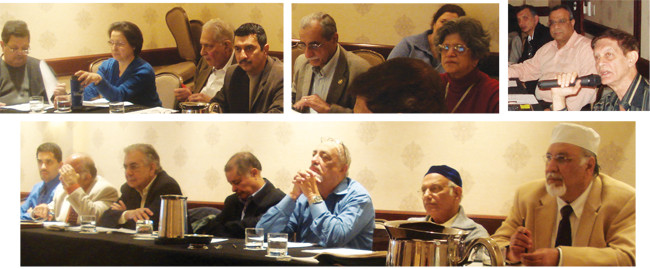
(Top row, from l): Homi Davier, Yasmin Pavri, Sam Vesuna, Darius Bharucha; Rohinton and Roshan Rivetna; Behram Pastakia, Bomi Patel, Homi Dhalla; (Bottom row, from l): Kayras Irani, Firdosh Mehta, Rustom Kevala, Alayar Dabestani, Kobad Zarolia, Soli Dastur, Kaiomerz Dotiwala
American anticipation
Before FEZANA (Federation of Zoroastrian Associations of North America) president Bomi Patel and Behram Pastakia represented the North American community at the GWG in Bombay they availed of the opportunity offered by the North American Zoroastrian Congress in Houston to review the agenda among 25 leading spokespersons.
The meeting in Houston on December 27, 2010 commenced with a benediction and monajat by Ervad Peshotan Unwalla and a welcome by Rustom Engineer, both of the Zoroastrian Association of Houston. Rohinton Rivetna, founder president of FEZANA who had conceived the CTR in London in 2005 urged that "regional leaders take the CTR to a higher plane, and through dialog and joint action work for the perpetuation and prosperity of our worldwide ‘community without borders.’”
Referring to the challenges facing the diaspora, former FEZANA president Firdosh Mehta presented the vision and mission of the CTR. The vision was "to nurture a caring, compassionate, altruistic, harmonious, observant, esteemed and prosperous worldwide community with respect for diversity so that we may move Ahura Mazda’s creation toward frashokereti.” The mission is "to come together and work together in the spirit of hamazori for the Zarathushti and global communities.” Keeping in mind the different interpretations of the term Parsi-Zoroastrian and Zarathushti, Mehta recommended, "We need to understand and respect every view of this term… rather than accept only one form.”
Presenting his thoughts on "Future directions and goals” for the CTR, Pastakia suggested that we should find commonalities with the worldwide Zarathushti diaspora on topics such as mobed welfare, youth exchange program, establishing a consecrated place of worship in North America.
Cultural and interfaith projects should also be on the agenda of GWG meetings, stated Dr Homi Dhalla, president of the World Zarathushti Cultural Foundation in Bombay who was present at the North American Congress. He shared vital demographic data of some Indian cities from 1900 to the present.
The other items considered suitable for discussion included socio-communal projects like community health and welfare, infrastructure like rehabilitation of Zarathushtis and organizing a welcome center for Pravasis visiting India, intellectual and spiritual projects. Alayar Dabestani was keen that such meetings also consider the needs, aspirations, requirements and points of view of Iranian Zarathushtis worldwide. Homi Davier who is connected with the travel industry pointed out that the proposed dates for the 10th World Zoroastrian Congress in Bombay (December 2013) fall in the peak season and hence air travel would prove costlier for overseas participants. Shifting the dates to early January 2014 would offer them relief.
For the community and humanity
For the GWG to be a success and to realize our potential, we need to work not only for the good of our community worldwide but also for the good of humankind in all regions of the world. Let us hold high before us the qualities of fortitude, determination and self-sufficiency, individually and collectively as exemplified by our forefathers.
(With inputs from Roshan Rivetna)
◆ ◆ ◆
From the archive