
10WZC
‘Circles of cooperation’
The fifth Coming Together Roundtable of regional leaders at the 9WZC is deemed a “watershed moment” for the community worldwide
They came together, not once, but thrice. At each session of the Fifth Coming Together Roundtable (5CTR) concerted efforts were made to create a "worldwide community without borders” wherein different regions assume their "responsibilities… and act in unison in consort with each other,” as recommended in the preliminary draft of the Memorandum of Understanding (MoU). This document was conceived by Rohinton Rivetna, founder president of the Federation of Zoroastrian Associations of North America (FEZANA), for adoption at the 5CTR during the Ninth World Zoroastrian Congress (WZC) in Dubai in December 2009.
"A foreboding sense of isolation and estrangement from each other exists, which if unheeded can culminate and become a reality in our next generation of Zarathushtis worldwide,” the MoU warns the minuscule community. Togetherness, hence, is deemed an imperative: "to come together and work together in the larger interest of preserving and protecting our worldwide community in the spirit of cooperation without competition, accepting each other on their own terms, without regard to any partisanship, embracing diversity and with no demands of a formal organization.”
The CTR forum was spearheaded by Rivetna, and convened for the first time during the Eighth WZC in London in 2005 with the support of then Congress chair Dorab Mistry. Before this 5CTR in Dubai the intervening ones in Bombay and Houston have deliberated and sought action on socioeconomic, communal, spiritual/religious, educational/cultural and infrastructure projects. To keep the world Zarathushti community connected and collaborating has been the endeavor of the dedicated team including Dr Behram Pastakia, Firdosh Mehta, Dr Zareen Karani Araoz, Yazdi Tantra, Percis Dubash and others.
For the 5CTR there were five goals/projects delineated: transition ownership of CTR to regional leadership; support technology platforms for global networking; follow-up on the WZC survey recommendations; collection and analysis of demographics to help make decisions about the community; support Zoroastrian Women’s International Networking (ZWIN).
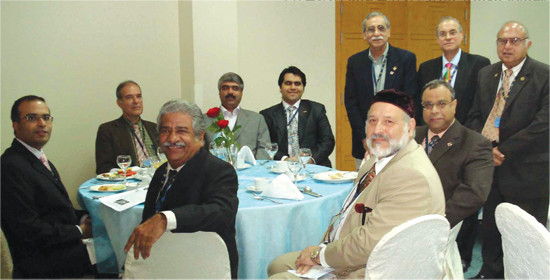
(Clockwise, from left): Paurush Jila, Dr Khodayar Attaie, Dr Esfandiar Ekhtiyari, Mehraban Hemavandy, Rohinton Rivetna, Dorab Mistry, Firdosh Mehta, Bomi Patel, Khojeste Mistree and Dinshaw Mehta
The transition of the CTR assembly from a "chaordic” (seemingly chaotic but with underlying order, working not through a hierarchy of authority but through a network of equals all driven by a shared mission) gathering to a structured forum led by elected representatives is viewed as a "momentous legacy of the Dubai Congress.” Elected leaders of the four major Zoroastrian regions — Iran, India, UK/Europe and North America — that represent 90 percent of the world’s Zarathushti population consensually agreed to assume ownership and responsibility as also to guide the future direction of this structure. This coming together of the regional leaders, elusive for decades, is considered a "watershed moment” for the world Zarathushti community, according to the minutes of the proceedings circulated by Roshan and Rohinton Rivetna. Representation from the smaller pockets like the Middle East, Singapore, Hong Kong, Australia, New Zealand will be woven into the fabric in the near future.
"Notwithstanding the urge and desire to cooperate it is to be recognized that there are several irreconcilable differences between the various groups… These differences have to be respected but ought not to diminish our zeal and desire for cooperation. Certain groups and bodies have affinities and synergies between them. Capitalizing upon these synergies, ‘circles of cooperation’ may be formed between them with mutual consent to link one with the other and thereby strengthen each other,” states the MoU referring to the World Alliance of Parsi Irani Zarthoshtis (WAPIZ), World Zoroastrian Organisation (WZO), World Zarathushti Chamber of Commerce (WZCC) and ZWIN with which bonds of cooperation and friendship need to be extended.
The CTR web presence is palpable due to the efforts of Tantra and his company On-lyne Systems that maintains www.zoroastrians.net to bring together all Zoroastrians under one roof. Thanks to Tantra making available the resources of his company like teleconferencing facilities and a part-time administrator Dubash, there is constant coordination between regions.
To overhaul and unify the Zoroastrian community’s technology platform for organization, administration, communication and collaboration purposes Eric Engineer proposed using pre-designed web platforms that are inexpensive. A World Zoroastrian Television Network, if introduced, could serve as a secure base for communication, a showcase for Zoroastrians and a tribune where Zoroastrian thought can be projected, recommended Rashid Shohrat.
An International Network of Zarathushti Organisations (INZO) that could speak with one voice to other religious communities, governmental and non-governmental organizations has been mooted by Jehangir Sarosh. This network would encompass all Zoroastrian organizations whether representing women, youth, mobeds, etc and collaborate at the world level.
ZWIN will be pursuing its two-fold projects — helping the neglected elderly as also assisting students going abroad for higher education to settle in their new abodes with the assistance of representatives networking in 30 cities, conveyed Karani Araoz.
As an incubator for innovative ideas, leadership cultivation and action oriented initiatives, NextGenNow (an offshoot of the Third CTR) has successfully attracted and inspired Zarathushti professionals, students, community leaders and elders in North America and throughout the world, according to a report by Engineer. "NextGenNow is committed to exploring the dynamics of our diversity, identifying specific challenges confronting our North American Zarathushti communities and proposing ways in which we can achieve harmony through a better understanding and respect for one another.” What challenges and expectations can the next generation expect over the next 20 years? How can we more effectively transition our maturing communities to a new generation of leadership? are the queries that surface.
Listed in their accomplishments are two successful North American conferences, two insightful chat group sessions and guest editorship of Fall 2009 FEZANA Journal, featuring 17 articles coordinated by the NextGenNow editorial team, social media campaigning (through social media groups on Facebook, LinkedIn and Twitter that are not open to the general public, but rather on an opt-in basis to join). The NextGenNow leadership team remains committed to working with Youth Leadership Enhancement Program (YLEP) leaders and organizations in North America and beyond.
"Let us move entitlement to enlightenment… We need to rebuild our ethic of collective giving…” were among the truisms laid down for reflection by the CTR. Zarathushtis have not indulged in building monuments. They would rather contribute to philanthropic causes like institutions of learning and medical/health facilities to benefit members of their own community as also all humanity. But with professionalism replacing entrepreneurship, lesser rewards leave lower surplus for charitable causes, making us draw from the charitable pool more than we may subscribe, raising consequent fears of entitlement and dependence. A newer model of charity needs to be developed such that individual giving is supplemented by collective giving where each member gives according to his/her means, recommends the note on "Cultivating an ethic of collective giving.”
Future community events coordinated by the WZC, WZCC, CTR, mobeds council should be held in Iran, urged Iranian delegates like Dr Esfandiar Ekhtiyari and Mehran Sepehri. A pride should be inculcated when speaking the Farsi and Dari language. "When you lose your language, you lose everything,” was the fear expressed. Those who are living in Iran and are genetically Zoroastrian should be considered Zoroastrian, urged Dr Rostam Khosraviani. Expressing concerns about healthcare in Iran was Dr Khodayar Attaie who also advocated setting up venture capital for entrepreneurs, hunnarshallas (vocational training institutes) and dharamshalas (rest houses). To strengthen the relationship between Zoroastrian youths in Iran and those around the world, Parto Kavoosian and Behnam Firoozfard highlighted the need for educational scholarships, hosts for youth studying abroad, tours to/from Iran, job placements and accommodation for new immigrants, English tutorials, opportunities to participate in sports/religious competitions, developing a Zoroastrian database.
The vision for Zoroastrians as envisaged by Rivetna is "To nurture a caring, compassionate, altruistic, harmonious, observant, esteemed and prosperous worldwide community.” His rationale is clear: "Organizations/communities with ‘vision’ are powerfully endowed — those without ‘vision’ are at risk — they perish… If we can imagine a future we can create it, if we can create that future others will live in it. That is the essence of success. Success is not about creating a definitive dogmatic end state; it is about the unfolding of thought processes, of dialog and continuum. It is not about what we create for ourselves, it is what we leave behind that will define us. Vision without action is merely a dream. Action without vision just passes the time, vision with action can change the world!”
◆ ◆ ◆
From the archive