
Politics and Policy
Global gateway
Three regional organizations represented at the Global Working Group in London formulated the nascent body’s vision, objects and action points
"To be the global voice of the Parsi/Irani Zoroastrian (Zarathushti) community worldwide and to function as a coordinating body for all regions of the world while at the same time respecting the autonomy of each region,” was the vision articulated by the Global Working Group (GWG) at its meeting at the Zoroastrian Centre in London on October 8 and 9, 2011. Thus each of the four main regions will be free to pursue "its own brand of religiosity,” it was mutually agreed.
Although the Press was not privy to the proceedings they were invited for a little over an hour towards the end of the second day when they were presented a communiqué by Dorab Mistry, former president of the Zoroastrian Trust Funds of Europe (ZTFE) who, in light of his experience, had been requested to chair the meeting by Malcolm Deboo, current president of ZTFE that was hosting the meeting. Other ZTFE past presidents who contributed to the meeting were Rusi Dalal and Paurushasp Jila. Lending weight to the GWG were Federation of Parsi Zoroastrian Anjumans of India (FPZAI) representatives, president Dinshaw Mehta and Bombay Parsi Punchayet (BPP) trustee Jimmy Mistry although the latter was not present for the Press briefing. Representing the Federation of Zoroastrian Associations of North America (FEZANA) were president Bomi Patel, Rohinton and Roshan Rivetna, the founders of the Coming Together Roundtable, the precursor to the GWG, and Dr Behram Pastakia, chair of FEZANA’s publications committee.
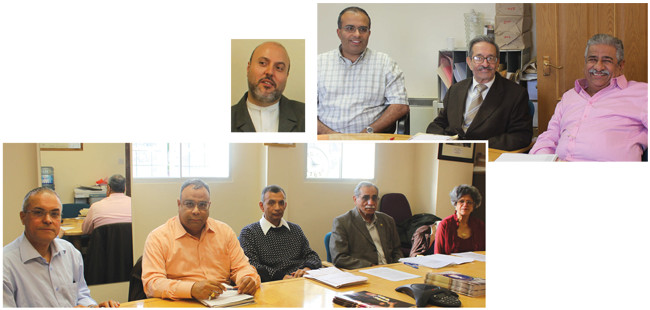
Clockwise from above left: Malcolm Deboo, Paurushasp Jila, Rusi Dalal, Dinshaw Mehta, Roshan and Rohinton Rivetna, Dr Behram Pastakia, Bomi Patel and Dorab Mistry
As agreed by the GWG, the elected regional bodies — FPZAI, FEZANA, ZTFE and Iran — are each entitled to two representatives with equal weightage which Dorab Mistry commented was "very generous of the FPZAI and the BPP” who despite their large numerical strength are not demanding more voice. Apart from the four major participants there will be representation from four small areas — Pakistan and Middle East, Hong Kong and Singapore, Australia, New Zealand — with one representative each. The GWG would have liked associations in the Far East to constitute one separate region but their "efforts have not been successful.” The GWG will also invite/involve institutional bodies as and when needed.
The twofold objects enunciated by the GWG are: to protect and enhance the interest of Parsi/Irani Zoroastrians worldwide and to advance the study and dissemination of information and knowledge of the Zoroastrian faith and the community.
The objects will be met by pursuing six "action points in a fairly reasonable time frame.” On the top of their agenda is a global exchange program for those in the 20-35 age group in March 2012, and for those in the 13-20 group in December 2012. Yet another action geared for the youth is the "India work experience program” where overseas associations are "looking to the BPP to open some doors for young apprentices as trainees.” As explained Mistry, since India and China are viewed as emerging markets, when qualified young people work in these economies in their "gap year” it is considered an advantage for their future prospects. This requirement is particularly specific to UK.
A New Mobed Trust is proposed under the chairmanship of Dastur (Dr) Firoze Kotwal with support from industrialist Nusli Wadia, the BPP, Jimmy Mistry’s Parsi Resource Group and others. With the cost of amelioration of priestly class in India, inclusive of educational aid estimated at six crore rupees annually, the GWG was hoping to set the ball rolling with an initial contribution of two crores from the BPP and one crore each from the ZTFE and FEZANA. This would ensure a minimum salary of Rs 25,000 to the 250 practising priests in India and provide an incentive to enroll young children in the madressas. The representatives at the GWG were hoping to obtain sanction from their respective boards for this financial pledge. As observed Deboo, "The diaspora community sees it as an investment.” Added Dorab Mistry, "We are planning to give a small backing for if we do, it strengthens Dinshaw’s hands.” Stake holders will be invited to pool in their resources by contributing Rs 50,00,000 for each year for a three-year period.
Besides creating a good cadre of priests, "for the future betterment of the religion” the GWG recognizes the need to promote scholarship and create sustainable career opportunities for Zoroastrian scholars. Referring to the opportunities for studying Zoroastrianism at the School of Oriental and African Studies as also the Stanford University, it was reiterated that investment in such studies was only justified if students go back to the parent community and recycle their knowledge. As one of the representatives commented, "If the student marries a white girl and settles here, it is of no interest to the community.”
Decisions regarding the venue for future World Zoroastrian Congresses will now vest with the GWG after a discussion and consensus decision is reached although they would like to give some priority to Singapore. The next North American Zoroastrian Congress will be held in New York from August 2-5, 2012 to coincide with the silver jubilee of FEZANA, reported Patel happy that the GWG will hold its ensuing meeting in that city on July 31 and August 1.
The final action point seeks "to inculcate the responsibility to perpetuate the community and reverse the declining population trend” although no specific course was outlined.
The GWG vision incorporates a "Code of Civil Conduct” as prepared by Ervad (Dr) Ramiyar Karanjia. Jila’s efficiency with the computer ensured printed copies were presented to the Jam-e-Jamshed and Parsiana representatives along with the communiqué. The Code declares, "If we want our community to progress and our religion to flourish, peace and unity is not a choice or an option but an inevitable course of action. Peace cannot come about by treading on the toes of others, hurting the sentiments of people and destroying precious legacy. In order to achieve peace and harmony it is necessary to have respect for peoples’ viewpoints, whether we agree with them or not… Tolerance gives rise to understanding, love and forgiveness… Obedience to a person, community, idea, message or a cause is an important aspect for achieving unity… Being at peace with oneself and others is an art which needs to be inculcated…”
The Code further defined hamazor as "united in spiritual energy” and recommended four tenets as enshrined in the Jasa me avanghe mazda prayers that lead to a state of hamazor: fraspaayokhedhraam, unity which leads to progress; nidhaanasnaithishem, not using force/violence; khaetvadathaam, self-dedication — service for a cause; ashaonim, truthfulness and sincerity.
When the GWG members invited queries from the Press, Shernaaz Engineer, editor of Jam-e-Jamshed sought feedback regarding their expectations from the community Press. Dalal stressed the importance of "reporting right things, being factual… It can have views but it should be constructive.”
According to Dorab Mistry, "The media reflects the state of the community, its prosperity, advancement. By and large the established Zoroastrian papers fairly well reflect the state of the community. It is a bonus if they reflect two ends of a debate.” He was keen that the media "spread a message of optimism, highlighting the good things and not only dwell on disabilities which any community may have.”
When Engineer told the GWG members that they were welcome to give even negative feedback, those present directly or indirectly insinuated that Parsiana should tone down its liberal stance. Mehta expressed, "Parsiana has twisted things to suit their agenda. Their agenda is ‘Zoroastrian.’ I don’t think it is in the larger interest of the community. We are very clear that the community identity should be ‘Parsi/Irani Zoroastrian’... The BPP elections have shown that the community in India as in the UK is very orthodox... Parsiana is doing a disservice to the community. It gives subtle hints. It is not doing what should be done.”
"The community worldwide has vast resources that lie underutilized because we are not able to come together, work together and flower,” reminded Rohinton Rivetna. "This is the object of GWG: to make it flower. Our differences should have nothing to do with the community. The community is a separate entity. We can all have separate views. We have to make that separation otherwise the writing is on the wall.”
Pastakia believed the role of the Press was "to educate, inspire and to build the community. It is for each one of you to search in your souls how that can be accomplished… Intrafaith dialog might bring about rapprochement and cohesiveness.” Interfaith dialog, in fact, respects all human beings and expects them to be true to their religion without seeking to proselytize, he added.
"The Press should be fair to both sides and try to give positive facts,” stated Patel. "If there are misunderstandings or doubts, they should clarify rather than carry wrong information.” According to him, "There is a lot of misconception about FEZANA… Ali Jafarey’s Zoroastrian Assembly is not a member of FEZANA. We do not promote conversion and intermarriage. In the diaspora where people are widespread and married out, parents accept (interfaith unions). Blood is thicker than water. FEZANA accepts them as members.”
"Appreciation of each others’ limitations and compunctions… is one of the great advantages of bonding at a GWG,” summed up Dorab Mistry. "The way we conduct a religious practice is particular to that region,” stated Deboo gratified that the GWG offered a "constructive dialog… unification purpose to ensure betterment of the community.”
◆ ◆ ◆
From the archive